

The Office of Maritime Communications at the Australian Maritime College is responsible for the management of all functions associated with marine radio examinations and certification services in Australia.
This includes the management of the invigilator network across Australia, production and distribution of the Marine Radio Operators Handbook, production and distribution of examination papers and certificates.
The AMC is also responsible for reissuing certificates to holders who have lost or damaged certificates of proficiency.
Marine Radio Operators Certificates
The LROCP qualification allows the operator to operate both the VHF marine radiotelephony equipment and the MF/HF marine telephony equipment. The examination consists of a 50 multi-choice question paper (duration 1 hour with a 70% pass mark) and a practical component. The practical component may be conducted by either the invigilator or another person nominated by the invigilator.
Applicants will be required to:
- Demonstrate a practical knowledge of GMDSS sub-systems and equipment which is appropriate to vessels operating in Australian waters on which a radio installation is not compulsory under international agreements. Specifically, MF/HF and VHF radio telephony equipment with digital selective calling (DSC) facilities, and emergency position indicating radio beacons of the 406 MHz.
- Demonstrate an ability to use MF/HF and VHF radio telephony and digital selective calling (DSC) operating procedures, particularly those relating to distress, urgency and safety.
- Demonstrate an understanding of simple maintenance practices required to keep the marine radio equipment specified in (1) in good working order, including the repair of minor faults.
- Demonstrate an understanding of the regulations applicable to ship stations equipped with radio telephony and digital selective calling facilities.
- Demonstrate a basic knowledge of the Australian marine search and rescue system.
- Demonstrate a practical knowledge of marine radio operations and equipment.
The SROCP qualification allows the operator to operate the VHF marine radiotelephony equipment only. The examination consists of a 25 multi-choice question paper (duration 30 minutes with a 70% pass mark) and a practical component. The practical component may be conducted by either the invigilator or another person nominated by the invigilator.
Applicants for the Short Range Certificate of Proficiency will be required to:
- Demonstrate a practical knowledge of GMDSS sub-systems and equipment which is appropriate to vessels operating in Australian waters on which a radio installation is not compulsory under international agreements. Specifically, VHF radio telephony equipment with digital selective calling (DSC) facilities, and emergency position indicating radio beacons of the 406 MHz and 121.5/243 type.
- Demonstrate an ability to use VHF radio telephony and digital selective calling (DSC) operating procedures, particularly those relating to distress, urgency and safety.
- Demonstrate an understanding of simple maintenance practices required to keep the marine radio equipment specified in (1) in good working order, including the repair of minor faults.
- Demonstrate an understanding of the regulations applicable to ship stations equipped with VHF radio telephony and digital selective calling facilities.
- Demonstrate a basic knowledge of the Australian marine search and rescue system.
- Demonstrate a practical knowledge of marine radio operations and equipment.
The MSCE qualification consists of a 25 multi-choice question paper (duration 30 minutes with a 70% pass mark) examination and a practical component. The practical component may be conducted by either by the invigilator or another person nominated by the invigilator.
Applicants require an understanding of:
- The concepts underlying the Inmarsat satellite system, including location of satellites, global coverage, ocean regions, network coordination and control stations and land earth stations.
- The worldwide rescue coordination centre (RCC) network and automatic routing of distress messages.
Applicants require a detailed knowledge of:
- Transmission and reception of distress alerts.
- The procedures to be used should a false distress alert be inadvertently transmitted.
- Transmission and reception of priority alerts.
- The Enhanced Group Calling system for reception of Maritime Safety Information.
Applicants require a knowledge of:
- The functionality of Inmarsat C and Fleet 77 equipment.
- Antenna stabilisation and shadows.
- The messaging facilities provided by Inmarsat C.
- Logging-in and logging-out of Inmarsat C.
- Two digit code safety services.
- Interfacing with navigational equipment and manual position updating of Inmarsat C.
- Authorised users of SafetyNET.
- How to perform testing of equipment to ensure functionality of Inmarsat C equipment.
- Radiation hazards associated with Inmarsat equipment installations.
- Demonstrate a practical knowledge of marine radio operations and equipment.
Additional information
To order a printed copy of the Marine Radio Operators and Marine VHF Radio Operators handbooks, please:
- Order and pay online (Please note: This link will take you through to the University of Tasmania payment page)
- For bulk handbook orders, email requirements to amcom@amc.edu.au or call 1300 365 262. OMC will calculate and advise postage.
Revision
Practical Component
A practical component will be included in the examination process. Applicants should discuss the practical process with the invigilator conducting their examination.
The minimum requirements for the practical are:
- demonstrate the ability to use a marine radio, turn on and off, adjust volume, power, background noise and set channel;
- demonstrate a Mayday call and message;
- demonstrate log in, routine call, message and log out;
- demonstrate an understanding of digital selective calling operating procedures and distress alert; and
- demonstrate setting the channel for dual watch.
Table of transmitting frequencies in the VHF maritime mobile band (PDF 106.8 KB)
Revision Questions
The Office of Maritime Communications is the only body in Australia that can award marine radio qualifications. The office is part of the Australian Maritime College, Australia’s national institute for maritime training, education and research.
Individual licences are not required for 27 MHz or VHF marine radio transceivers but the operator of a VHF marine radio does require a Certificate of Proficiency. Because 27 MHz and VHF marine radios are now class licenced, official call signs are no-longer issued. However, operators are still required to identify their vessels at the beginning of each series of transmissions.
Yes, the apparatus needs to be licenced and the operator requires a Certificate of Proficiency. When the apparatus is licenced a call sign will be issued by the ACMA (Australian Communications and Media Authority).
An Invigilator is a person who is certified to supervise examinations. A list of Invigilators is located on Invigilator Search.
No, if you sit a Short Range Operator Certificate of Proficiency and then want to upgrade to a Long Range Operator Certificate of Proficiency you will need to sit the full LROCP exam.
No, marine radio qualifications are perpetual.
Certificates of Proficiency are issued for life and do not need renewing. This is different from the GMDSS qualification which is required to be revalidated every five years.
No, there are no ongoing fees associated with your certificate, however if you lose your certificate and require a replacement you will be required to complete a Replacement Application Form and pay the current replacement application fee published on our website.
The Office of Maritime Communications has a maximum of 15 workings days upon receipt of your application to finalise processing.
The certificate is a plastic card (similar to your Driver Licence).
The Radio Operator Certificate of Proficiency (ROCP) and Restricted Radio Operator Certificate of Proficiency (RROCP) are historical marine radio certificates and are now only valid for recreational purposes. They are not equivalent to the current qualifications (SROCP/LROCP) issued.
No, these qualifications are the same. The certificates changed title in September 2015. If you are seeking a replacement your certificate will be issued as the current equivalent title.
Candidates are required to wait 24 hours before attempting an assessment. The current published assessment fee is payable each time an attempt is made.
If you lose your certificate or it becomes damaged, you may apply for a replacement certificate.
No. Amateur and aviation radio certificates are not valid for marine radio operations. These operators must successfully gain their SROCP/LROCP Certification.
No, OMC does not offer RPL. To obtain a marine radio qualification you will need to either sit an assessment or complete a Statement of Attainment (MARC043 or MARC044) to obtain the LROCP or SROCP qualification.
Not necessarily, it depends on the Certificate of Proficiency. There are two options to obtain the SROCP/LROCP either self-study or attending a course.
You are required to attend a course for the Marine Satellite Communications Endorsement (MSCE) qualification.
Email amcom@amc.edu.au with your full name and date of birth details and OMC will respond with the details of your qualification.
Australia recognises other countries’ marine qualifications that are issued according to International Telecommunication Union recommendations. Submit a copy of your qualification to the Australian Communications and Media Authority by emailing info@acma.gov.au
Marine Radio Operator Certificates: Search for examination supervisors and associated training organisations.
Click on your state to find invigilators near you.
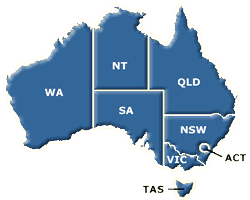
Or list International Invigilators
Or list MSCE (SATCOM) authorised invigilators
Whilst OMC lists the names of organisations and trainers associated with invigilators, as an aid to finding a training organisation or trainer, the OMC does not certify, recommend or endorse any of the organisations or trainers listed, nor does OMC endorse or recommend any study materials other than the Marine Radio Operators Hand Book and/or Marine Radio Operators VHF Hand Book produced by OMC.
Exam ordering
Online Assessment Requests (preferred delivery method)
Invigilator to complete and return one of the below options to place a request and email to amcom@amc.edu.au
Paper Assessment orders
Invigilators may place a request for paper assessments if:
- location is unsuitable to conduct online assessments;
- candidates cannot access online assessments;
- backup for online assessments.
Access the Paper Assessment Request using the PAPER exam ordering portal.
Information and forms
- Invigilator Guidelines (PDF 220.6 KB)
- Invigilator Application Form (PDF 251.3 KB)
- Exam Lodgement Form (PDF 187.9 KB)
- Notes and examination Instructions (PDF 263.0 KB)
- Radio Operators Certificate Information brochure (PDF 2.1 MB)
Long Range Operator Certificate of Proficiency (LROCP)
- Application for Initial Issue LROCP (PDF 158.8 KB)
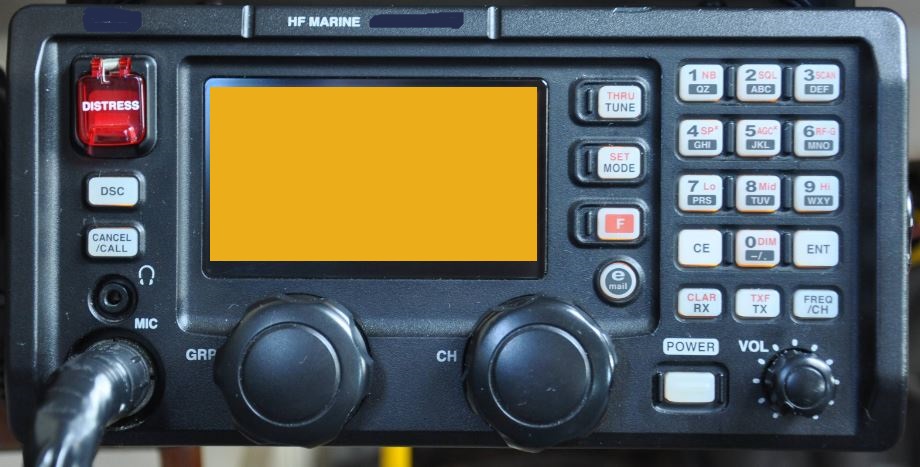
- Marine radio mf hf (image) (JPG 42KB)
- Observation checklist LROCP (PDF 101.9 KB)
- Observation checklist LROCP suggested responses (Word 272KB)
- Application Form/Answer Sheet - Paper ( PDF 254.2 KB)
Short Range Operator Certificate of Proficiency (SROCP)
- Application for Initial Issue SROCP PDF 159.4 KB
- Marine Radio VHF (Image) (JPG 17KB)
- Observation checklist SROCP (PDF 100.4 KB)
- Observation checklist SROCP suggested responses (Word 235KB)
- Application Form/Answer Sheet - Paper (PDF 267.4 KB)
Marine Satellite Communications Endorsement (MSCE)
Privacy Policy
An agreement between University of Tasmania (UTAS) / Australian Maritime College (AMC) and the Australian Communications & Media Authority (ACMA) delegates certain powers under section 122A (1) of the Radio Communications Act 1992 (the Act), which enables AMC to fulfil its role in accordance with the Deed of Agreement and to perform the Statutory Functions and Services (SFAS) required. These statutory functions are:
- issuing marine radio operator certificates of proficiency under section 121 of the Act;
- conducting marine radio examinations as an approved body or organisation for the purposes of section 122 of the Act; and
- referring applications for the marine radio operators certification to the ACMA under section 122A(2) of the Act where the delegate has decided not to issue the certificate.
The Privacy Act 1988 imposes obligations on the ACMA in relation to the collection, security, quality, access, use and disclosure of personal information. As a delegate of the ACMA for the purposes of issuing marine radio certificates of proficiency, these obligations also apply to AMC. Details of the obligations are located in the ACMA Privacy policy.
Fees and payment
The Office of Maritime Communications (OMC) manages the marine examination and certificate service for the Australian marine community under a Deed with the Australian Communications and Media Authority (ACMA).
The Deed provides that the OMC must maintain financial viability and also that the OMC must only charge fees for its functions and services on a cost recovery basis. The following schedule shows the current fee structure.
Cheques and money orders should be made payable to the University of Tasmania.
| Item (inclusive of GST) | Fees 06/10/2025 |
|---|---|
| Marine Radio Operators Handbook | $49.50 |
| Marine VHF Radio Operators Handbook | $18.00 |
| Examination/Application | $97.90 |
| Replacement or Verification of Certification | $38.50 |
| Unit of Competency | $53.90 |
Order Handbooks Online
To order online and make a payment for OMC Handbooks, please visit: Handbooks payment page (Please note: This link will take you through to the UTAS payment page)
Examinations, Unit of Competency and Replacement Applications
To make an online payment for examinations or replacement certificates, please visit: Exams and Certificates payment page (Please note: This link will take you through to the UTAS payment page).
Contact us

General Office Hours
Monday to Friday 9am to 5pm
(excluding public holidays and Tasmania University days)



Postal address
Australian Maritime College
Office of Maritime Communications
PO Box 2036
NEWNHAM TAS 7248