

Bystander intervention needed
Any attempt at resuscitation is better than no attempt when someone is suffering a cardiac arrest. Whether you’re trained or untrained, it’s essential to recognise a cardiac arrest, call 000, start chest compressions, and send for an AED (Automatic External Defibrillator).
In Australia, approximately 24,000 people will suffer an out-of-hospital cardiac arrest each year; approximately 10% of people survive.
About 75% of out-of-hospital cardiac arrests occur at home, making it likely that if you are in a situation to provide chest compressions, it will be for a friend or family member.
The early provision of chest compressions and the use of an AED can nearly double the chance of survival from a cardiac arrest.
Prior Shock Verdict campaign
The Shock Verdict campaign was run by Menzie's Cardiovascular Research Flagship in late 2025 and early 2026.
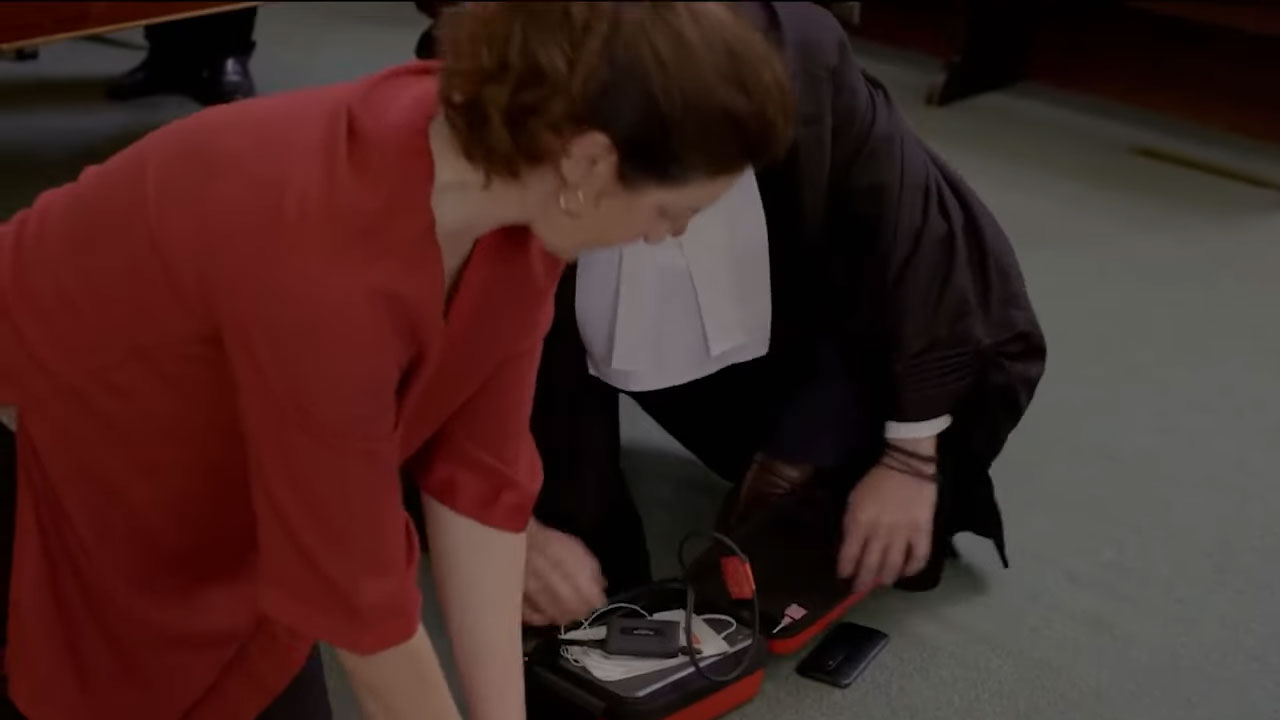
The video was relaunched, sharing the message that no matter whether people were in the courtroom or at home, acting quickly as a bystander is essential. The cast of ABC’s Rake were featured, and joined in the setting of a courtroom by Tasmanian cardiologist, Dr Paul MacIntyre, and Tasmanian cardiac arrest survivors in the jury, to receive a Shock Verdict.
Shock Verdict aimed to entertain while inspiring Australians to save a life- to step and take action by calling 000, providing lifesaving chest compressions and by using an AED if available.
The message was clear: recognise a cardiac arrest, call 000, start chest compressions, and use an AED. Check out our social media and share with your friends and family. The majority of cardiac arrests occur in the home, outside of a hospital.
What to do when a person suffers a cardiac arrest

Call Triple Zero (000) immediately
The operator will guide you through CPR and help find an AED.

Start CPR Push hard and fast in the centre of the chest
Push at a rate of 100–120 compressions per minute. Do not stop until help arrives.

Use an AED to deliver a shock as soon as possible
AEDs are easy to use and provide verbal instructions.
What is an AED?
An Automated External Defibrillator (AED) works by delivering an electric shock to the heart to restore a normal rhythm during sudden cardiac arrest.
You do not need training to use an AED; simply turn it on and the machine will 'talk' you through the procedure. You cannot do any harm to a person by applying an AED- the machine can measure their heartbeat and will not administer a shock if their heart does not need it.
The Heart Foundation also share the message that it is easy to use an AED with their Shockingly Simple campaign. Check out the information on their website about how simple an AED is to use - remember you don't need to be trained, just follow the voice prompts.
There is a growing network of AEDs across Tasmania- and you can proactively search for locations in areas by searching this map which is managed by the Tasmanian Government.
If you feel comfortable to give a person CPR, or use an AED, you can register with GoodSAM (Smartphone Activated Medic), which is a global emergency service smartphone app. The app connects community responders who have registered to patients in the first critical minutes of cardiac arrest, prior to ambulance arrival. Alerts through this app have allowed bystanders in Tasmanian to save lives.
More information on AEDs can be found at Ambulance Tasmania - GoodSAM Partnership and Shockingly Simple - Heart Foundation.
Shocking statistics
Cardiac Arrest Survival
Survival from cardiac arrest in Australia is literally shocking at about 10%

Every 15 minutes
Every 15 minutes someone living in Australia experiences a cardiac arrest.

32,000+
Over 32,000 Australians have a heart attack every year

CPR and AED
When CPR is performed and an AED is used, survival rates can increase to 60 – 70%
Tasmanian Statistics
- Incidence of out of hospital cardiac arrest in Tasmania is 115 per 100,000 people per year, which is the second highest incidence rate in the country behind South Australia (121 per 100,000 people per year)
- Bystanders are less likely to perform CPR in Tasmania than in other states with 61% of cases having bystander CPR, which is the lowest followed by the Northern Territory (66%) compared to the ACT which is the highest (81%)
- Tasmania has the highest use of defibrillators by bystanders than any state (12%) followed by South Australia (7%)
- Tasmania has longer response times for emergency services to reach someone – 10.5 minutes, followed by Western Australia at 9 minutes – suggesting geographic factors are important.
- Survival at 30 days in Tasmania is similar to many other states at 11.7%, with South Australia and New South Wales have similar proportions surviving, but Queensland having higher survival (14.4%).
Source: A binational report from the Australasian Resuscitation Outcomes Consortium (Aus-ROC)
Thank you to those who made the Shock Verdict video possible
The video was funded by an educational grant from Biotronik.
The campaign was supported by Laerdal Medical, Philips, University of Tasmania, the Tasmanian Health Council, the Australian Heart Foundation and the Tasmanian Health Minister.
This is an initiative of the Australian Resuscitation Council, Tasmania Branch and is part of a National Health Campaign. The campaign intends to save lives by empowering untrained members of the community to perform bystander CPR, locate an AED and use it.