

Project details
Status: Completed
At a glance
- This project evaluated the effectiveness of Halter’s virtual fencing and herding technology for managing lactating dairy cows in intensive pasture-based systems.
- The research demonstrates how the technology can automate grazing allocation and cow movement to the milking shed, reducing labour demands while maintaining animal welfare and control.
- This trial was conducted from 2023 - 2024.
Virtual fencing research at TIA
Learn more about TIA's virtual fencing research program and associated research projects.
Project background
Pasture-based dairy systems are becoming more intensive, with larger herd sizes and increasing labour constraints. Managing grazing allocations and moving cows efficiently to the milking shed are key challenges.
Virtual fencing is an emerging technology that replaces physical fences with GPS-enabled collars that guide animals using audio, vibration, and low-energy electrical cues. While widely explored in extensive livestock systems, its application in intensive dairy systems has been limited.
This project addresses the need to:
- Evaluate whether virtual fencing can work reliably in intensive grazing systems
- Assess how quickly cows learn to respond to cues
- Understand the implications for animal welfare and farm management
Research questions
This project investigated the following themes:
- Can virtual fencing effectively contain lactating dairy cows within allocated pasture?
- Can the system reliably herd cows to the milking shed without human intervention?
- How quickly do cows learn to respond to audio cues?
- What level of electrical stimulus is required once animals are trained?
Project activities
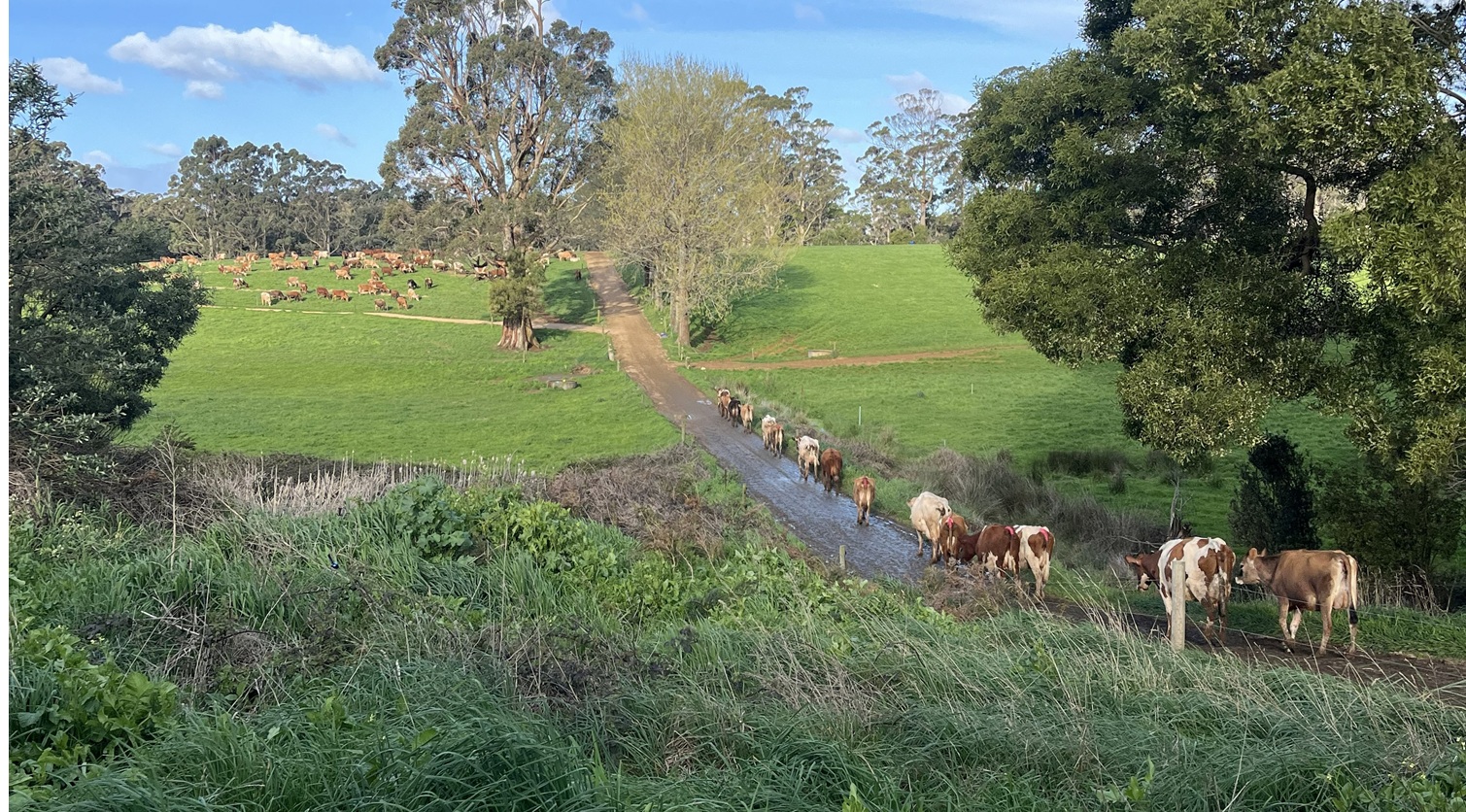
The study involved two groups of approximately 40 mid-lactation dairy cows (predominantly Friesian and Friesian × Jersey) managed under a pasture-based feeding system. Cows received a controlled daily ration consisting of pasture, silage, and grain to reflect commercial dairy practices. Each cow was fitted with the Halter collar, which continuously recorded the number of cues delivered, the timing and location of the animal’s movements, time spend outside virtual boundary and behavioural responses to both grazing and herding events.
A 10-day structured training period was conducted to familiarise cows with the virtual fencing system and the workings of the Halter neck collars. Cows learnt to associate audio cues (sound and vibration) with movement and boundary limits. The cows would receive a low energy electrical pulse if they failed to respond to the audio cue.
Following this training faze, they moved into a 28-day schedule of being managed only by virtual fencing. Cows were allocated daily pasture using virtual boundaries and remotely guided to the milking shed using virtual herding.
Project outcomes
Learning and adaptation
The study demonstrated rapid learning by dairy cows. Most cows began responding to audio cues within less than one day. By day four of training, cows were successfully moving to the milking shed without human assistance. Importantly, reliance on electrical pulses decreased sharply after the initial training period, indicating effective behavioural conditioning.
On the first day of training, a relatively high proportion of cues required an electrical pulse. This declined to 6.4% during training and further to 2.6% after training. By the final week, many cows received no electrical pulses at all, both during grazing and herding. These results suggest that the system operates primarily on non-aversive cues once animals are trained, supporting positive animal welfare outcomes.
Virtual fencing proved highly effective at maintaining grazing allocations
90% of cows spent ≤1.7 minutes per day outside the virtual boundary. The cows remained largely within assigned pasture areas, demonstrating reliable containment. This indicates strong potential for precise pasture management without the need for physical fencing.
Improvements to operational efficiency
The system successfully guided cows to the milking shed without manual labour, maintained consistent herd movement patterns and reduced the need for staff to physically move animals. This highlights the technology’s capacity to address labour shortages and improve operational efficiency.
The number of electrical pulses delivered per animal was lower than previously reported for other virtual fencing systems. Cows adapted to operate almost entirely based on audio cues. Behavioural patterns indicated that animals could function effectively within the system with minimal disruption
Implications for the dairy industry
The findings demonstrate that virtual fencing Is feasible and effective in intensive pasture-based dairy systems. It can reduce labour requirements and automate routine tasks. It supports precision grazing and improved pasture utilisation. As well as maintaining animal welfare standards through reduced reliance on aversive cues.
Overall, this research provides strong evidence that virtual fencing can be successfully integrated into modern dairy systems, offering both productivity and sustainability benefits.
Related resources
Open access research paper by Dr Megan Verdon et al. 2004.