

About PCOR-TAS
The Prostate Cancer Outcomes Registry – Tasmania (PCOR-TAS) is a longstanding clinical quality registry, commencing in Tasmania in 2015. The goal of the registry is to support the delivery of high-quality care to people with prostate cancer and minimise unnecessary variation in prostate cancer care. The registry includes over 5000 participants, with 9 urologists, 3 radiation oncologists and 2 medical oncologists from across Tasmania currently contributing.
PCOR-TAS is part of the binational PCOR – Australia New Zealand (PCOR-ANZ) network of prostate cancer clinical quality registries. Through the collection of both clinical and patient-reported outcome data, PCOR-ANZ aims to improve the quality of care and life for men diagnosed with prostate cancer.
In Tasmania, the most common cancer diagnosed in men is prostate cancer, with a reported incidence of 858 men diagnosed in Tasmania in 2022. (Tasmanian Cancer Registry, 2025. Cancer in Tasmania: Incidence and Mortality 2022, Menzies Institute for Medical Research, Hobart, Tasmania).
Each year, PCOR-TAS includes over 90% of all men diagnosed with prostate cancer in Tasmania. Clinical diagnosis and treatment data and patient reported outcomes are collected on all included participants.
The aims of PCOR-TAS are to:
- Assess patterns of care.
- Reduce variation in treatments and outcomes.
- Improve compliance with best practice-based guidelines for the treatment of prostate cancer.
- Provide information to assist in the credentialing of clinicians and identification of appropriate training resources.
- Identify factors that predict favourable and unfavourable treatment outcomes, particularly in relation to the major adverse effects.
- Provide information to patients about the risks and benefits of specific approaches to prostate cancer treatment.
- Support research into prostate cancer at a population level.
PCOR-ANZ
PCOR-TAS is one registry that contributes data into the Prostate Cancer Outcomes Registry - Australia and New Zealand (PCOR-ANZ). PCOR-ANZ is a bi-national initiative funded by the Movember Foundation.
Registries participating in PCOR-ANZ collect data regarding diagnosis, treatment and long-term quality outcomes to help identify whether there are trends or gaps that exist in service provision across Australia and New Zealand.
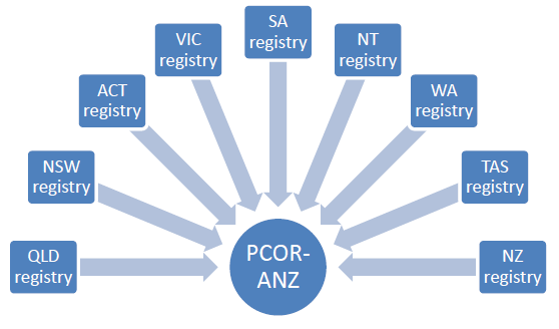
Other jurisdictions participating in PCOR-ANZ include:
Each year, PCOR-ANZ releases an Annual Report.
For more information regarding PCOR-ANZ, including participating hospitals and clinicians, registry governance and copies of annual reports, please visit PCOR-ANZ.
Information for participants
If you have recently been diagnosed with prostate cancer, you will be identified as eligible for inclusion in the registry via a notification to the Tasmanian Cancer Registry (TCR) or by your diagnosing/treating doctor. Notification of a cancer diagnosis to the jurisdiction-based cancer registries is a legal requirement in each state/territory of Australia and New Zealand.
If your hospital and clinician are contributing data to the PCOR-TAS, you will receive an Introduction Letter and Participant Explanatory Statement from PCOR-TAS. This explains the registry to you in detail and includes instructions on how to opt out of the registry.
If you do not opt out, the registry will collect information directly from your treating doctor and the health service that was involved in your care. We will also contact you by mail, phone or email to complete a survey about your health, including your urinary, bowel and sexual function.
Information collected from your medical records will include:
- Contact details (including postal address, phone number, email address)
- PSA levels
- Biopsy results and clinical staging information
- Clinical information regarding treatment and outcomes
Information collected from participants will include:
- Pre-treatment (within 3 months of diagnosis) and 12-month quality of life patient-reported outcome questionnaires (available via mail, email or telephone interview)
Participation in the registry is voluntary, and you may choose to opt out at any time, without incurring any out-of-pocket expenses or affecting the level of treatment or care provided to you. If you would like to opt out of the PCOR-TAS, please call the free-call number 1800 771 410 or email pcor.tasmania@utas.edu.au.
Consumer engagement
PCOR-TAS welcomes consumer engagement and feedback in all aspects of the registry, with a lived-experience person being part of the registry governance. Broader engagement with consumers is needed to enhance the registry outputs for consumers, these being men who have participated in the registry, those just beginning their prostate cancer journey and the family and friends supporting these men. PCOR-TAS seeks to become more consumer- and community-centred and identify ways to better share information based on registry data with consumers and the community.
If you would like to become involved with the registry as a consumer and/or provide feedback, please contact us at pcor.tasmania@utas.edu.au.
The Menzies Institute also has a range of opportunities for people with lived experience of a health condition, either personally or as a carer, family member, or friend, to become involved in research. Please visit Menzies Community & Consumer Involvement for more information.
Information for clinicians
As a participating clinician, data acquired from PCOR-TAS will influence research, development and education. The benefits can include:
- A cross-sectional view of multiple clinical and demographic aspects of prostate cancer that may be studied in detail using targeted, prospective study design or using health statistics.
- Identifies whether clinicians are managing the disease in accordance with the principles of evidence-based practice.
- Collects up-to-date information about patterns of care and enables oversight of changing patterns of disease demographic and management.
- Enables clinicians to compare their own patient population and therapeutic management with that of other clinicians (NB. No clinician identifying information will be released by the Registry).
- May be used to assist in the design of clinical trials, including identifying questions for study.
- Provide clinicians and institutions with mortality and morbidity data associated with various risk and treatment groups, both for their own patients and the wider cohort of men with prostate cancer.
- May be used as an educational tool for clinicians and students.
Only clinicians working within contributing hospitals are eligible to enrol in the PCOR-TAS. While enrolment is voluntary, it is important that the registry collects information from close to, if not all, the eligible population.
To participate, please contact the PCOR-TAS Coordinator at pcor.tasmania@utas.edu.au.
Research activities
The PCOR-TAS encourages the use of its data for a variety of purposes such as quality improvement, research and clinical planning. The PCOR-TAS Data Access Policy defines how Registry data may be accessed and used for the following:
- provision of aggregate data (summary),
- unit-record data for HREC approved research activities (de-identified),
- access to data for HREC approved data linkage projects (de-identified).
- recruitment of participants for HREC approved research studies.
Researchers and clinicians wishing to access data from the PCOR-TAS registry will be required to complete a Data Access Request Form that will be reviewed and approved by the PCOR-TAS Steering Committee. We recommend contacting the Registry prior to seeking HREC approval.
For a copy of the Data Access Policy, or to contact the Registry about a proposed study, please contact us at pcor.tasmania@utas.edu.au.
Current research studies
The BIOPC study commenced in 2018 and aims to improve prostate cancer outcomes in Tasmanian men. These outcomes include both treatment response, i.e., how well a man responds to their treatment, and quality of life outcomes, given some treatments can leave a man with mild to severe reductions in their quality of life. To achieve these aims, we propose to use genetic information from blood and/or tumour samples from Tasmanian men with prostate cancer, in addition to demographic and clinical information collected by the Prostate Cancer Outcomes Registry – Tasmania (PCOR-TAS).
Specifically, our study is asking men who participate in PCOR-TAS, if they would also be willing to participate in our BIOPC study. For those men who consent to participate in BIOPC, we request a blood sample and/or access to their tumour sample(s) from which we can generate genetic data. We also request access to their demographic and clinical information that has been collected by PCOR-TAS. Together the genetic and PCOR-TAS information can be used to identify genetic biomarkers that indicate whether a particular treatment, for example radiation therapy, is going to work or not work for a man. Similarly, we can use the genetic and PCOR-TAS information to determine whether a man is at risk of mild or severe side effects from a particular treatment.
Ultimately, we hope to identify genetic biomarkers that we can use before a man commences treatment, so we can determine if a particular treatment is likely to work or not, and whether it will have mild or severe side effects. This information will help to guide treatment choices to ensure that a man is provided with the best treatment for his cancer. This will also result in better outcomes for a man, reducing the chances of treatment failure and improving their quality-of-life post-treatment.
At present, we are recruiting men into the BIOPC study, with over 1,800 Tasmanian men recruited to date. We hope to commence our genetic studies in the next year or two, once we have 2,000 men with genetic data.
This study has been approved by the University of Tasmania Human Research Ethics Committee - H0017078.
Previous studies have consistently shown that men diagnosed with prostate cancer and who reside in regional and rural areas, have disparities in their cancer diagnosis, treatment strategies, and outcomes, including quality of life. This is reflected in the 2020 Australian Institute of Health and Welfare Cancer Report, which shows that the regional state of Tasmania has the highest age-standardised prostate cancer mortality rate in the nation (https://www.aihw.gov.au/reports/cancer/cancer-data-in-australia/contents/state-andterritory).
In this first study utilising demographic and clinical data from the Prostate Cancer Outcomes Registry – Tasmania (PCOR-TAS), we sought to determine whether there were disparities in prostate cancer within Tasmania, between men living in inner regional areas and men living in outer regional and rural areas. Similar to previous studies, our analyses demonstrated that Tasmanian men living in outer regional and rural areas are more likely to reside in lower socio-economic areas and be diagnosed at an older age and with more aggressive cancer. They were also less likely to be diagnosed or treated in a private hospital. In contrast to previous studies, there were no differences in the method of diagnosis or treatment strategies, however men from outer regional and rural areas took longer to commence treatment and travelled further to do so.
Overall, our study highlights the need to increase public awareness of these inequities and develop health policies to ensure these disparities are addressed. Equitable access to health services will improve outcomes and reduce prostate cancer mortality in our outer regional and rural Tasmanian communities.
This study has been approved by the University of Tasmania Human Research Ethics Committee - H0017095.
Publications
Foley, G.R., Blizzard, C.L., Stokes, B. et al. Urban–rural prostate cancer disparities in a regional state of Australia. Sci Rep 12, 3022 (2022). doi.org/10.1038/s41598-022-06958-2
Foley, G.R.; Blizzard, C.L.; Skala, M.; Redwig, F.; Roydhouse, J.; Dickinson, J.L.; FitzGerald, L.M. Prostate Cancer Disparities Between Public and Private Healthcare Patients in Tasmania, a Regional State of Australia. Cancers 2026, 18, 79. doi.org/10.3390/cancers18010079
The PC4PC-TAS study commenced in 2023 and offers genetic testing to Tasmanian men diagnosed with highgrade prostate cancer (Gleason score 8 and above) or who were diagnosed at a young age (55 years or less). We are particularly interested in genetic changes that are passed through families that may be causing prostate cancer. Our study asks men who have consented to the PCOR-TAS-linked, BIOPC study and who meet our eligibility criteria, whether they would be happy for their sample to be used in our PC4PC-TAS study. We also have several other avenues of recruitment including through a man’s doctor or men can approach the study team themselves (PC4PC-TAS@utas.edu.au).
Our PC4PC-TAS study generates genetic data from a blood or saliva sample, which is then screened for important changes in genes involved in DNA repair and or are known to cause prostate cancer. If we identify a genetic change that we consider to be relevant to the participant’s prostate cancer, if they wish to receive this information, we return it to them through the Tasmanian Clinical Genetics Service. This information could influence their treatment decisions and/or effect their family members. Participants are also notified if we do not find any important genetic information currently relevant to their health. In addition, the genetic data we generate can also be used to identify new genes or genetic changes for prostate cancer, which may be targeted by certain treatments, thus benefiting more men affected by prostate cancer.
In a second part of our PC4PC-TAS study, we ask all participants to complete surveys before and after receiving their genetic information. These surveys ask them questions about their previous experience of genetic testing, as well as their opinions (risks and benefits), and the resources/support they think they would require if they were to undergo genetic testing. Their responses will help us to develop an ‘Information Toolkit’ to support men through the process of genetic testing for their prostate cancer, as well as inform future research focussed on using genetic testing in mainstream prostate cancer care.
Ultimately, PC4PC-TAS hopes for men to have equal access to genetic testing for their prostate cancer.
This study has been approved by the University of Tasmania Human Research Ethics Committee - H0028525.
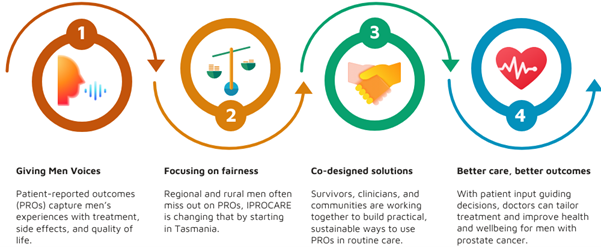
Every man’s experience with prostate cancer is unique. Beyond the scans and test results, it is how men feel, cope, and recover that tells the real story of treatment. The IPROCARE project is making sure those voices are heard.
Patient-reported outcomes (PROs) are simple but powerful tools: surveys that ask men about their quality of life, side effects, and wellbeing during and after treatment. This information helps doctors and nurses understand what really matters to patients, so care can be tailored to their needs. While PROs are used in some large hospitals, men in regional and rural areas often miss out, despite facing some of the toughest challenges in accessing cancer care
IPROCARE is changing that. Starting in Tasmania, the project is working with survivors, clinicians, and community members to design practical ways of collecting PROs in everyday clinical settings. By building on the Prostate Cancer Outcomes Registry (PCOR-TAS), it ensures that information flows smoothly from patients to healthcare teams. The approach will then be tested elsewhere in Australia, with the long-term goal of rolling it out nationally.
The aim is simple but transformative: better conversations, better decisions, and better outcomes for men living with prostate cancer.
This study has been approved by the University of Tasmania Human Research Ethics Committee - H00 32132.
A prostate cancer diagnosis does not just affect health. It can also disrupt work, income, and financial stability, especially for men living in regional areas. The Financial and Employment Challenges in Prostate Cancer project is exploring these often-overlooked issues to make life beyond cancer more manageable.
By shining a light on these challenges, this project is helping build a future where cancer care is not only about survival but also about living well, financially secure, and supported at work.
This study has been approved by the University of Tasmania Human Research Ethics Committee - H00 30883.
Funding
PCOR-TAS is currently funded by the Movember Foundation. Movember has financially supported the registry since 2015.
Contact us
- Philippa Scanlon
PCOR-TAS Coordinator
Phone: 1800 771 410
Email: pcor.tasmania@utas.edu.au - Jessica Roydhouse
Academic Lead
Email: Jessica.roydhouse@utas.edu.au
Address
- Location: Menzies Institute for Medical Research, 17 Liverpool St, Hobart 7000
- Mailing: Menzies Institute for Medical Research, GPO Box 341, Hobart 7000