

The new Human Intelligent Movement Analysis Centre (HIMAC) is a state-of-the-art facility based at the Medical Sciences Precinct 1 building in the centre of Hobart. It has been purpose built with a range of cutting -edge tools to precisely measure and analyse human movement. HIMAC was funded through a competitive $512,000 infrastructure grant awarded in 2022 by the University of Tasmania to a team of researchers and clinicians, led by Dr Rebecca St George (Psychological Sciences) and A/Professor Jane Alty (Wicking Dementia Centre/ School of Medicine). The lead technical officer and neuroscientist of HIMAC is Dr Bill Bennett.
Participants attending HIMAC can be assessed using a range of equipment that provide measures of eye-tracking, facial expression, fine motor hand control, whole-body movements and gait. These are supplemented by equipment such as gait mats and force plates that measure individual steps, pressure and balance, and electromyogram (EMG) sensors that detect the electrical activity of individual muscles. The tools are so precise that they can detect subtle changes in movements that may not be visible to the human eye, but can be detected by high fidelity kinematic, kinetic and muscle activity responses, as well as computer vision technologies from video recordings. Some of the key types of measures that can be undertaken are summarised below but this list is not exhaustive:
Gait measurement and motion tracking
Gait variables (gait speed, step time, step length, step width and double support time) can be measured using the 6.4 m Zeno electronic walkway. While participants are walking up and down the gait mat, or performing any sort of movement task, we can simultaneously record their whole-body movement using a precision motion capture system (Vicon Nexus). This uses twelve infrared cameras to track small, lightweight reflective markers placed on anatomical landmarks, and advanced biomechanical modelling to calculate the position of underlying joints centres, and relative segment kinematics (feet, legs, pelvis, trunk, arms and head) with sub-millimetre precision.
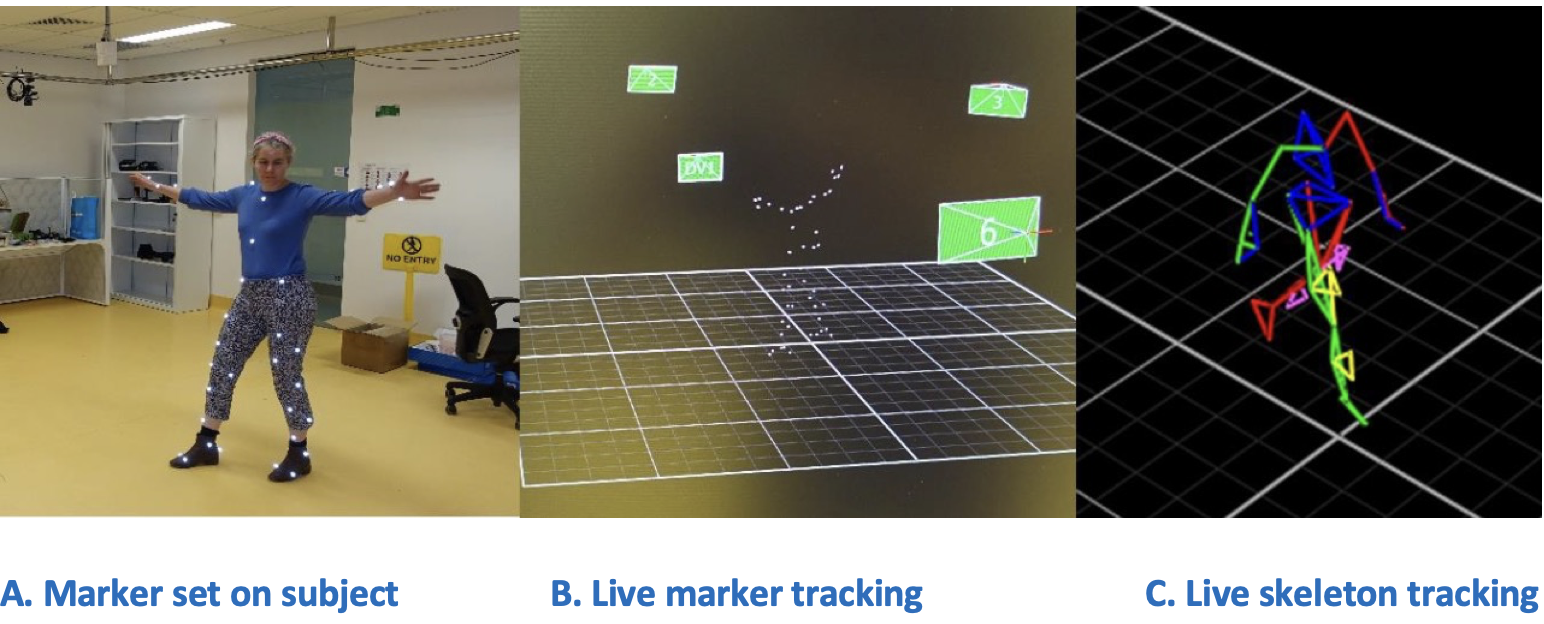
Vicon motion capture system.
- A. Reflective markers are placed on a participant’s clothing at specific points.
- B. 8 Vicon cameras (green rectangles) track the markers (white dots) in real-time.
- C. Reconstruction of the skeleton and segments from the marker set and real-time tracking of gait using Vicon Nexus software.
Eye tracking
We have a video-oculography system (SR Eyelink 1000 Plus) which sits below a computer monitor and tracks gaze fixation (where the pupils are looking) and pupil diameter (a proxy for cognitive load). The system tracks at 1000Hz with a freely-moving head, so the participant can sit comfortably and look at the monitor while visual and audio stimuli are presented.
We use this to measure saccades (rapid eye moment to lock onto a target), as these are affected in neurodegenerative conditions such as Parkinson’s.
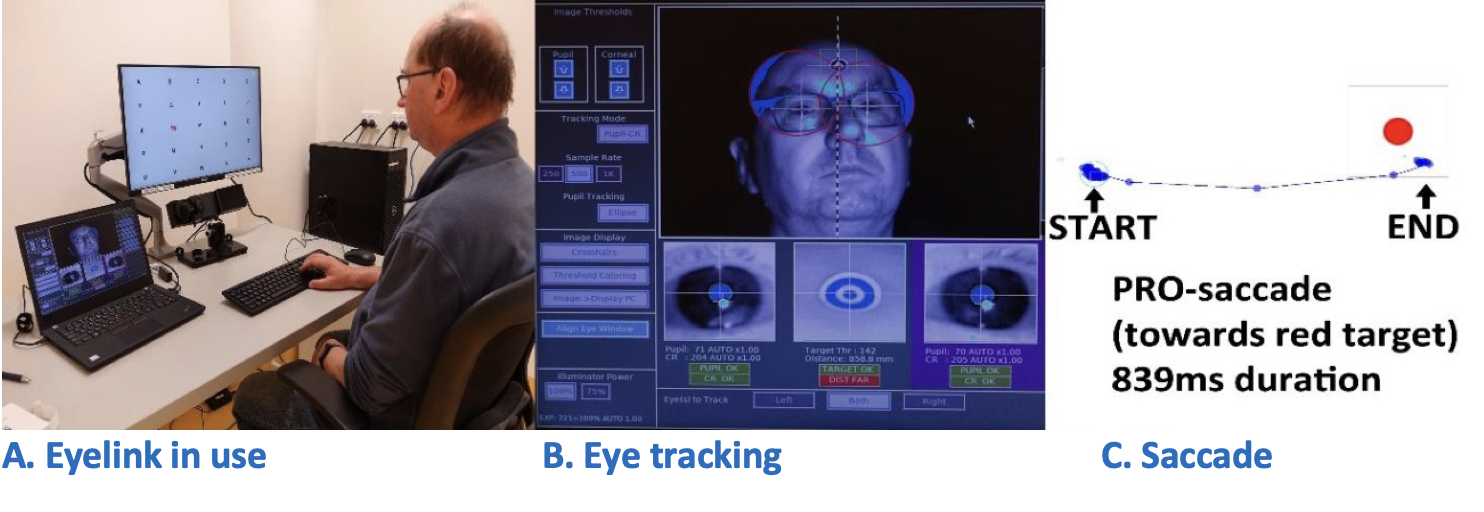
Eye tracking system, Eyelink 1000 Plus
- A. The Eyelink system in use, with freely moving head. The video-oculography system can track participants’ eye movements and binocular gaze on the large monitor at 1000Hz with an accuracy of 0.5°.
- B. The Host computer, which controls the system, showing the camera view of the face, and the two eyes and pupils below, with the target sticker in the centre (this cues the system to left and right eyes during binocular tracking). The centroid position of both pupils is tracked simultaneously (gaze tracking) along with pupillometry (pupil diameter, which changes during cognition and language processing).
- C. A single saccade event measurement. This was a pro-saccade, where the gaze was fixed on a black target presented on the left side, which was then replaced with a red target on the right. In this case, the gaze switched fixation to the new target within 839ms. The trajectory of the saccade is shown in blue.
Delsys Trigno wireless EMG and motion sensors
This system comprises small sensor packages which are stuck onto skin. They contain electrodes to measure muscle firing (electromyography or EMG) and accelerometers and gyroscopes to measure spatial position (inertial motion unit or IMU). They wirelessly transmit this information back to base over a distance of up to 30m. We use these to give a readout of specific muscle group firing during several complex tasks e.g. when there is a “partial burst” (a subtle muscle twitch) in response to a stimulus, even in the absence of overt movement.
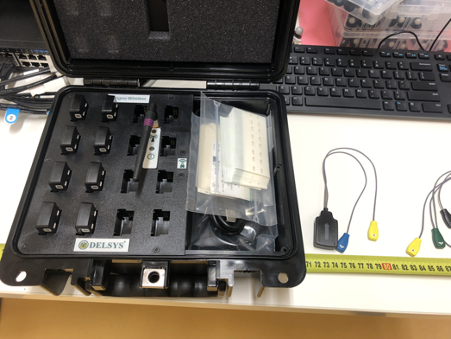
Delsys Trigno wireless EMG system
On the left is the wireless base station with sensor packages sitting in charging slots. 2 of the “Duo” sensors are shown on the right. The black rectangles are the main sensor packages with the accelerometers and battery, the wires connect to the two small, coloured EMG sensor electrodes.
Fine motor hand control
Many neurological disorders are characterised by subtle changes in repetitive hand movements such as slowing and an irregular rhythm. We can measure these with our camera tracking systems as well as EMGs and wearable sensors. Wearable movement sensors, specifically the Polhemus electromagnetic sensors and Delsys inertial sensors (3D accelerometer and gyroscope) can be attached to the hands to precisely measure the characteristics of repetitive hand movements and any tremor. A range of motor features can be calculated such as speed, accuracy and rhythm.
FNIRs – Functional Near Infrared Spectroscopy
The FNIRs system has a cap with an array of infrared LED transceivers worn upon the head of the participant (no gel is required). These non-invasively measure blood oxygen levels in regions of the cortex, using the same technology as a pulse oximeter. We use it to measure cognitive processing during complex tasks, and it can be used in freely-moving subjects.
Force plates – AMTI Accusway Plus x2
These are two large metal plates which measure the force applied to them along XYZ axes. We use these as part of complex stepping and balance tasks, and it can be combined with EMG, Nexus motion tracking or FNIRS.
Assorted small equipment
- Hand dynamometers for measuring grip strength
- Pinch gauge for measuring finger strength
- ActiveForce2 digital muscle tester and dynamometer (plus straps for leg strength etc)
- Wacom inking digitizing tablet – for converting drawings and handwriting directly into digital form
- Purdue pegboard – a widely-used test of manual dexterity
- Ostralis IOPI system for measuring intra-oral pressure (tongue strength)
- Various cameras, tablets, phones and tripods for video and still capture
- Tablet laptops with active pens - can be used as conventional laptops with keyboard or as a tablet with touchscreen data entry