About
The Design and Dementia Global Knowledge Translation (DESIGN) prioritises international research collaboration and the translation of research into accessible information for the community. This project aims to benefit people living with dementia as well as the broader health, social, design and education workforce. The ultimate goal is to facilitate the development of sustainable housing and community environments that are inclusive for everyone, allowing people living with dementia to age in place in the community.
The project comprises two key initiatives – The Global Research Consortium for Design and Dementia Research (See point 1 in Figure 1.), and a digital knowledge translation intervention, which is known as the Design and Dementia Research Project (See point 2 in Figure 1.). Both arms work together to bridge the knowledge gap between design principles and their practical application in dementia care.
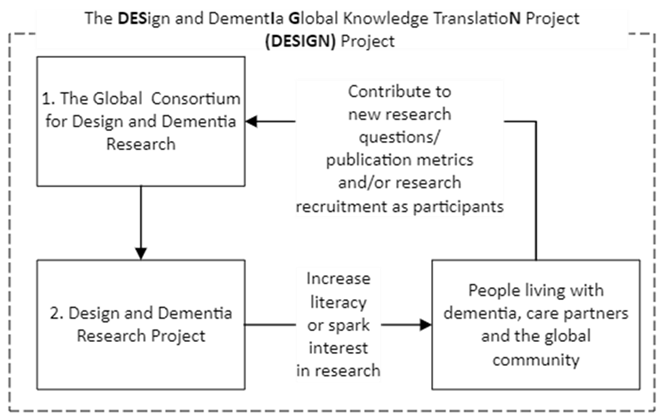
The Dementia and Design Research Project leverages user-friendly web interface to deliver the latest evidence-based best practice research findings in short, sharp, and engaging media pieces (Podcast, Vblogs, blogs, news stories, infographics). This approach promotes engagement, ultimately leading to increase levels of awareness and agreement and improving literacy in design and dementia (Davis et al., 2003). The global research consortium and the Dementia and Design Research Project will work together to advance Implementation research in the field as the project will have a real-time co-designed web elements to identify existing research gaps provided by stakeholders and strategically align these identified gaps with researchers globally whose expertise aligns with and is motivated to advance an investigation in the specific domain. This cost-effective process ensures that high-quality research is carried out in the field and the work is current and relevant to real world events.
The DESIGN project offers a significant cost advantage compared to traditional face-to-face global engagement programs with a scalable and accessible approach (Arinze, (2012). This economic advantage translates into increased system capacity, allowing us to support a larger number of researchers globally. The synergy between website, social media presence and online global research consortium will offer unparalleled reach and accessibility, transcending geographical limitations and time constraints. For the global research consortium, real-time data sharing and collaborative research efforts accelerate knowledge dissemination compared to localised face-to-face interactions. This fosters a sense of global research community and empowers researchers to actively participate in collaborative projects. Knowledge translation delivered via the Dementia and Design Research Project enables global alignment and rapid dissemination of the latest evidence-based best-practice findings on design and dementia research, and the information is readily available 24/7, empowering individuals to access evidence at their own pace.
This fosters democratisation of knowledge, ensuring individuals from diverse backgrounds and locations worldwide have equal access to crucial design and health information. The combination of the Global Consortium and the Dementia and Design Research presents a superior strategy for promoting global design and dementia literacy. This approach empowers researchers and individuals, fostering a sense of global research community, and ultimately contributing to a more informed and unified global fight to increase awareness and ultimately adherence to good design for people living with dementia.
Reference
Arinze, B. (2012). E-Research Collaboration in Academia and Industry. Int. J. e Collab., 8, 1-13. https://doi.org/10.4018/jec.2012040101.
Contact Us
Email: Joanna.Sun@utas.edu.au
Register - The Design and Dementia Research Project
Team Members
Alignment with global and domestic standards and recommendations
Australia
The project fosters the advancement of design and dementia literacy, aiming to enhance community understanding and encourage broader adherence to the literacy National Aged Care Design Principles and Guidelines. These guidelines are a comprehensive, evidence-based resource that directs the design of accommodation, ensuring the delivery of high-quality, safe, respectful, and dignified care for older adults and individuals living with dementia in residential aged care settings.
The research project aligns with Standard 5 of the Aged Care Quality Standards (Service Environment) and aims to enhance the design and dementia literacy of individuals involved in the creation and maintenance of physical service environments. This initiative is particularly relevant to those working in and designing facilities for residential care, respite care, and day therapy centres.
International
The project responds to the Alzheimer’s Disease International World Alzheimer’s Report 2020, which highlights a significant difference in dementia design compared to advancements made in the physical disability’s movement. The report underscores the urgent need for design solutions to be integrated into national dementia strategies, positioning design as a crucial non-pharmacological intervention. While many nations have acknowledged the importance of dementia-inclusive design in their national plans, there remains a substantial gap in education, funding, and expertise necessary to elevate understanding in this field. This project aims to bridge these gaps by enhancing global literacy on dementia design, ensuring that countries at all income levels—whether low, middle, or high—can achieve a unified and advanced understanding of how design can have a positive impact on people living with dementia.