
Held on the 10th Aug 2026 to
30th Oct 2026
, Northern Tasmania
Digital Art Wall, Level 1, Inveresk Library
To fill the air is part of a body of work that looks at the idea of the Nation, as a tool of unity and separation.
To gain a better understanding of the Nation I decided to look into the records of the State, as the two are intrinsically linked in liberal democracies (the State being a reflection of the Nation and the Nation being a reflection of the State). I became interested in the Hansard parliamentary transcripts as an archive to draw from and was specifically interested in the insights it held about Australia’s national identity.
I wanted to see how a political ‘we’ is defined. Who is included in this narrative and what are the characteristics associated with the Nation? I began looking at the language used in the Hansard transcripts and became interested in the phrase ‘Australians are’, and how it was used in parliament over time.
Working with various programmers we text mined all the Hansard transcripts of Senate proceedings since Federation, extracting every sentence that used the phrase ‘Australians are’ from the transcripts. This yielded a long document of sentences from politicians that described or perhaps prescribed the characteristics of the Nation (from a settler perspective).
This document was then text mined using a secondary program, which extracted the first verb or adverb immediately following the phrase ‘Australians are’, consolidating them into a final list which has been used for this body of work.
The words from this list are processed, manipulated and played through various materials, bodies and places to try and find points of resonance and resistance. This process is a sort of litmus test to see if there is a familiarity (resonance) with the language used or whether there is a distance or opposition (resistance).
I am interested in the certainty of these verbs and phrases and how they are delivered as a series of axioms or truths. How they are used to build an argument, conjure a narrative, and describe a nation.
In To fill the air, the words extracted from Hansard transcripts are spoken into space. The resulting turbulence created from the speech lingers beyond the words’ audible existence, becoming part of the air. They suggest a lasting legacy of the past. The words are spoken in one sitting, which suggests a 120-year filibuster that fills the air, leaving little space for counter narratives.
This usually invisible phenomenon is made visible and captured through Schlieren imaging, where the air density from the breath refracts light differently to that of ambient air.
View To fill the air on the Digital Art Wall, Level 1, Inveresk Library, until 31 October 2026
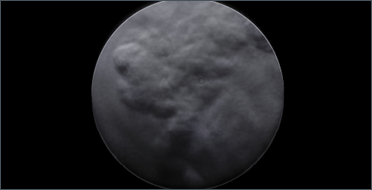
Image credit:
Denis Beaubois
To fill the air, 2024
single-channel digital video, colour
505 minutes
Python programming: Snow, Kynan Tan
Thanks to: Tim Sherratt, Historic Hansard
Filmed at Clothing Store Artist Studios, Carriageworks, Sydney, 2024
Courtesy the artist
