
Held on the 26th Feb 2026
at 5:15pm to
6:15pm
, Northern Tasmania
Inveresk Library, Level 2, Room 216 , Invermay, TAS 7248
Ways of Knowing – artist panel
Join us on Thursday 26 February for an artist panel discussion with artists Georgia Lucy and Emma Magnusson-Reid, facilitated by Zara Sully, Director of Sawtooth ARI.
Georgia and Emma will talk about their recent work and creative processes as part of the UTAS x Sawtooth Vitrine series.
University of Tasmania
Inveresk Library, Room 216, Launceston
or Online
Thursday 26 February
5:15 - 6:15pm
Georgia and Emma’s works are currently on display as part of the ‘UTAS x Sawtooth Vitrine series,’ at Inveresk Library, Level 3. You can view their works during business hours until 31 March 2026.
Artists
Georgia Lucy
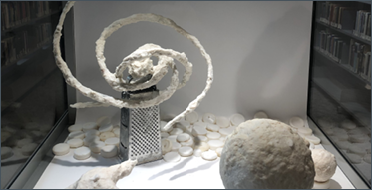
Constructed from soaps abandoned in the basin vanities and ceramic clams of the hotel where I performed my duties as housekeeper. A 3-4 star rating. I held the keys to the intimate spaces of tourists of Tasmania. When I tested the television I saw what they'd been watching: day-time TV. And by the time I was cleaning: soap operas. Check out was 10. Enter Georgia, scrubbing, listening to soapie dialogue, looking in the mirror, daydreaming, hospital corners. Working, removing hair from the sink, noticing Mona tickets in the bin. I start thinking: there’s something about a soap that’s touched a skin. Something… ..Motive speculative. Da Da! Dada data! I accept your cookies. The soap hoard built up in a plastic bag in the boot of my car. A monster conglomerate of white suddy biscuits and DNA. My car smelt good, lemon myrtle. Moving in the room, Soap Stars’ first iteration took the form of a suspended mobile. It was a balancing act, much like balancing art with my day-job. I often try to bridge these worlds, using the monotony of repetitive work to meditate on artistic quandaries. Sometimes it fails. The mobile fell spectacularly at the opening; a collapsed constellation, a big bang. When Zara asked me to be part of this vitrine project, we met up in town for a car boot deal. Zara had made the journey from Launceston with a soap work of their own to put in a show at Good Grief. Soaps from the north exchanged for soaps from the south. The witches of Oz. It was an honour to share soap with this fine artist it felt like bubbles merging for some good clean fun. Thank you for believing.
Emma Magnusson-Reid
The human body is changing. Through the accretion of petrochemicals within our organs, bloodstreams, and bones, we are rapidly approaching a future in which the human form itself is being reconfigured to accommodate and respond to these particles. The first synthetic fibre, nylon (a petrochemical) reached consumer shelves in 1939 in the form of women’s stockings - a revolutionary step in the textile industry. They became wildly popular but were soon unavailable when nylon production was redirected toward parachutes and other military gear during World War II. After the war, their return caused huge demand and even “nylon riots,” marking the end of wartime shortages and a return to “normal life.” Just prior to this, as a small child, my mormor would hand-stitch repairs to silk stockings for the women of her village in Sweden, using colour-matched strands of human hair to earn a few extra cents for her household. For the past decade, I have been sewing these synthetic, bodily forms - crafted from collected materials: plastic fibres pulled from old cushions, disassembled shiny polyester bridesmaids’ dresses, and most notably, flesh-toned nylon stockings. I was initially motivated by the U.S. deployment of Agent Orange and my father’s experiences in the Vietnam War, where this man-made chemical caused profound and lasting mutation within the human body. I once thought this extreme, unnatural substance was a cautionary relic of history - yet I now worry for what is immediate: the unseen, unnoticed petroleum molecules that shed from our everyday domestic items, collecting slowly, silently, and insidiously within the porous human body, and across all living ecologies.
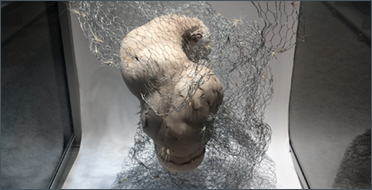
Image credit: Georgia Lucy, Soap Stars 3, 2025, Soap and Steel, dimensions variable. Photo Ella Boas; Emma Magnusson-Reid, Petro_Nexus_Future_Human, 2025, reclaimed synthetic materials, brass dress pins, chicken wire, Seaside Barley seed heads, paraffin wax, dimensions variable. Photo Ella Boas.
