
Online and the Sir Stanley Burbury Lecture Theatre, Dobson Road, Sandy Bay
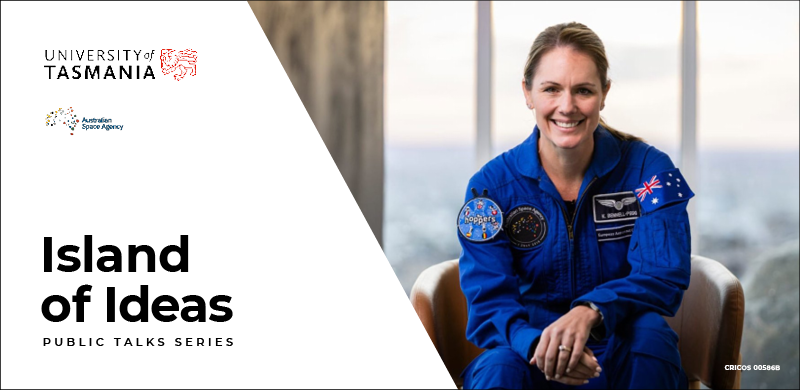
Summary:Exploring in Extreme Environments with Katherine Bennell-Pegg, astronaut and Australian of the Year 2026
Presenter(s):
- Katherine Bennell-Pegg, Australian astronaut
- Doctor John Cherry, Deputy Chief Medical Officer of the Australian Antarctic Division, and Senior Lecturer in Space Medicine, University of Tasmania
- Professor Andrew Cole, Professor of Physics, University of Tasmania
- Doctor Alicia Tucker, Tasmanian Emergency Medicine Physician, Royal Hobart Hospital (RHH). and Senior Lecturer in Space Medicine, University of Tasmania
- Facilitated by Dr Tara Martin, Director, Antarctic Tasmania
From outer space to Antarctica, humans are increasingly working in places where isolation, risk and uncertainty are part of everyday life.
As exploration expands into more extreme environments, new questions emerge about how we prepare, adapt and care for people operating at the limits of human endurance.
Australian of the Year 2026 and astronaut Katherine Bennell-Pegg joins Tasmanian experts working in Antarctic medicine, astronomy and aerospace health to explore how people prepare, adapt and perform in remote and challenging environments.
Tickets are free but essential, register now to avoid missing out.
Head to the venue early and enjoy complimentary refreshments from 5.30pm.
About the experts:
Katherine Bennell-Pegg, Australian astronaut
Katherine is an Australian astronaut and space systems engineer, and the first professional astronaut to officially represent Australia. In 2024, she graduated from the European Space Agency’s Astronaut Basic Training as part of the “Hoppers” class, selected from more than 22,500 applicants. She is a Director at the Australian Space Agency, where she has contributed to national space capability and major international missions, including work on NASA’s Artemis program. Katherine is passionate about using space to expand opportunity for research, industry and the next generation of STEM leaders.
Doctor John Cherry, Deputy Chief Medical Officer, Australian Antarctic Division, and Senior Lecturer in Space Medicine, University of Tasmania
John is Deputy Chief Medical Officer at the Australian Antarctic Division and a Field Leader in space analogue research with the Polar Medicine Unit. He specialises in emergency, rural and aerospace medicine, and has worked with both NASA and the European Space Agency on astronaut medical support and training. He is a Senior Lecturer in Space Medicine for the University of Tasmania’s Healthcare in Remote and Extreme Environments program, a Supervisor and Examiner for the Australasian College of Aerospace Medicine, and he previously worked for NASA and the European Space Agency developing medical support models and training for astronauts. Prior to medicine, he worked as an astrophysicist, commercial helicopter pilot, high school science teacher, and expedition leader.
Professor Andrew Cole, Professor of Physics, University of Tasmania
Andrew's research focuses on the stellar populations of nearby galaxies, including our own. He investigates how the observable properties of stars can be used to trace the formation and evolution of structures in the Universe: from planetary systems to galaxy groups, and from the earliest stars after the Big Bang to the present day. Andrew is also Director of the Greenhill Observatory, the University of Tasmania’s home of optical astronomy research, where they study of exoplanets, transient astrophysical events, and objects within our Solar System.
Doctor Alicia Tucker, Tasmanian Emergency Medicine Physician, Royal Hobart Hospital (RHH), and Senior Lecturer in Space Medicine, University of Tasmania
Alicia is a Tasmanian Emergency Medicine Physician with specialist qualifications in diving and hyperbaric medicine and aerospace medicine. She is a Senior Lecturer in Space Medicine at the University of Tasmania, focusing on human health, risk and performance in extreme and remote environments. Alicia has participated in analogue lunar missions, including serving as Commander responsible for crew health and wellbeing in fully isolated conditions. Her work explores how we assess and manage medical risk beyond Earth.
Facilitated by Doctor Tara Martin, Director, Antarctic Tasmania
Tara is the Director of Antarctic, Science and Technology with the Tasmanian Department of State Growth, where she seeks to grow the Antarctic, space, science and technology sectors in Tasmania. Tara's prior professional expertise is in Antarctic and marine science, geophysics and research infrastructure management.
Subscribe:
Find out about future events and subscribe to our mailing list for Island of Ideas updates.
Find out more:
Want to learn more about the University of Tasmania's Island of Ideas public talks series? Catch-up on past events, register for upcoming talks or get in touch with us via Island of Ideas.
