
Rory Spence Lecture Theatre, The Workshop, Inveresk campus, University of Tasmania, Launceston
Summary:From our backyards to global ecosystems, insect populations are declining. What does it mean and what can we do about it?
Presenter(s):
- Doctor Jonathan Finch, Lecturer in Entomology, Tasmanian Institute of Agriculture, University of Tasmania
- Alfonsina Arriaga Jimenez, Senior Curator Natural Sciences, Queen Victoria Museum and Art Gallery (QVMAG)
- Dr Justin Cappadonna, Lecturer in Entomology, Tasmanian Institute of Agriculture, University of Tasmania
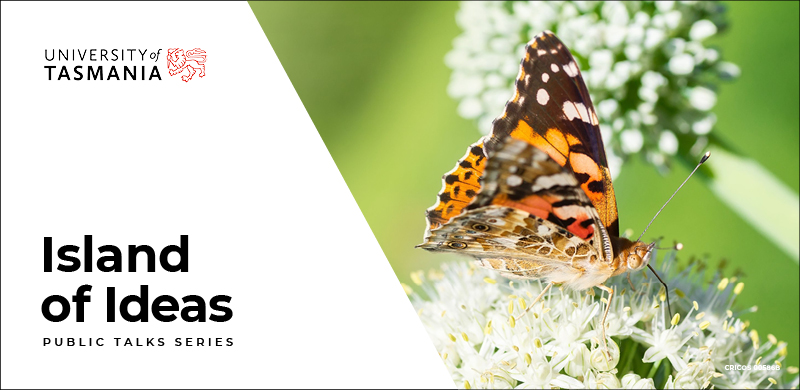
Many insect populations around the world are in steep decline, with serious implications for ecosystems, food production and human wellbeing. While the health of Tasmania’s insect populations remains largely unmeasured, the same pressures driving global losses, including climate change, habitat disruption and industrial agriculture, are already at play here.
Discover the science behind the so‑called insect apocalypse: what’s happening to insect populations, why it matters, and how we can respond. Bringing together leading Tasmanian experts in entomology, ecology and biodiversity, this conversation spans current research, species knowledge, and the real‑world challenges of conservation and land management.
Whether we swat them, study them or simply marvel at them, insects shape our food systems, environments and imaginations. Understanding their decline isn’t just about saving insects. It’s about safeguarding the intricate web of life that sustains us all.
The experts:
Doctor Jonathan Finch, Lecturer in Entomology, Tasmanian Institute of Agriculture, University of Tasmania
Dr Jonathan Finch is a Lecturer in Entomology at the Tasmanian Institute of Agriculture (TIA), University of Tasmania, with extensive teaching experience across entomology and agriculture. His research focuses on the vital role insects play in agroecosystems — including pollination, pest control and nutrient cycling, alongside broader interests in insect ecology, behaviour and conservation.
Jon collaborates with researchers across Australia and internationally, including work on pollination in protected cropping systems with Western Sydney University and the Liverpool School of Tropical Medicine. He also leads a national project aiming to harness the power of biological control in the raspberry and blackberry industry to produce more sustainable fruit crops .
His work has been recognised by the Royal Entomological Society, where his PhD was shortlisted for the Alfred Russel Wallace Award, and has been featured in international media including Smithsonian Magazine and Knowable Magazine.
Alfonsina Arriaga Jimenez, Senior Curator Natural Sciences, Queen Victoria Museum and Art Gallery (QVMAG)
Dr Alfonsina Arriaga is an entomologist, conservation biologist and science communicator who serves as Senior Curator of Natural Sciences at Queen Victoria Museum and Art Gallery (QVMAG) in lutruwita/Tasmania. Her work focuses on understanding and conserving biodiversity, with a particular interest in Australia’s native dung beetles and other invertebrates.
Alfonsina has worked on threatened species conservation, ecological gradients and biodiversity monitoring across Australia, Mexico and the Mediterranean. Her research combines field-based ecology, museum collections and species assessments to better understand how species respond to environmental changes. She is also interested in the role of Traditional Ecological Knowledge in informing our understanding of landscapes, biodiversity and conservation.
Alongside her research, Alfonsina is passionate about making science accessible to diverse audiences. She works closely with museums, universities and research institutions across Australia and Europe, she has helped to develop exhibitions, workshops and public programs that inspire curiosity about the natural world. As a museum curator, she also supports and enables research by providing access to collections, enabling collaborations and helping connect researchers with the specimens, data and expertise needed to advance our understanding of biodiversity. She encourages children and adults alike to discover the remarkable diversity and importance of insects and other invertebrates in our everyday lives.
Dr Justin Cappadonna, Lecturer in Entomology, Tasmanian Institute of Agriculture, University of Tasmania
Dr. Justin Cappadonna is a lecturer in entomology at the University of Tasmania, where he studies insects in agricultural landscapes. His research combines ecology and emerging technologies to improve how we monitor and manage pests and pollinators, with the goal of supporting more sustainable farming systems.
Pre-event refreshments:
Head to the venue early and enjoy complimentary refreshments from 5.30pm.
Subscribe:
Find out about future events, and subscribe to our mailing list for Island of Ideas updates.
Find out more:
Want to learn more about the University of Tasmania's Island of Ideas public talks series? Catch-up on past events, register for upcoming talks or get in touch with us via Island of Ideas.
