

Artificial intelligence (AI) is rapidly reshaping the world of work. Universities must ensure graduates are equipped to use AI effectively while maintaining confidence in the qualifications they earn.
At the University of Tasmania, our approach addresses both priorities together:

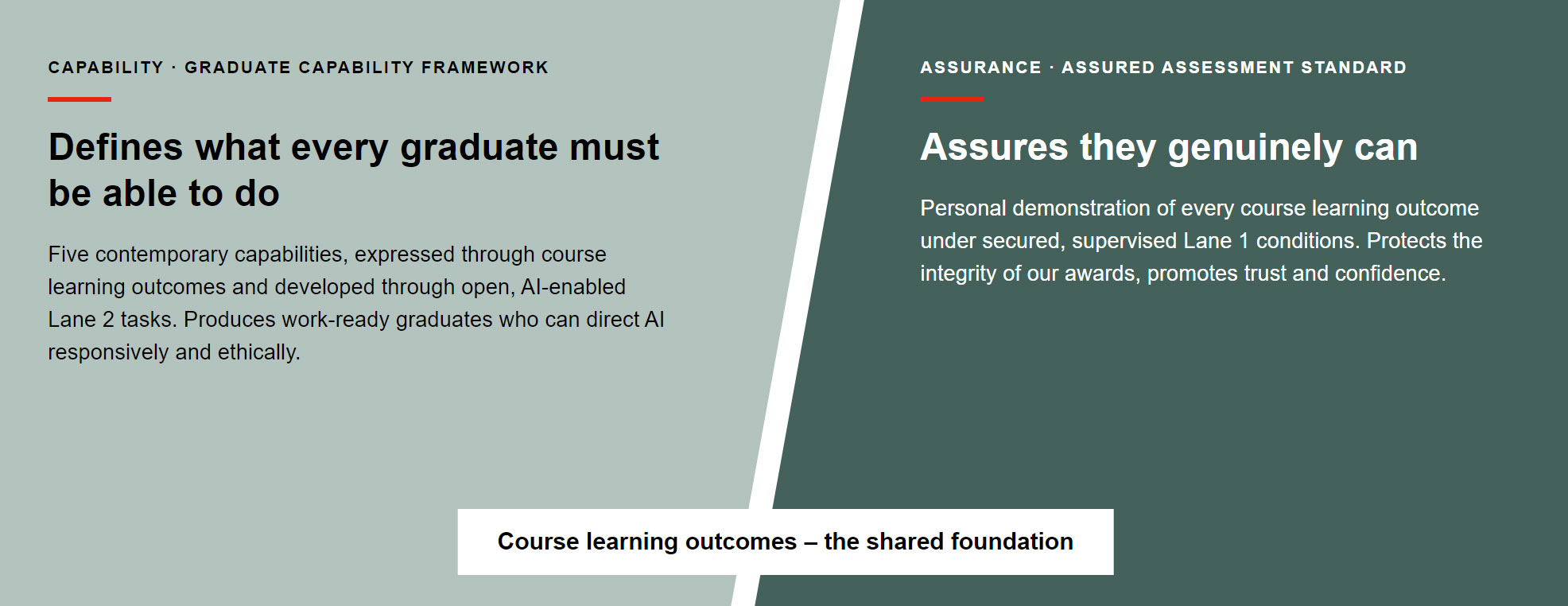
Capability
Graduates can use, direct and evaluate AI responsibly and effectively in their profession.

Assurance
Graduates have personally demonstrated the knowledge and skills required for their qualification.
This approach is underpinned by two complementary frameworks that are designed to work together; the Graduate Capability Framework (PDF 148.8 KB) develops capability, and the Assured Assessment Standard (PDF 1.5 MB) verifies attainment.
What does this look like in practice?
The Assured Assessment Standard (PDF 1.5 MB) addresses the assurance problem with a single testable claim:
"Every graduate has personally demonstrated every course learning outcome under secured Conditions.” The Standard is built on the Two-Lane Approach (developed by the University of Sydney).
- Lane 1 (secured) tasks carry the verification of learning: secured conditions guarantee identity, authorship and observation.
- Lane 2 (open) tasks build capability under open conditions, explicitly including the ethical and effective use of AI, and do not count toward assurance.
The dividing line between the lanes is observation and authorship, not the presence of AI: where a learning outcome itself concerns working with AI, its use is directly observed and assessed within a secured task.
A course meets the Standard when four tests hold for every course learning outcome: coverage, sufficiency, progression and no exceptions, evidenced through the curriculum mapping we already maintain.
The Graduate Capability Framework (PDF 148.8 KB) defines what it means to be a University of Tasmania graduate across five capabilities and fifteen domains, anchored to the Australian Qualifications Framework at Levels 5 to 10.
It was designed directly against the national and global workforce evidence, including Jobs and Skills Australia’s Generative AI Capacity Study: generative AI is more likely to augment jobs than replace them, demand is rising simultaneously for AI capability and for the higher-order human skills AI cannot substitute, and the pace of occupational skill change is intensifying.
Graduates cannot be taught to direct AI with judgement by staff who lack that capability themselves, so the Framework is supported by structured AI capability development for academic and professional staff.
What this results in
Because learning outcomes are verified through secured assessment throughout courses, students can engage with AI, with appropriate acknowledgement, in many learning activities without compromising the integrity of their qualification.
At the same time, AI capability is an expected graduate outcome. Where students are required to demonstrate AI-related skills, those skills are assessed directly.
This resolves what is too often presented as a dilemma – embrace AI or protect integrity – into a design principle: verify deliberately, then embed AI confidently. Graduates leave with demonstrated AI capability and a qualification in which every outcome was personally demonstrated under secured conditions. Employers receive a highly capable graduate while trust and confidence in our awards is maintained.
Further information
The Assured Assessment Standard and Graduate Capability Framework are available for adoption and testing by other institutions.
For more information, please contact: AcademicDiv.Admin@utas.edu.au.