

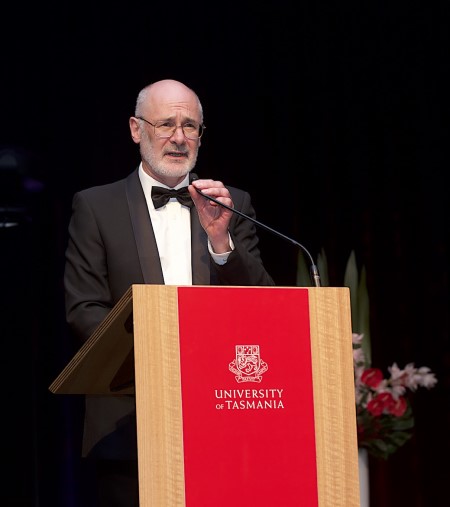
After an extraordinary career spanning more than four decades, world-renowned forensic pathologist Professor Roger Byard AO PSM has been awarded the highest academic degree that can be bestowed by the University of Tasmania.
The alumnus was awarded the Doctor of Science (DSc) on merit by the College of Science and Engineering. Since 1923 only 52 have been awarded by the University.
It recognises his prodigious research contribution, the significant impact he has made on forensic pathology and his pioneering work on Sudden Infant Death Syndrome (SIDS).
Professor Byard, who holds the George Richard Marks Chair of Pathology at the University of Adelaide and is a senior forensic pathologist at Forensic Science SA, prescribes to a preventative pathology approach where lessons are learnt from the dead that can prevent further loss of life.
While his highly attuned clinical expertise is sought around the globe, Professor Byard’s work extends well beyond the mortuary, where he has performed more than 6,000 autopsies. His remarkable and relentless pursuit of research excellence has resulted in 1,000 publications and chapters, including 10 books covering a wide range of topics from Sudden Infant Death Syndrome (SIDS) to geriatric medicine, including an encyclopaedia and an atlas.
The highly respected leader in paediatric pathology has awards and accolades aplenty, yet he describes receiving his DSc as the apogee of his career.
“It’s the high point of my academic career and I am so proud to receive it and for it to be awarded by my alma mater, it means so much to me,” Professor Byard said.
Born in Wynyard, Professor Byard attended the local primary school and Marist Regional College in Burnie before moving to Hobart to study medicine.
He graduated from the University of Tasmania with a Bachelor of Medicine and Bachelor of Surgery degree in 1978. For five years he worked in clinical medicine including doing flying doctor work and qualifying in family practice in Canada. It was here that Professor Byard became interested in paediatric pathology.
He can still recall his first autopsy patient, a girl who died from cancer. Her name was Genevieve.
“It was an awful disease and I was just horrified about what had happened,” he said.
“The medical treatment was appropriate, but I thought about the family and how no parent should have to deal with the death of their child.”
While he was completing his Research Fellowship in Toronto, Professor Byard’s focus shifted to SIDS. Upon returning to Australia, he worked with paediatrician Dr Susan Beale, who was the first person to identify babies sleeping face down as a risk factor for SIDs.
Many years later Professor Byard was part of a breakthrough study that discovered a developmental abnormality in the brainstem, which controls breathing and movements of the head and neck.
“We were able to answer the question of why babies don't they lift their heads if they are struggling to breathe- they probably can't because their brains prevent them from moving into a safe position.”
Research is now underway to work out if they can find a genetic marker that could be used to identify at-risk babies.
Despite many years working on some of the world’s most gruesome, complex and tragic deaths - from the Snowtown Murders to the Boxing Day tsunami - he still retains the same passion and curiosity that first drove him to pursue forensic pathology.
“I really enjoy my work, it’s important and every day something new will turn up where you think - how did that happen?
“For instance, most recently I have been looking at herbal medicines and we’ve discovered that certain anti-arthritic herbal preparations can increase the toxicity of Panadol.”
In addition to taking University students under his tutelage, Professor Byard is committed to sharing his knowledge on the global stage, frequently conducting paediatric forensic workshops, and carrying out examinations overseas.
Executive Director of Advancement Kate Robertson congratulated Professor Byard, who was awarded the 2016 Distinguished Alumni Award, on the wonderful and thoroughly well-deserved achievement.