


Bachelor of Medical Research with Honours 2009, PhD 2014
Lila Landowski had a light bulb moment when she was seven years old, thanks to fish slime.
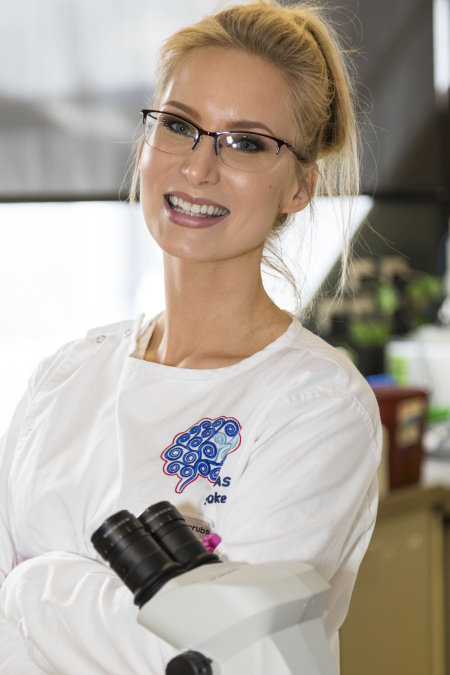
Fast forward 20-plus years and the 31-year-old is now one of the leading neuroscientists and lecturers at the University of Tasmania, Director of the Australian Society for Medical Research, board Director of Epilepsy Tasmania and was recently anointed by Australia’s Chief Scientist as a National Science Superhero.
It’s been an impressive journey for the Moonah (Hobart)-born resident, who has achieved much since her years growing up in a housing commission home and attending the local public schools.
The self-confessed ‘old soul’ is proof that hard work and determination can take you all the way, and that includes a PhD in neuroscience.
“I knew I wanted to be working in therapeutic development at the age of seven, it was a very specific moment,” Dr Landowski said.
“I was at a grade-four school camp, and I caught my first fish. As I was holding up the fish, I noticed its cloying slime sticking to my fingers.
“I’d recently heard about shark liver oil capsules having healing properties (which turns out not to be true after all), but I thought ‘wouldn’t it be cool if I could find some kind of fish extract that could help people’.
As it turned out, the natural protein that Dr Landowski proved could regenerate nerves in the skin during her PhD studies is found in fish.
“It’s funny to see things come around in full circle and find that my very naive idea came to fruition,” she said.
In a CV heavy with outstanding achievements, the passionate science communicator and advocate is most humbled by her 2015 Premier’s Young Achiever of the Year Award.
For Dr Landowski, winning the award made the suffering she encountered on her journey “worth it”.
She had contended with an environment of significant family hardships, juggling carer responsibilities with studies, and coping with bullying.
“The science is always worth it, but it’s hard to justify suffering,” she said. “Winning that award gave me a sense of validation at a really important time in my life.”
She looks back on her University of Tasmania days as a positive experience thanks to inspiring lecturers.
Starting her university journey studying a Bachelor of Marine and Freshwater Biology, she switched to the new Bachelor of Medical Research, followed by Honours in Medical Research and a Doctorate in Neuroscience.
Dr Landowski’s research career highlight was during her PhD studies in 2013 when she discovered that a natural protein could regenerate peripheral nerves in the skin.
“Looking down the microscope and seeing that we may have achieved the impossible was mind-boggling,”
After completing her PhD at the Menzies Institute for Medical Research, Dr Landowski trained at the Peripheral Nerve Division of the Mayo Clinic to cement her status as an emerging leader in the field of peripheral nerve injury.
At the same time, she was recruited to teach and coordinate neurosciences units at the Wicking Dementia Research and Education Centre in Hobart, which is at the forefront of translational research and support for issues confronting people with dementia and their carers.
It is here that Dr Landowski, alongside some of the State’s brightest minds, is studying the number-one cause of death in women (and number-three cause of death in men) in Australia.
“People don’t realise that dementia kills. They often think of it as a condition where you become forgetful,” Dr Landowski said.
“Let’s consider that the brain controls everything we do, whether we’re thinking about it or not. When a person has dementia, neurons in various parts of their brain break down and die, affecting how well those regions can do their job.
“As the disease spreads to other parts of the brain, you lose the ability to perform basic functions, such as speaking or swallowing.
“The brain’s hippocampus, which is the learning and memory centre, often stops working effectively when someone has dementia. Not only can’t they remember what they did five minutes ago, they lose track of where they are in space and time.”
With no cure for dementia in the foreseeable future, Dr Landowski said the research indicated the disease could be present up to 20 years before the symptoms begin.
Today Dr Landowski is currently a postdoctoral fellow in the lab of Professor David Howells, who she attributes her success to.
And her research focus has shifted from peripheral neuropathy to stroke.
With stroke being the second leading cause of death in Australia, Dr Landowski is part of a 14-member Stroke Research Unit headed by Professor Howells.
“The Royal Hobart Hospital Research Foundation has funded us $450,000 for three years to figure out how to improve the success of stroke research,” Dr Landowski said.
While no two days are the same in the lab, Dr Landowski feels lucky to do what she does.
“There’s no such thing as an average day. Today I spent part of the day writing a paper and making a figure using Adobe Illustrator,” she said.
“We have to do a lot of art in science, such as making images or illustrations for papers to communicate an idea.
“Today I’ve also spent time in the lab troubleshooting one of our experiments.
“It’s such a privilege to get to spend a day thinking of problems and figuring out how to solve them. It’s just pure joy when you do solve them; there’s no better feeling in the world.”
Away from work, Dr Landowski spends most of her time spreading science over her social media pages and ABC radio in a way that’s as engaging and accessible as possible.
She also loves fishing and playing music in her friend’s folk-pop group Gnarlhünd.
Image by Reg Ashman