

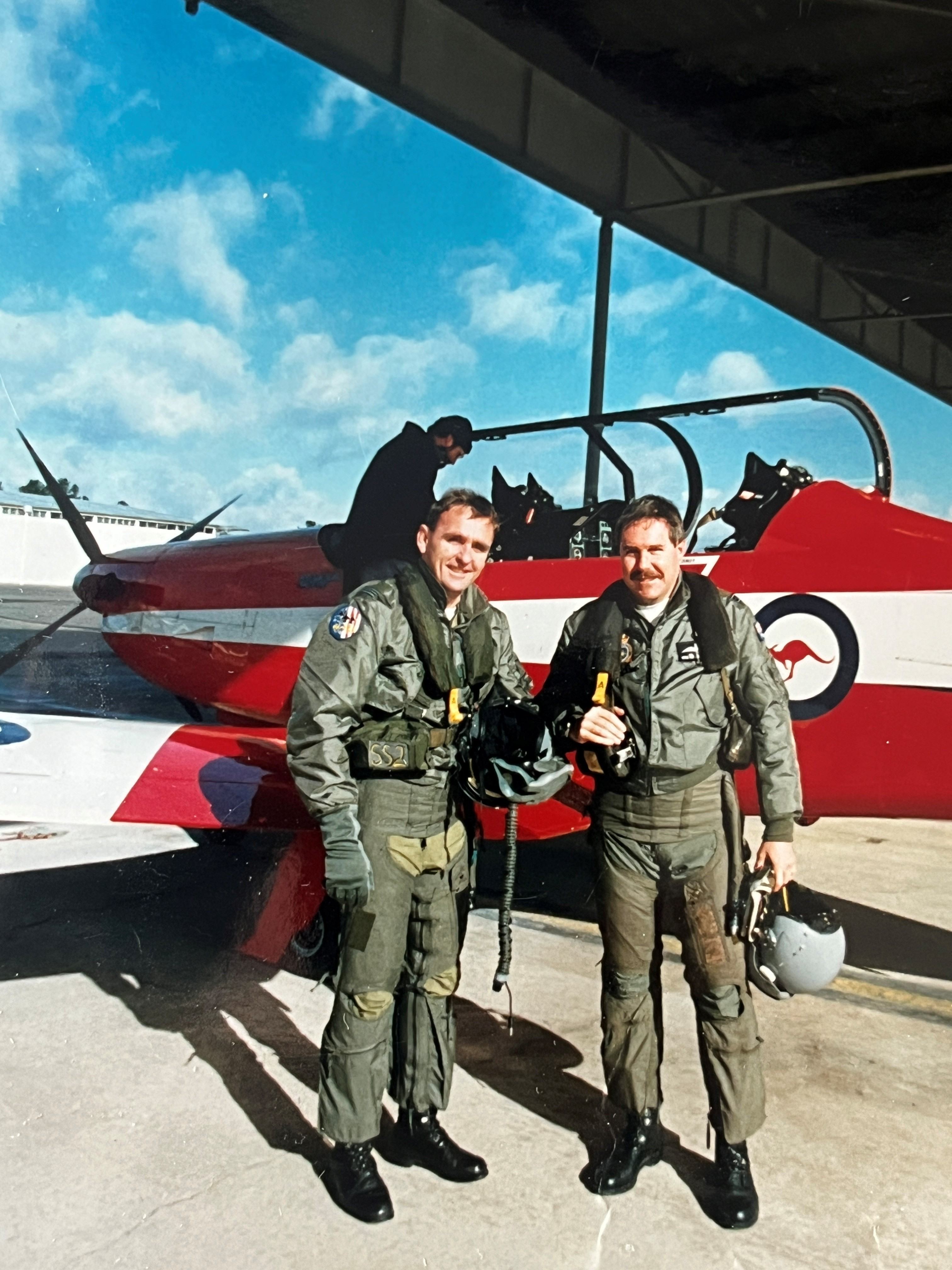
Clinical Associate Professor Marcus Skinner’s career has seen him combine two great loves, not often thought of in the same breath – medicine and flying.
The science and medicine alumnus trained as a medical undergraduate with the Royal Australian Airforce (RAAF) and, later, after graduating, the School of Aerospace Medicine in Texas, where he completed the United States Air Force Flight Surgeons program. The combination provided a unique set of skills that he says gave him the resilience and capability to work as an anaesthetist in the most challenging environments. He has had a life-long interest in aviation medicine, retrieval medicine and trauma management.
Deployments as a specialist anaesthetist included working as an RAAF Specialist Reservist during the Bougainville crisis, the East Timor conflict, and the Banda Aceh aeromedical evacuations after the 2004 Tsunami. Marcus says providing service in the face of such overwhelming humanitarian need proved both immensely challenging and rewarding.
He has held leadership roles as Director of Anaesthetics and Intensive Care in Burnie, Director of Anaesthetics and then Clinical (Medical) Director of the Surgical and Perioperative Surgical Stream at the Royal Hobart Hospital and, most recently, as the inaugural Co-Chair of the Tasmanian Health Senate.
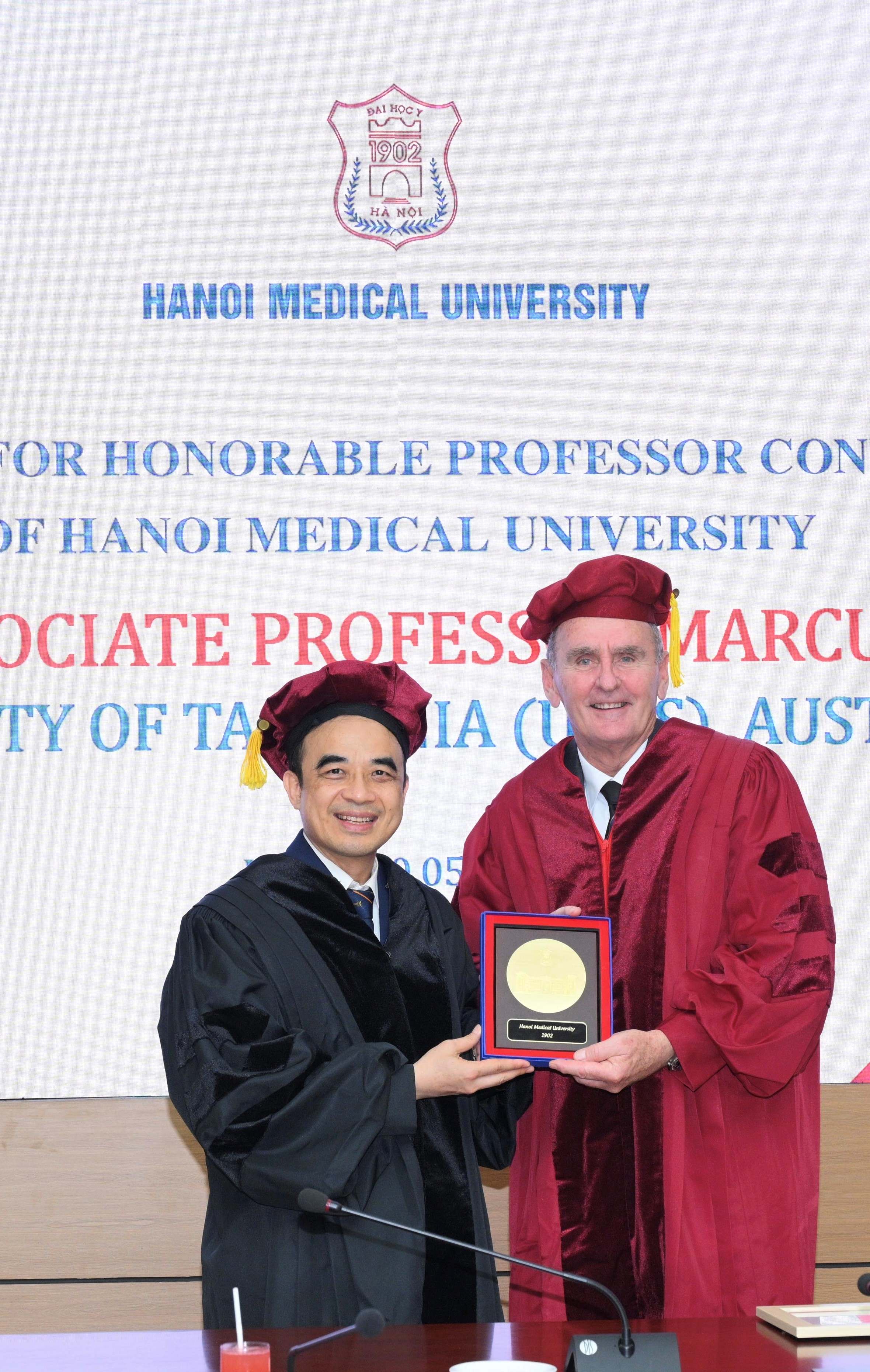
In May 2025 he was made an Honorary Professor at the Hanoi Medical University (HMU), Vietnam. His significant service to medicine has also seen him awarded an Order of Australia.
So where did this passion come from, and what have been some of the highlights and challenges along the way?
When did your interest in a career in medicine begin?
Growing up in a medical family (my father was a surgeon), medicine always appealed. I remember my father telling me stories of his medical training at St Mary’s Hospital in London and his military training before World War 2. I always found his stories about his medical experiences during the war, and subsequently when he went to Vietnam on two tours with the Australian surgical team, riveting. There were lots of conversations around the dinner table and, in my school holidays, my father used to get me to develop the chest Xrays that he used to take in the clinics. It was all manual back then, and I remember it being lots of fun. So I suppose it was just ingrained. A number of other life events shaped my desire to undertake medicine, one being that my mother, a nurse, died when I was nine years old from breast cancer. I remember discussions around medical and surgical treatments and always thought what more could be done.
Did you go straight into studying medicine after school?
I didn’t make the initial cut-off for entry into medicine – the Tasmanian Medical School only had 44 places then – which was a pretty solid disappointment, but my father said there were other pathways and “you just have to stick at it”. So, in effect, I did. That initial failure to gain entry certainly gave me the drive and desire to achieve that goal.
I went on and did a Bachelor of Science in Biochemistry at the University of Tasmania and all the while re-applied each year for medicine without success. I enjoyed the great camaraderie at Christ College at UTAS during that time, culminating in strong support from friends when, late in my last year of my BSc, my father died of a heart attack. After completing my science degree, I was selected to undertake a Master’s in Biochemistry at the University of Western Australia, based at the Royal Perth Hospital, a paid position that had potential to give me independence. I reapplied to study medicine in Tasmania as a second-year “lateral entry student”. To my great excitement and relief, I was one of three accepted.
What have been some of the highlights of your medical career?
There have been so many. The friendships established during medical training and the camaraderie built through mutual military experience in training and deployment provided enormous satisfaction in a career where I actually enjoyed getting up to go to work pretty well every morning. Every day was different, the clinical spectrum of scenarios I encountered was broad but all very personal; it always made me feel privileged to be part of a patient’s journey when they were at their most vulnerable.
Being able to combine my passion for medicine and flying throughout my career was an amazing opportunity and provided a lifelong professional and personal pleasure.
My time with the United States Air Force Flight Surgeons program at the School of Aerospace Medicine in Texas provided me with an experience that was truly remarkable and, combined with my military training in the RAAF, gave me the resilience and capability needed to work in the most challenging environments.
All of this, supported by my role as a specialist in anaesthesia, provided me with the capacity to undertake leadership and subsequent senior medical administrative roles.
My time as a Fellowship Examiner for 12 years with the Australian and New Zealand College of Anaesthetists has been a career highlight. I feel so privileged to have been part of a respected team that assesses the performance of trainees and to witness their transition to an independent specialist mastering complex skills.
In aeromedical support of the Australian Antarctic Division, one particular highlight was the successful mid-winter aeromedical retrieval of a critically ill patient from Pegasus Ice Runway at the McMurdo Base Antarctica in 2012.
What have been some of the challenges, and how have you navigated them?
The most challenging deployment was Aceh after the Boxing Day Tsunami in 2004, where most of us who were sent to assist were taken to both our mental and physical limits. It left unimaginable devastation in its wake with entire communities swept away, infrastructure totally destroyed, and families torn apart. Yet, amidst all of the devastation, we saw incredible human resilience in the survivors, many of whom had literally lost everything. It gave me a great understanding that resilience is founded in deep cultural strength, faith (in whatever form that may be) and a spirit that failed to be broken by tragedy.
Congratulations on your Order of Australia for significant services to medicine. What did receiving that recognition mean to you?
It was a lovely surprise. I certainly felt honoured to receive that award. To me it provides a reminder of the importance of service, and I’m humbled that it reflects the recognition of one’s peers for the work that has been undertaken.
Congratulations on your recent position as Honorary Professor at the Hanoi Medical University (HMU) Vietnam. Can you tell us more about your work in trauma education overseas?
I started the Primary Trauma Care (PTC) program in 1995 with Prof Doug Wilkinson, then specialist in Anaesthesia in Nuffield Anaesthesia Department in Oxford, after being asked to work with Dr Wilkinson to establish a trauma training program in Fiji. There were some serious limitations as the program needed to be accessible and inexpensive for the candidates. The inaugural PTC course was held in Suva, Fiji, in 1997. It was a resounding success and, from that, with the support of many NGOs, we accelerated the development and expansion of the PTC Program to train anaesthetists, surgeons and other health care workers to systematically manage severe trauma victims at the local district hospital with minimal resources.
In 2004 I went to Vietnam to an ASEAN anaesthesia conference with Prof Rob McDougal another anaesthetist and graduate from University of Tasmania. It was then that I met Professor Tu, Director of Anaesthesia at Viet Duc Trauma Hospital in Hanoi, and Dr Nguyen Duc Chinh, Head of Trauma Surgery at the same hospital. Trauma management courses in Vietnam followed, including the training of local Vietnamese instructors.
We forged connections with other NGOs, including the HOC-MAI Foundation, involving exchange programs for medical students and young doctors between Australia and Vietnam.
I have been involved now for over 20 years in Vietnam culminating in the University of Tasmania Pistachio Project, funded by the Elphinstone Group and Broadreach Holdings, and a PhD by one of our PTC candidates, Dr Ba Tuan Nguyen. The Pistachio Project and Dr Tuan’s PhD found thatthe trauma management course was successful in reducing road trauma mortality and morbidity. It shows that with cooperation and collegial engagement between clinicians and our universities (UTAS and HMU) across continents we can achieve amazing things. I’m very proud of what has been achieved in Vietnam.
Can you tell us more about your recent role as inaugural Co-Chair, with Assoc Prof Viet Tran, of the Tasmanian Health Senate?
The Tasmanian Health Senate was established in 2022 and brings together individuals – including clinicians and consumers – from across the State with the common goal to improve the health and wellbeing of all Tasmanians. Its primary role is to provide strategic independent advice to the Department of Health and, with debate, provide advice to influence health policy and planning.
You’re a pilot with an aerobatic rating! What do you love about that? What has it taught you?
My father had a private pilot’s licence and I started flying when I was 16. One of the privileges as an airforce doctor was to be allowed, on occasion, to fly with the squadrons and I took every opportunity to get some free flight instruction by the best pilots whenever I could. This also brought out another passion and that is for aerobatics and formation flying, and I’ve been fortunate to have good health to allow me to continue to undertake this.
There are some parallels with anaesthesia. The pilot and the anaesthetist both orchestrate a journey from start to finish, from the take-off/anaesthesia induction to the landing/anaesthesia emergence. They both involve careful monitoring, vigilance and responsibility. Both need to be well trained to respond and act promptly in the event of an incident and both professions are unforgiving of incapacity or neglect.
Have you got advice you would like to offer to new medical alumni, and our recent graduates more generally?
When the Covid 19 Pandemic started with its frightening outcomes, particularly felt in North-West Tasmania, it required anaesthetists and our critical care colleagues to develop management protocols to stay up-to-date with the latest world evidence and to adapt practices accordingly. The pandemic required two things more than ever: flexibility and collaboration.
The advent of AI is changing the face of medicine, but medicine remains not merely a learnt science but an art that requires empathy, continued learning, and total respect for patients at their most vulnerable time.
So, my recommendation is to be adaptable but always remember, medicine is a clinical profession that requires humanity and the people we care for rely both on our expertise and our compassion.
Is there anything you would like to add?
It’s a team effort. I have greatly valued the support of my wife, Alison, who with her critical care, perioperative nursing and midwifery background has kept me “wings level” yet has enabled me to focus on my career. With no conscious pressure, our three children have taken up either medicine at UTAS or pilot training.
We’ve enjoyed the journey together. What more could I ask for?
Written by Katherine Johnson for Alumni Magazine Issue 56, 2025.
Connect with our alumni community to discover more.
Top right: Clinical Associate Professor Marcus Skinner AM | Photo: Dr Roger Wong