

Dr Anita Wild might have the most fitting surname of anyone in her field. For 25 years, the ecologist has devoted her time to researching threats to natural landscapes and to restoring damaged environments.
It’s a career that has taken her from remote areas of the Victorian Alps to Tasmania’s high country, where she did her PhD.
“I am motivated by the beauty and complexity of mountain landscapes, in particular,” Anita said.
“I think I’ve always been a practical person, so seeing research integrated into effective on-ground restoration works is really important to me, as are the ultimate environmental outcomes.”
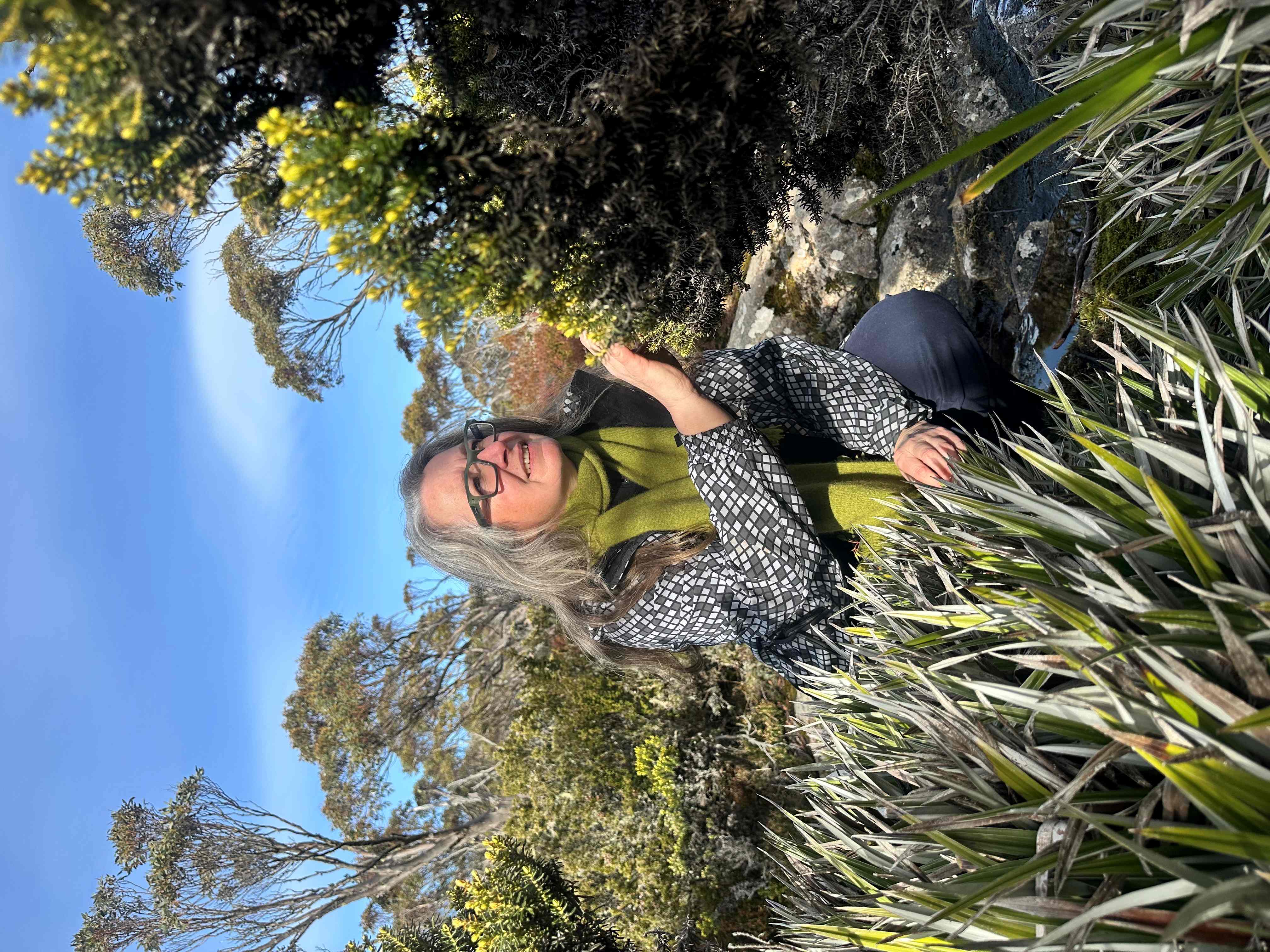
Anita’s PhD at the University of Tasmania focused on understanding the natural processes behind the recovery of alpine landscapes following disturbance, knowledge that is now being applied to restoration projects.
“Most importantly, this understanding helps prioritise where we may need to intervene following disturbances such as fire,” Anita said.
“For example, grasslands in alpine areas generally demonstrate relatively ‘quick’ natural recovery (for alpine areas), so the limited resources available for environmental restoration may be better directed elsewhere, such as to ensuring moisture is restored in bogs and other alpine wetlands, which may need assistance after disturbance.”
Anita is now Director of the ecological consulting firm Wild Ecology. She counts among her career highlights returning to restoration sites on the Bogong High Plains in Victoria, which she first assisted with in the 1990s following road construction, and seeing them flourishing despite repeated fires.
She says that while the effects of increasing frequency and intensity of fires can be confronting, “it’s those little pockets of natural resilience and recovery that offer hope”.
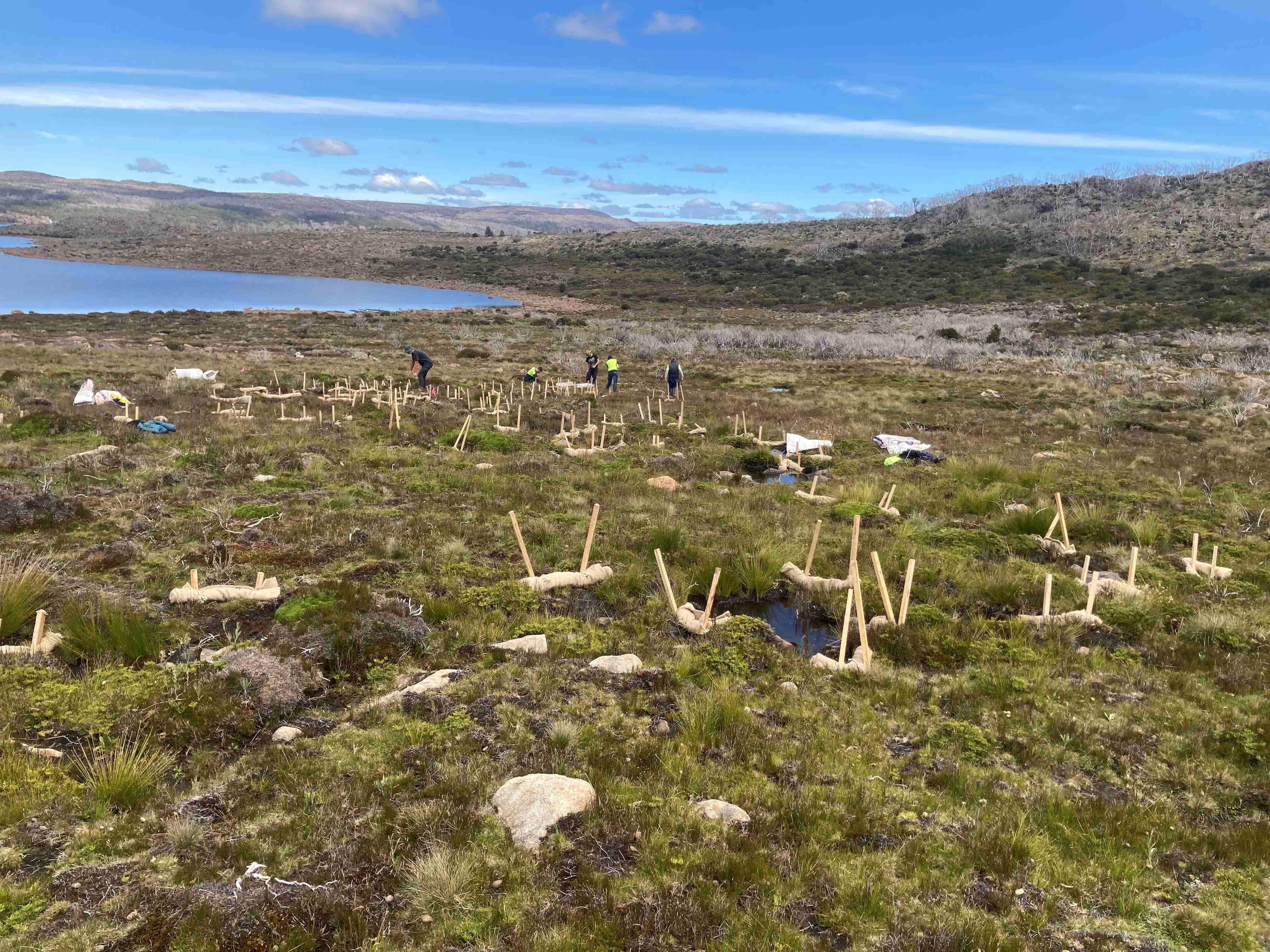
Anita has since applied this knowledge to Lake Mackenzie in the Tasmanian Wilderness World Heritage Area after it was severely impacted by fire in 2016. Adapting techniques for Tasmania’s unique climate, soils and vegetation, this project investigated ways to reduce organic soil loss after fire, mitigate long-term erosion risks and restore ecological function.
“The research showed that installing biodegradable materials such as matting and small weirs helped improve ecological function by capturing soil, water and nutrients,” Anita said.
“While full recovery will take many years, these sites are demonstrating proof of concept for the on-ground techniques and also the different recovery rates I observed in my PhD research.”
Visiting remote locations has been another highlight throughout Anita’s career.
“While working at Hydro Tasmania and writing my PhD, we commenced a project to understand how altered river flows from hydro-electricity generation would potentially impact riparian vegetation (vegetation growing alongside rivers),” she said.
“This involved field work that required getting dropped by helicopter, along with inflatable boats, into rivers in remote areas of south-western Tasmania; I got to work alongside some really knowledgeable hydrographers and geomorphologists.”
But such work has its challenges, including alpine weather. “Despite now having satellite communications and improved weather forecasts, a bit of ‘old school’ in-field weather observation/ cloud reading always helps, and having flexibility and contingency to change plans,” Anita said.
She has recently completed a project for Hydro Tasmania to protect alpine lunettes (sand dunes that form beside lakes) from erosion, which was impacting Aboriginal artefacts on Tasmania’s Central Plateau.
“The on-ground works for my restoration and research projects in Tasmania are done with pakana services, an Aboriginal land management training organisation, so our projects also include training and knowledge sharing,” Anita said.
“The Central Plateau project is a highlight because we have been working with, and learning from, Tasmanian Aboriginal people to better understand their cultural values and incorporate restoration techniques the Aboriginal community has used on the West Coast.
“Working with the community, we understood there was a very strong emphasis on using only local, natural and biodegradable materials and ensuring the materials blended with the landscape, so tea tree was harvested from nearby transmission easements for the works.”
The tea tree was used as a fence at the dune front in addition to leaky weirs made of coir to manage surface water flows. Mid-winter monitoring shows this is reducing active erosion at the site.
“I have Gunai kurnai (Victorian mountain people) heritage, so this project, protecting both natural and cultural values, is like coming full circle for me and is deeply satisfying,” Anita said.
And what would success, more broadly, look like for Anita Wild?
“Success to me would be a world in which natural values were appreciated and valued for how critical they are to our very survival.” Dr Anita Wild
Written by Katherine Johnson for Alumni Magazine Issue 56, 2025.
Connect with our alumni community to discover more.
Top right: Lake Mackenzie post-fire restoration research | Photo: Olivia Zadro