

When Dr Greg Clark AC did his undergraduate honours degree in Physics at the University of Tasmania, he could not have anticipated where that degree would take him.
From an award-winning research career in material and solid state physics to senior management roles in organisations including IBM, News Corp, Loral Space and Communications, and ANZ, Greg credits his success to the excellent teaching in maths and physics he received at the University.
“I was unbelievably lucky to have that first degree at UTAS; it was a wonderful place to move from high school into tertiary education.
“The lecturers were superb; a number of those lecturing in maths, physics, geology and chemistry had come from Europe after WW2 and were as good as you would get anywhere.”
Greg speaks fondly of many of those former teachers, one being Dr Michael Hasofer, who came to Tasmania from East Germany, saying his influence has flowed on.
“Dr Hasofer taught me so much about statistical analysis; if I ran into an analytical challenge in my career, I always referred back to what he taught me.
“Apart from the teaching and the wonderful physical environment at Sandy Bay, the other thing my education at University of Tasmania gave me was the space to think about what I was doing in a broader context and meet people outside my discipline.”
Greg went on the do his PhD in nuclear physics at ANU, and from there was awarded a post-doctoral position at the UK’s Atomic Energy Agency. I was then recommended by fellow University of Tasmania alumnus Professor Ken McCracken AO – who Greg rates as “one of the best scientists Australia has ever produced” – to the position of Principal Research Scientist at CSIRO’s Division of Mineral Physics.
A position at the US Atomic Energy Commission followed in Oak Ridge Tennessee, before Greg joined IBM’s research division in New York, where he remained for 15 years. At IBM he worked on computer chip technologies.
“Out of the blue, I was then contacted by Rupert Murdoch to run all the tech in News Corporation and Fox. At this stage, they were doing a digital transformation across the business – the movie studios, and television, and online presence.
“Satellite TV was becoming important, so I was responsible for that from a technical point of view. This involved developing authentication and encryption technologies to allow the business to develop.”
Greg’s career then took him deeper into the world of space as his interest in satellites grew, culminating in him becoming President and Chief Operating Officer of Loral Space and Communications, a satellite manufacturing and communications company operating out of Silicon Valley.
“My interest in space continues to this day; just this morning I was on the phone regarding the funding of a space start-up,” he said.
Greg has also carved a career in finance and was recruited to the board of ANZ Banking Group, where he says his maths background helped enormously.
“STEM (science, technology, engineering and maths) is always useful and its relevance in the work force is growing,”
He says enjoying his work has been a large element of his success, and offers this advice to new graduates.
“I think fun is crucial. People need to get a job they enjoy and are interested in – I never really thought of my work as work.”
His other advice? “Have great aspirations for yourself; don’t underestimate yourself in the work environment.”
This article featured in the monthly eNews Alumni and Friends. If you are a member of the University of Tasmania community and would like to receive this publication, please provide or update your email address.
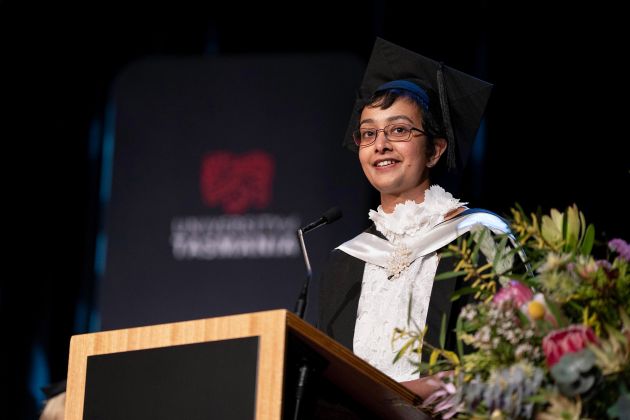
Image top right: Dr Greg Clark AC