

For University of Tasmania mechanical engineering graduate Paul Allen, a severe head injury sustained on a white-water rafting trip turned his world upside down. He had been working for only four months as Development Engineer with Ardmona Foods, his first professional engineering job, when the accident occurred.
Following a 3.5-week coma and two years of intensive rehabilitation, Paul was unable to continue in engineering but was thrilled to discover he could still pursue another long-held interest.
“I was eventually convinced to take on something I realised I always preferred – designing and making furniture,” he said.
In 2019, he won the Emerging Designer award in the Australian Furniture Association’s ACE Awards for his Plane Waveform Coffee Table, inspired by memories of surfing as a child.
Paul’s furniture company is Pallendesigns. He describes himself as a furniture designer maker who challenges creative boundaries, as well as being a writer, engineer, and resilient spirit crafting stories in form.
So how did this journey unfold?
“I was always interested in the design of things and the way they worked; originally (my interest was) in mechanical design, so engineering was a natural step in education,” Paul said.
However, after sustaining the head injury in 1994 and being unable to continue as an engineer, despite a number of years trying to overcome his new limitations through rehabilitation, he moved from Hobart to Launceston and helped renovate his first house.
“I enjoyed the building and decorating process. Along the way, I designed and made some furniture for the house too but was frustrated not knowing enough about the making process,” he said.
“I subsequently undertook training in woodwork and furniture making, to develop my skills and satisfy my creative and problem-solving drives.”
This included a TAFE Diploma in Wood Design and, later, the decision to enrol in a Bachelor of Fine Arts majoring in furniture design at the University of Tasmania.
Paul’s furniture designs are innovative and inspired by nature.
“I would like to think my designs employ natural curvature, structural integrity and gracefulness instead of thoughtlessly-maximised production of disposable furniture,” he said.
The journey has not been without significant challenge, and Paul has attempted to help others learn from his experience.
“It has been a struggle, but I think everyone struggles at some time in their career,” he said.
“Over the years I have found the right friends who have been supportive and helped me both in life and in achieving my goals in design.”
He says that alumni Jon Hemming (Master of Fine Arts, Bachelor of Arts in Environmental Design) and Ross Straker (Master of Fine Arts), as well as Brad Moss, gave him “teaching, inspiration, humbling encouragement and incredible laughs”.
Jon says that Paul, likewise, has been an inspiration to him.
“I first met him when I was teaching Wood Design in Creative Arts at TAFE. His talent and perseverance stood out,” Jon said.
Jon and others were able to facilitate Paul’s pathway to the University and then on to Designed Objects Tasmania (DOT).
“Paul has received much support from the co-operative and collaborative opportunities that DOT provides. He has an approach to life, and dare I say its challenges, that is truly astounding and humbling.”
Paul also wrote a book, My Life as a Fish, to give people a sense of what it was like for him to be in a coma, trying to make sense of what he describes as an anarchic world over which he had no real comprehension or control.
“My experience of ‘coma’ was, at the time, utterly real. There was nothing at all that suggested ‘it’s okay; it is only a coma dream’. If my book is helpful for the medical profession and the public in general in portraying the patient’s perspective and experience, then I’m thrilled.”
Paul says that, after surviving the accident and coma experience, everything about living feels renewed – it’s a challenge inviting him to participate, rather than a presumption of powerlessness.
“It would be wrong to consider severe injury as a good thing, but having the luxury of a second go has given me much stronger perspective on the relative importance of things, rather than becoming caught up in self-pity,” he said.
“I came to see the vital importance of attending regular live local comedies, which were important for trying to establish any sense of perspective – being able to make people laugh became massively reassuring. I still had a place in the world. Interestingly, since the accident I no longer have acute (or any!) fear of performing my own comedy set – impossibly valuable in winning social respect and appreciation.”
He says he leaps at opportunities to make people laugh lightly at himself as well as at themselves. “The affirmation that I can still be a valued and appreciated member of society, despite everything, is life-giving and allows me to provide a glimpse to others of what can happen to anyone and what survival can be like.”
Paul’s advice for graduates who may experience significant changes in their lives that cause them to set off in a new direction is to be open to what is ahead.
“Life isn’t over – it may just take a new direction, which you hadn’t formerly considered,” he said.
He says he still has an engineer’s perspective, which guides his design approach to furniture. His biggest commission to date is the Celery-Top Pine outdoor tables and benches at Salamanca Courtyards in 2020.
“I still think like an engineer as far as design work goes. Sometimes my work can be a little overcomplicated, but I like designing dynamic furniture with a lot of moving parts.”
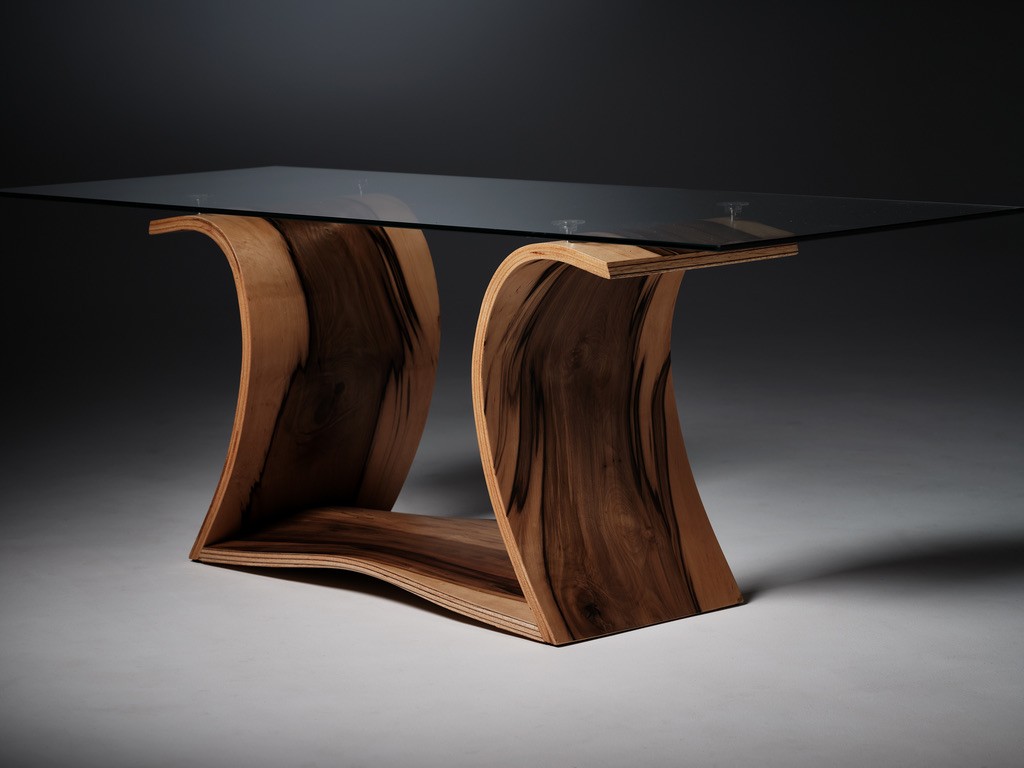
Image credit: Peter Whyte
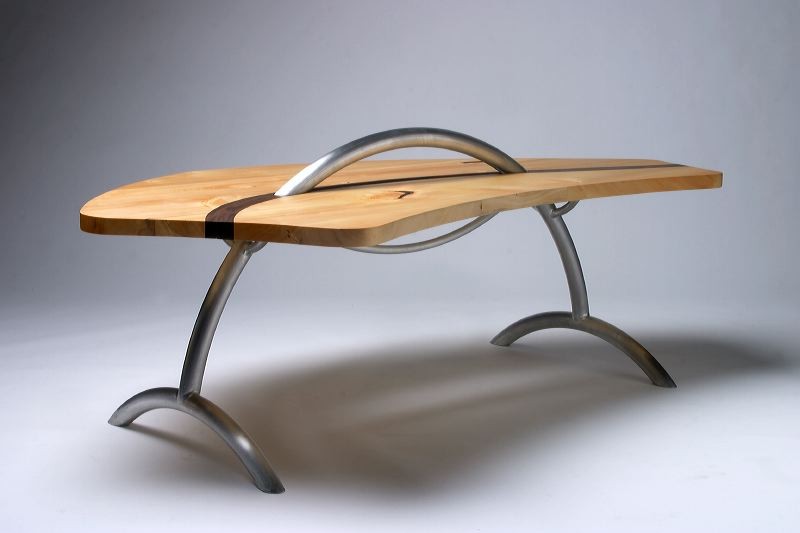
Image credit: Peter Whyte
Image top right: Paul Allen, Waveform coffee table the Australian Contemporary Emerging Design winner 2019
Image credit: Peter Whyte
This article featured in the monthly eNews Alumni and Friends. If you are a member of the University of Tasmania community and would like to receive this publication, please provide or update your email address.