


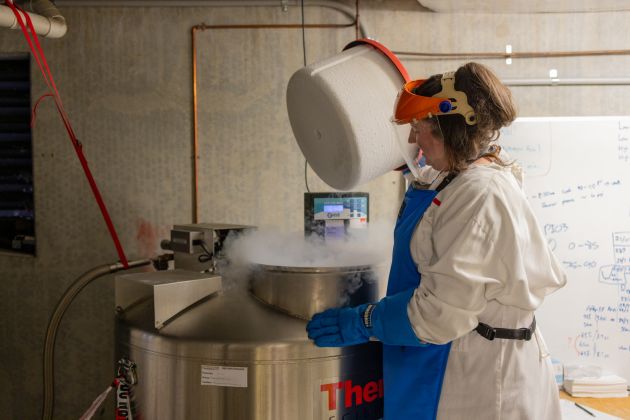
Medical students at the University’s Tasmanian School of Medicine will benefit from a fully refurbished, purpose-built simulation lab that brings the look and feel of a contemporary hospital ward into a supervised teaching environment.
The upgraded facility includes a three-bed simulated ward designed to closely replicate real clinical practice, with layout and specifications informed by input from the Royal Hobart Hospital.
The sim lab is based at the Hobart Clinical School, providing medicine students with dedicated teaching spaces and close connection to clinical services.
“Simulation-based learning is where our students can make decisions, work as a team and practise core procedures in a realistic setting – while closely supported by teaching staff,” Hobart Clinical School Director, Dr Lester Pepingco, said.
“It helps students build confidence and clinical judgement before they apply those skills in real clinical environments.
“The refurbishment has been shaped with guidance from the Royal Hobart Hospital and features high-fidelity simulators including ATLAS.
“ATLAS is an advanced life support mannequin capable of realistic airway, breathing and cardiac responses.
“Used with a connected monitoring system, ATLAS can display vital signs and provide real-time CPR feedback, helping students learn to assess and respond as they would at the bedside.
A dedicated control centre featuring a one-way mirror allows teaching staff to observe sessions and remotely run simulation scenarios without interrupting learning.
The refurbishment also includes upgraded IT and environmental infrastructure to ensure the space remains contemporary and adaptable to evolving simulation technology.
The lab can also support live streaming to other teaching spaces, extending access and enabling broader participation in simulation-based learning.
“The simulation lab supports teaching for Years 3, 4 and 5 medical students, from core skills training such as CPR to high-fidelity sessions that replicate acute clinical scenarios,” School Simulation Coordinator Louise Kindon said.
“Students can practise clinical decision-making, communication, teamwork and procedures in a safe setting, with structured feedback and time for reflection—building confidence and competence before applying these skills in real clinical placements.”
Dr Pepingco said partnerships with the health sector are central to the lab’s impact.
As part of our ongoing partnership with THS, a Code Blue III simulator is also due to be installed, further expanding the range of scenarios that can be delivered.”