

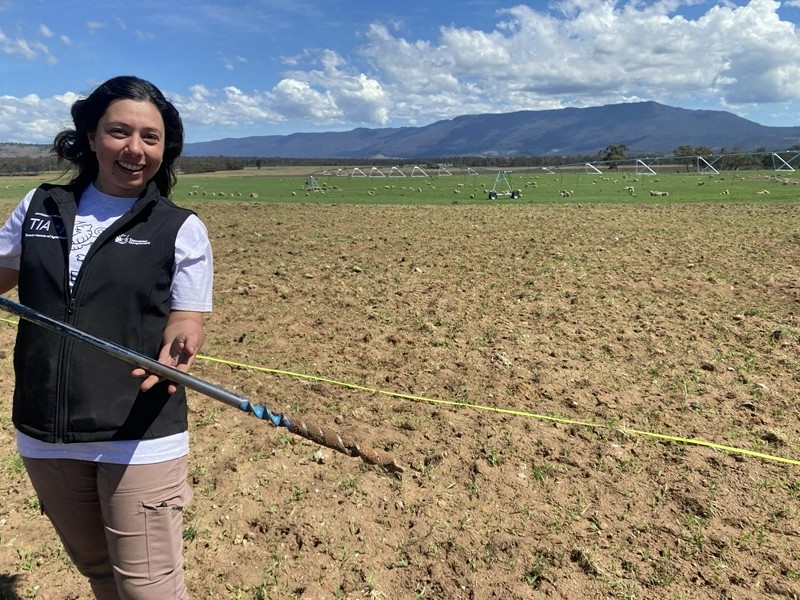

Researchers from the Tasmanian Institute of Agriculture (TIA) have been collaborating with Northern Midlands farmer Richard Burbury to investigate how clay spreading techniques can be used to improve irrigation performance under his new pivot.
Richard Burbury is a sheep and mixed cropping producer at ‘Rokeby’ north-west of Campbell Town. He has built a new pivot which will use water from the Northern Midlands Irrigation Scheme (Tranche Three – Phase One).
Dr Ana Avila, Research Fellow in Irrigation Science at TIA, said having access to irrigation water is only part of the equation. If the soil cannot hold that water, farmers may not see the full benefits of their investment.
"We want to understand whether adding clay can help these sandy soils hold more water and make better use of irrigation,” Dr Avila said.
The area under the new pivot includes 6 hectares of deep, windblown sand. These sandy soils, referred to as Panshanger sands, occur across Tasmania's Northern Midlands.
Panshanger sands are hydrophobic, have low water and nutrient retention and are sub-optimal for irrigation as they typically exhibit runoff, low fertility and deep drainage.
“The soils are not holding water, not holding nutrition, even with variable rate application,” Richard said.
“Even in the years we get the rain, we still don’t get the performance.”
To improve irrigation efficiency on these difficult soils Richard had an idea: using the subsurface clay excavated during the installation of the Northern Midlands Scheme to spread over the Panshanger sands.
“It’s considered financially viable on the mainland,” he observed.
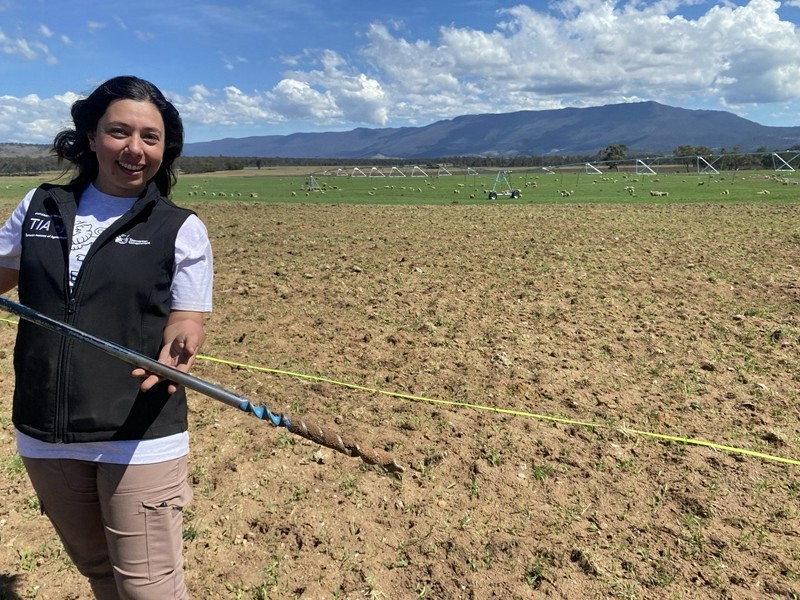
Dr Ana Avila and Dr John McPhee (TIA adjunct and consultant) are working on the Growing Value from Irrigation project funded by the Tasmanian Government’s Agricultural Innovation Fund. They have collaborated with Richard Burbury and Reuben Wells (Ag Logic) to design a trial to test whether clay spreading is a viable option in Tasmania.
The TIA team has consulted with experts from the Western Australia Department of Primary Industries and Regional Development and South Australia’s Soil Function Consulting, to determine application rates, spreading and incorporation techniques, and field/research measurements.
Throughout this season, the team will examine soil texture, infiltration, and productivity response to low, medium, and high clay application rates, incorporated to a depth of 20 cm.
“What makes this trial exciting is that we are testing a practical solution using locally available materials. If successful, it could give farmers another way to improve sandy soils and get more value from their irrigation water,” Dr Avila said.
To help spread the clay, Richard reached out to Cressy farmer and contractor Rob Tole, who has recently purchased a new bucket scraper. Working with the TIA team, Rob has used this opportunity to calibrate, and field test the bucket scraper’s suitability for clay spreading.
This project brings together growers, contractors and researchers to develop a farm-based trial looking to tackle a regionally specific challenge with the aim of maximising the benefits of the Northern Midlands Irrigation scheme.
Findings and potential opportunities will be discussed at a workshop and field day scheduled for 2027. To find out when the workshop is announced, subscribe to the TIA newsletter.