


When Judi Adams graduated from the University of Tasmania in 1996 with a Bachelor of Arts, majoring in Sociology and History before completing Honours in Social Research, she could not have predicted the role her education would play in helping her navigate one of life's most challenging experiences.
Nearly 25 years later, she was diagnosed with pancreatic cancer, a moment that changed the course of her life.
"Having a university degree opened opportunities for me and changed the direction of my working life. Studying humanities taught me to think critically, understand complexity and look beyond black-and-white answers. Those skills became incredibly important when I was faced with my diagnosis," Judi said.
A mature-age student, she balanced study with full-time work and still recalls the friendships formed during her years at the University.
"Some very special friendships were formed during my time at university, and those friendships continue today," Judi said.
Her diagnosis came in November 2021 after a series of seemingly unrelated symptoms, including back pain, discomfort when exercising and difficulty sleeping comfortably.
"It wasn't until I suddenly lost my appetite and visited my GP that I realised something was wrong."
After multiple scans and inconclusive tests, surgeons discovered and removed an eight-centimetre tumour from the tail of her pancreas.
"I woke from what was meant to be an exploratory procedure and learned I had undergone major surgery. The tumour had been hiding in plain sight. The ground shifted beneath me. Life as I knew it changed in that moment," Judi said.
Treatment brought significant uncertainty, along with the challenge of understanding a complex and unfamiliar medical world.
"I quickly realised I needed to become health literate and learn how to advocate for myself," Judi said.
Living in Brisbane during the COVID-19 period, Judi was separated from much of her support network in Tasmania. Alongside the physical impact of cancer treatment, she faced profound personal and professional changes before eventually returning home to rebuild her life.
"I slowly started to rebuild a second life. The one you have when you realise your own mortality and decide to make the most of the time you have," Judi said.
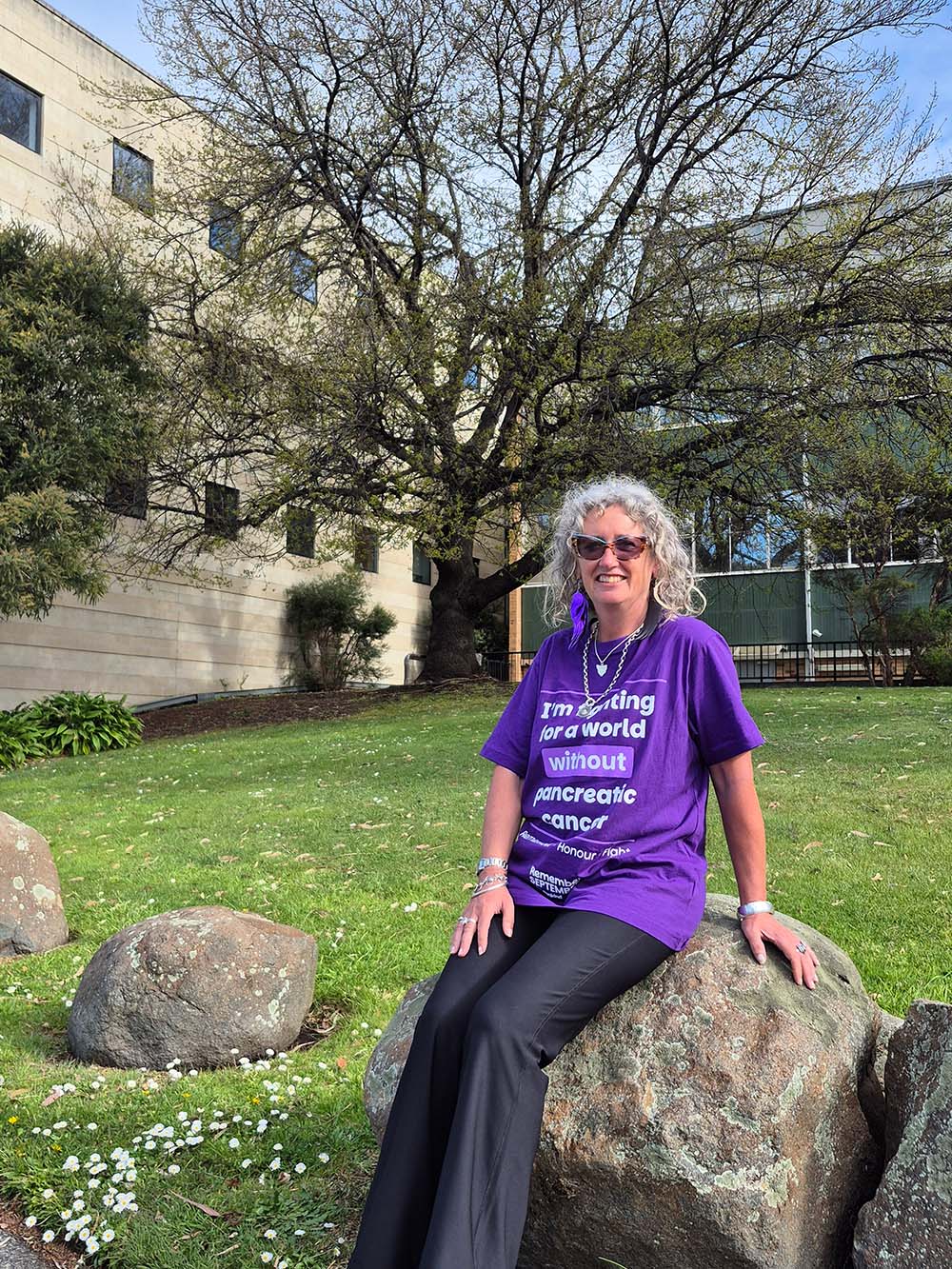
A cancer hiding in plain sight
Support from the pancreatic cancer community became a crucial source of strength with Judi making new friends who provided her hope beyond the statistics.
That experience inspired Judi to turn her attention to advocacy and awareness. As an Ambassador for Pankind, Australia's pancreatic cancer foundation, she works to raise the profile of a disease that is often overlooked despite being one of the nation's deadliest cancers.
"If sharing my journey and raising awareness helps save even one person, it will be worthwhile," Judi said.
Through campaigns that light up universities, landmarks and organisations in purple, Judi helps draw attention to pancreatic cancer and encourage conversations about its signs and symptoms. For her, improving awareness is closely tied to improving outcomes.
Pancreatic cancer remains far less recognised than cancers such as breast cancer, despite its devastating impact. Without an effective early diagnostic test, symptoms can be vague and easily mistaken for other conditions, contributing to late diagnoses and poorer outcomes.
"I owe it to those who need help to raise awareness and try to save lives," Judi said.
Judi's advocacy also extends to research. Through her involvement with Menzies Institute for Medical Research, she brings a lived experience perspective to health and medical research. Her experiences help researchers better understand what matters most to people affected by cancer, complementing clinical expertise and helping ensure the patient perspective remains an important part of research focused on improving health outcomes.
Today, Judi remains deeply engaged in research, education and advocacy. She shares her experiences with medical students, contributes to research projects and advisory groups, serves as an Ambassador for Pankind, and provides a lived-experience perspective across several health and community organisations.
"Living well, helping others, offering hope and supporting research are what matter most to me now."
Her diagnosis has transformed her outlook on life.
"Cancer taught me that many of the things we spend our time worrying about simply aren't important. Quality of life matters. I focus on living in the moment and helping others wherever I can," Judi said.
As World Pancreatic Cancer Day approaches, Judi hopes her story will encourage greater awareness of a disease that is often diagnosed too late. The annual campaign highlights the importance of recognising symptoms, improving early detection and increasing support for research into better treatments.
This November, Judi will mark five years since her diagnosis, a milestone that reinforces her commitment to helping create change.
"Hope is a powerful tool. Every person who survives beyond expectations creates hope for somebody else. The need for better treatments, better diagnostic tools and greater awareness is what keeps me advocating. Research and science hold the answers, and I want people to have hope while we continue pushing for change."
Reflecting on her journey, she returns to a simple philosophy.
"Between birth and death there is a small window called life. How we choose to live that life makes all the difference. I choose to live it with kindness, gratitude and purpose," Judi said.
Find out more about the symptoms of pancreatic cancer at pankind.org.au
You can also get involved with health and medical research through your lived experience.