

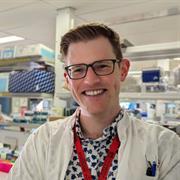


Dr Blackburn is a Senior Research Fellow in Computational Genomics at the University of Tasmania’s Menzies Institute for Medical Research. Genetics, he says, has an important role in the development of MS with around one in five people with MS having a family history of the disease.
Studying the genetics of diseases through families is a focus area at Menzies, particularly as the institute is well placed to trace large, multigenerational family trees given Tasmania’s island population with relatively stable residency patterns. Tasmanians also have the highest rate of MS in the country.
Dr Blackburn grew up in the north and north-west of the State. Following his Bachelor of Science with Honours, Dr Blackburn was awarded his PhD in human genetics from the University of Tasmania in 2015. He then spent five years working in the United States at The University of Texas Rio Grande Valley, first as a postdoctoral fellow and then as a faculty member.
In 2020 he returned to Australia to work at Menzies where he uses his genomics expertise across a wide range of studies at the institute while growing his own research into complex disease. In 2022 Dr Blackburn was awarded a fellowship from MS Australia to investigate rare genetic variation in multiple sclerosis.
“MS varies from person to person, with some having only mild disease that responds well to therapies and others having severe disease that worsens over time,” Dr Blackburn says.
He wants to discover why some families have multiple relatives with MS, which could lead to an understanding of why MS starts in the first place and how we can stop it.
We asked him some questions for our Alumni and Friends readers:
What drew you to research into human genetics?
During my undergraduate degree and PhD at Menzies (UTAS) I became fascinated with the code of DNA – strings of letters that we use to represent the chemical molecules that make up our genomes. The fact that a seemingly simple change to that code could change your risk of developing a disease during your life, or change how your body processes chemicals at the molecular level, amazed me. I’m drawn to understanding the puzzle that is our DNA, and identifying how DNA changes affect our biology.
Have there been some particular highlights of your career in terms of research that is increasing our understanding of diseases such as MS?
Technology advancements underpin so much of my work. Some of the approaches we apply today to study the genome just weren’t routinely feasible five years ago. Genome sequencing (reading the entire DNA code of a person) is one such area. When I started my PhD back in 2011, it cost anywhere between $5,000–$10,000 to sequence the genome of one person. This cost was a challenge for many research groups. Now we regularly sequence genomes, faster and more accurately, for less than $1,000.
My work in MS uses genome sequencing to study families where multiple people have MS. The falling costs of genome sequencing has enabled my work to progress rapidly – identifying new genes to understand better what might lead to MS development in these families. It’s rewarding to see the DNA changes my team has identified in these families progressing into new laboratory experiments with my colleagues to model, test, and understand their effects.
Your career took you to the US before returning to Australia. What brought you back home?
After I completed my PhD at Menzies I moved overseas to Texas for my postdoctoral training for around five years. I relished the opportunities that living outside of Australia gave me to grow as a researcher, and personally as well. Your world view changes the more of it you see, or live through, and I think having these broader perspectives makes me a better scientist. The longer I was away the more I realised that, for me, Tassie, and indeed Menzies, was home. My partner and I (and our cat) moved from Texas to Hobart at the end of 2020 when an opportunity my skills were needed for opened at Menzies.
Our research here at Menzies is deeply connected to, and shaped by, the Tasmanian community. It’s this connection that drives me to continue the research that I do – doing my part for our community. Tassie is growing and changing – and that excites me for the future.
Have there been anecdotes from patients and research supporters that inspire you?
When I talk with research participants involved in my work, as well as people who have lived experience of MS, or the people that support our research at Menzies, the one thing that always strikes me, and inspires me, is their excitement and interest in our work. The genuine passion for supporting research and our mission to make discoveries that improve people’s lives. How lucky am I that the work I get to do every day is part of that?
What else do you do in your life to keep the balance with your research?
I’m a science fiction / fantasy genre buff, whether it be a new novel to read or new worlds to explore in games. I enjoy gardening to get some time outside – this was certainly something that I’ve embraced since returning home.
Most of all I really enjoy travelling within and outside of Tassie. My favourite place is Premaydena, down on the Tasman Peninsula. It really refreshes me to have a trip down there, particularly when I visit my friend’s (and fellow UTAS-alum’s) vineyard and cellar door, Premaydena Hill.
Do you have advice for young researchers (or other alumni) entering the workforce?
Find mentors that inspire and challenge you. I’ve been incredibly lucky to be mentored locally and nationally by amazing Australian scientists in my research area. One-on-one conversations about where you want your career or work to go, with people who are not directly involved in your day-to-day work, provides very insightful perspectives.
Would you like to send a message to the people supporting your research?
We are incredibly indebted to the generosity of the Tasmanian community, and UTAS alumni, for their support for research at Menzies. Be this support through participating in a study or donating financially to support our research.
The research funding environment in Australia is incredibly competitive. Across the country there are many highly important, ground-breaking research studies that are all applying for funding from the same pot of money. Grant funding is essential to support our research, and our teams, with the infrastructure needed to make advancements.
Support from the Tasmanian community can give us the competitive edge to secure large-scale project funding, as well as advancing important experiments and research questions. This support is very valuable to researchers like me to establish our careers and research programs here in Tasmania.
Is there any general advice about lifestyle factors that can be preventative or reduce the severity of the diseases you research?
We know that for many chronic diseases, including MS, part of the risk of developing the disease is due to genetics. While this is not strictly my research area, we also know there are environmental or lifestyle risk factors, many of which are ‘modifiable’ (we can do something about them). For example, being overweight, being a smoker, not getting enough sleep, chronic stress, are all risk factors for a range of diseases. If we can each reduce our modifiable risk factors we can prevent or reduce the chance that we will develop a chronic disease. Even for diseases that are caused entirely by genetic factors, improving our health overall can reduce the severity of the disease.
…………………
Banner image: Dr Nicholas Blackburn
Connect with our alumni community to discover more.