


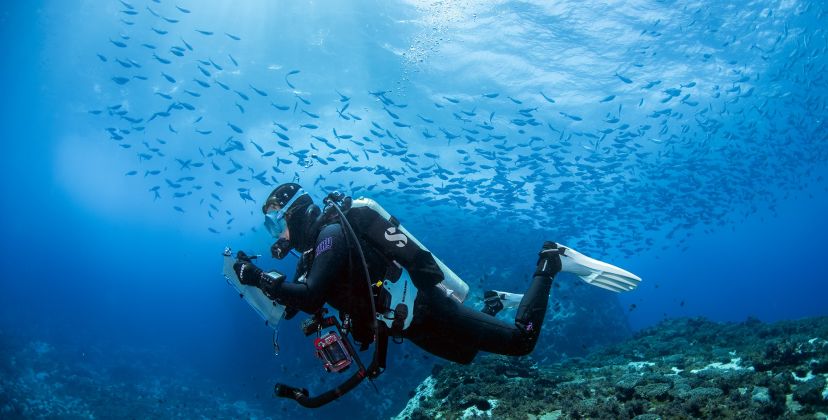

A rapid climate-driven population explosion of the long-spined sea urchin has happened in recent decades along southeastern Australia, where they are overgrazing kelp forests and leaving behind desolate stretches of reef known as ‘urchin barrens’.
While these urchins pose a major threat to marine ecosystems, the predators that keep them in check and the specific factors influencing those predator-prey relationships are an important and ongoing area of research.

A new study led by University of New South Wales PhD candidate Jessica Nguyen and her supervisor Professor Adriana Verges, in collaboration with Associate Professor Scott Ling and Dr John Keane from the University of Tasmania’s Institute for Marine and Antarctic Studies (IMAS), reveal a range of predatory fishes capable of feeding on the long-spined sea urchin within its native range near Sydney.
The research team identified five predatory fishes from seven sites in the Sydney region, using urchin tethering assays with remote underwater videos to identify predators across a range of different sized urchins.
“Big eastern blue groper was responsible for 75% of all observed predation events. The other four smaller predatory fishes – crimson banded wrasse, six-spined leatherjacket, yellowfin bream and southern Māori wrasse – accounted for the remainder 25%,” Ms Nguyen said.
“Groper larger than 600mm in length was the only predator observed to be capable of consuming sea urchins across the full-size range we studied, from 16 to 110mm in diameter. The other fish only targeted smaller size-classes of urchins. But when there’s a greater variety of predators present, smaller urchins in particular are hunted more quickly.”
Associate Professor Ling said fish predatory behaviour also varied with urchin size. “Larger urchins are harder to eat, so they tend to be attacked less often,” he said.
“We also found smaller urchins were more often attacked from the top, whereas predators had to flip over larger urchins and target the less protected underside around the urchin’s mouth.”
The findings reveal size and diversity of predator species are crucial in determining how much predation pressure is placed on the long-spined sea urchin.
“On Tasmanian reefs where eastern blue groper is rare but fully protected, the exact same predation experiments reveal big southern rock lobsters to be the most important urchin predator,” Associate Professor Ling said.
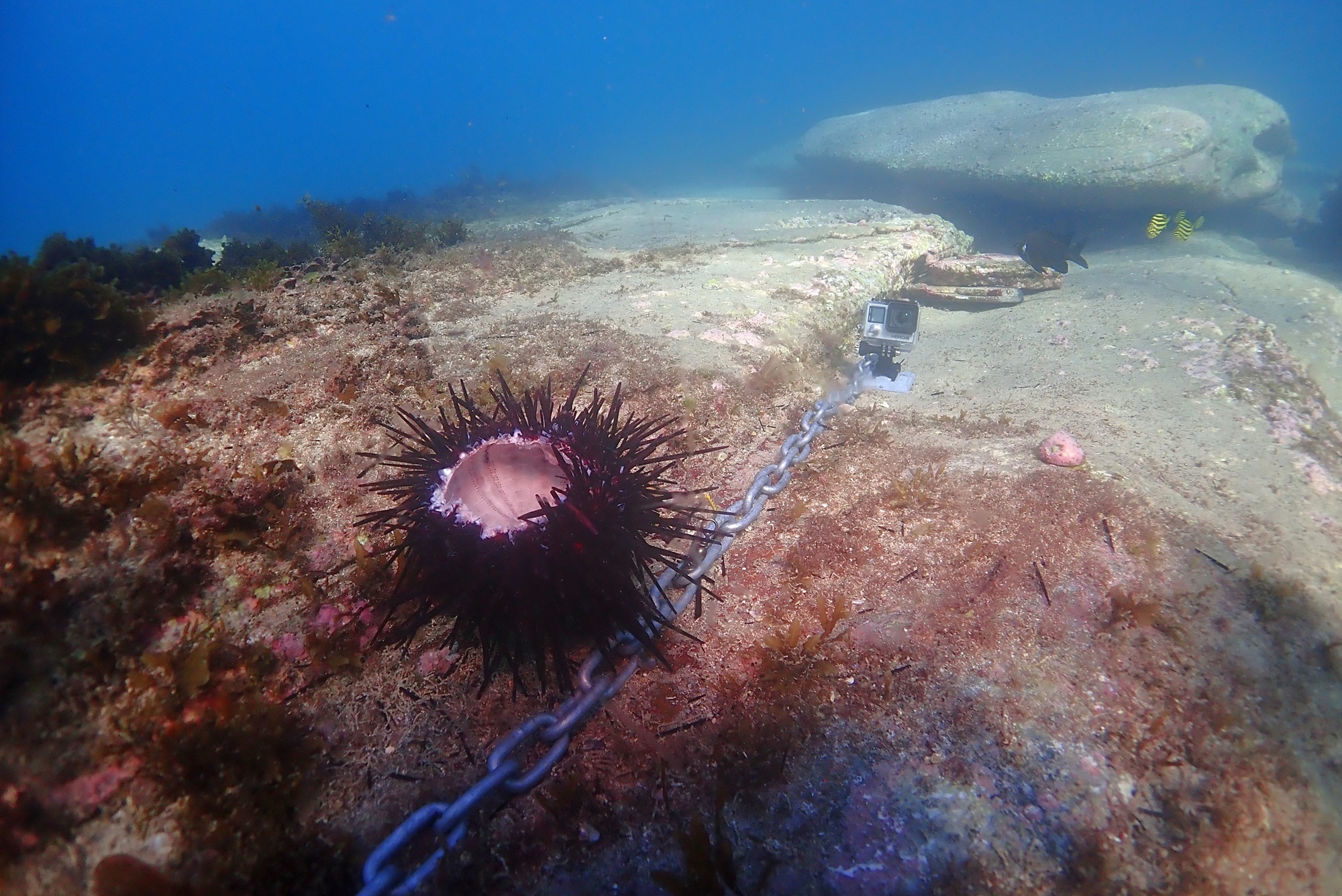
In these Tasmanian experiments, the large bluethroat wrasse, a smaller cousin of the blue groper, were also observed to very occasionally consume small, long-spined urchins.
Of the four smaller fishes observed to prey on long-spined urchins around Sydney, the six-spined leatherjacket is common in Tasmania, the southern Māori wrasse is uncommon, the crimson banded wrasse is rare and found in the Bass Strait Islands, and the yellowfin bream is absent altogether.
“Protecting and rebuilding all urchin predators, particularly the larger more powerful and longer-lived species, isn’t just good for exerting control on urchin populations, it cascades to increase resilience of the whole reef ecosystem,” said Associate Professor Ling.
Cover image: An eastern blue groper (Achoerodus viridis) preys on a large Longspined sea urchin (Centrostephanus rodgersii) on a reef near Sydney. Credit: Jessica Nguyen.