

Congratulations to alumna and quantum physicist Dr Sol Jacobsen (PhD 2010) who has been jointly awarded the Australian Institute of Physics’ (AIP) federal medal for Women in Physics Lecturer 2025 for her significant contribution to physics.
As part of the award, Sol will embark on the AIP Marie Curie lecture tour of Australia in July and August. Entitled “Your Quantum Future”, Sol’s lecture will discuss how less well-known properties of electrons, such as their spin, are advancing a new technological revolution.
Quantum physics – theories which explain how the smallest particles behave and interact – was established as a science a century ago, but has now become a part of our every day.
Electrons’ charge underpins much of modern technology, powering almost every aspect of daily life, from toasters to cars and phones. Harnessing spin is now changing the way we build devices, from sensors to computers, and new state-of-the-art innovations are just around the corner.
Sol is a Group Leader at the Norwegian University of Science and Technology (NTNU), where she investigates ways to combine and control quantum properties, such as superconductivity, magnetism and spin, in future technological devices.
She studied physics and philosophy at the University of York, UK, where she was awarded the Goodwin Prize. After receiving her PhD in quantum physics at the University of Tasmania, she worked as a postdoctoral researcher in Germany and Norway, before establishing her own research group in 2019. She was selected as an Outstanding Academic Fellow at NTNU, and Emerging Leader in Condensed Matter Physics by the Institute of Physics. In August 2025, she starts her new project – SuperFlex.
Here Sol answers some questions about her journey to date and what she plans to do next:
What are you working on in your role as a group leader at the QuSpin Centre for Quantum Spintronics in Trondheim, Norway?
I am working on understanding the quantum physical mechanisms of how materials interact with each other, and, in particular, how we can combine superconductivity and magnetism. Superconductivity and magnetism are usually competing material states, but once we understand the fundamental physics, combining them can provide new technological opportunities. Applications could range from better sensors, and communication and medical devices, to significantly reduced energy consumption in computing, as well as uses we haven’t foreseen yet.
Congratulations on receiving the Australian Institute of Physics’ federal medal for Women in Physics 2025. What does this award mean to you?
I am incredibly honoured to receive this award from the Australian Institute of Physics. I look forward to the associated Australian Lecture Tour that I will embark on with my co-recipient, Dr Danielle Holmes. It is a great opportunity to spread enthusiasm about quantum physics, especially in this International Year of Quantum Physics. I’ll be delivering lectures for the general public (the Marie Curie Lectures) and visiting schools around Australia. I’ll be starting the tour in Tassie with schools in Launceston, Devonport and Hobart, and a public lecture on 30 July at the Physics Lecture Theatre 1, Sandy Bay Campus, at 6pm .
What advice would you have for students contemplating a career in STEM? What doors has it opened for you?
Be proactive: find information about the diverse opportunities and what those careers are like in practice. Motivation is key to enjoying and succeeding in any job, so invest some time in introspection about what aspects of STEM-in-practice appeal the most to you. For me, academic research is a perfect combination of autonomy, collaboration, creativity and societal contribution.
What does a day in the life of Sol Jacobsen look like?
The content of my days has changed a lot over the years (especially since I’m now a mum to three kids!), but since I’m a theoretical physicist a lot of time is still spent at a desk with pen and paper and my thoughts, or with a computer running simulations. It perhaps doesn’t sound so exciting, but there’s an incredible freedom in being able to decide which questions are interesting, building a strategy to solve them, and pushing your mental capabilities every day. After starting my own research group, I now spend a lot more time supervising master’s students, PhDs and postdocs. Being able to discuss problems together with this group has brought an unexpected new level of enjoyment to my days, and a feeling of collective purpose.
What do you hope your lecture tour will inspire in students?
I hope to give a starting insight into quantum physics, and that my pathway has transferable elements they can relate to as they carve out their own. I hope to motivate some introspection by challenging their perception of themselves and what they can achieve, discussing how people change and develop, and how improvements and breakthroughs are made by ordinary people.
Have you always been interested in STEM? Was there a moment when your interest was sparked?
I don’t think I ever really separated these subjects out; I liked all the subjects I studied at school, and rather I was interested in understanding things I didn’t understand before. I enjoyed honing skills, being creative, and seeing improvements, so I also spent a lot of time on athletics, playing music, and writing stories. I loved all these things. I didn’t have a clear idea of what career I wanted, but quantum mechanics was a big, inaccessible problem that intrigued me. I wanted to learn the tools for understanding it more clearly, and that was only really accessible at university.
The most formative and motivating moment was perhaps being awarded the University of York’s Goodwin Prize at the end of my honours degree in physics and philosophy, which made me feel like I could have something valuable to contribute to the field, and spurred me on to do a PhD.
Is there anything else you would like to add?
Investing in fundamental science is our best chance of finding innovative solutions to some of the world’s biggest challenges. The quantum future is yours if you can keep it! I recently recorded an interview with the Tassie-based “That’s what I call science” podcast, as well as the Clear as Quantum Australian science podcast . They will air in July, and you might like to have a listen, or come along to the lecture tour! I post updates on my website sites.google.com/view/soljacobsen, and you can find me on social media with the handle @SpintronicMum.
Find out more about Dr Sol Jacobsen’s lecture tour across Australia. For Hobart-based alumni, she will give a public lecture at Physics Lecture Theatre 1, Sandy Bay Campus on 30 July at 6pm. Register your interest.
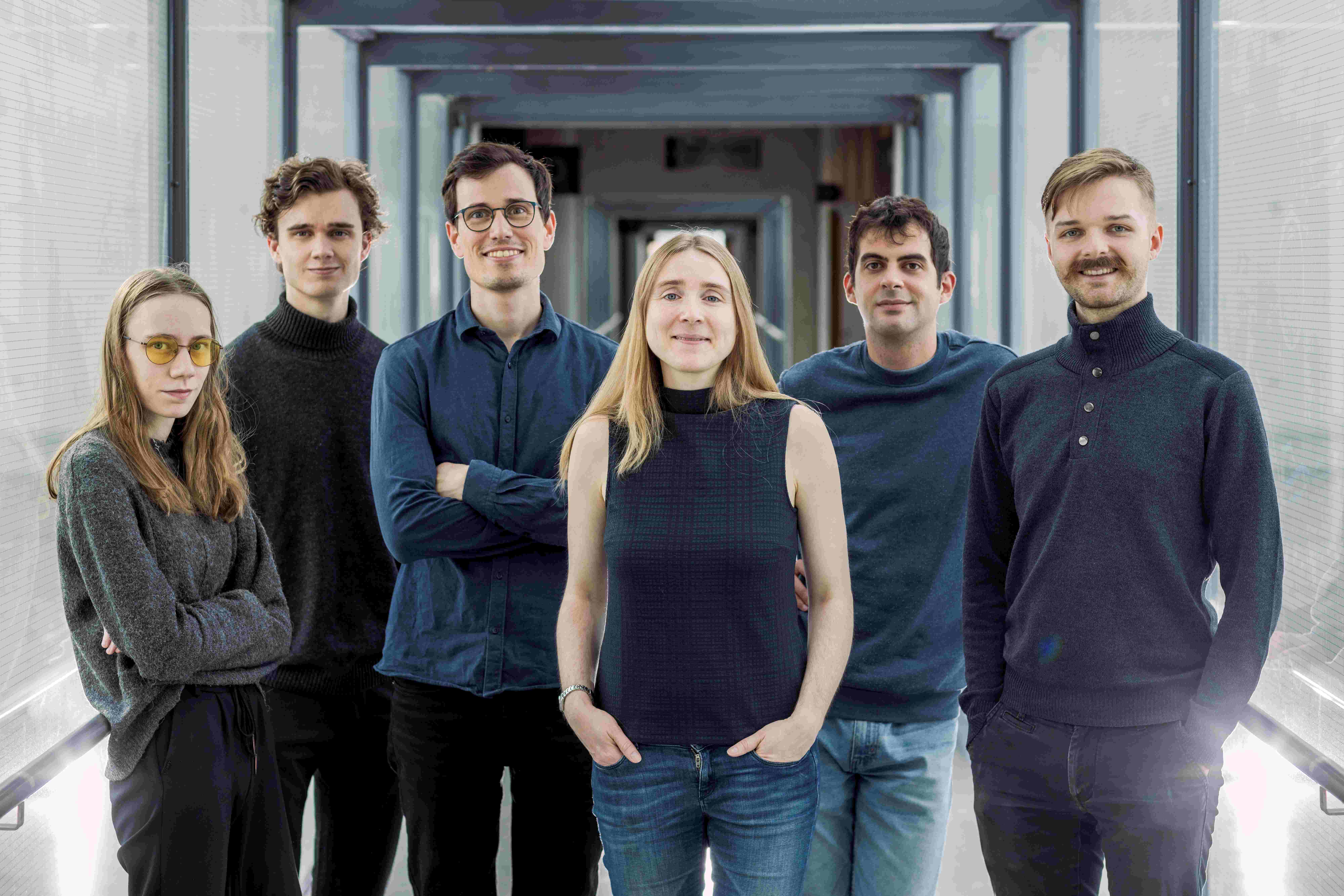
Image Credit: Geir Mogen
This article featured in the monthly eNews Alumni and Friends. If you are a member of the University of Tasmania community and would like to receive this publication, please provide or update your email address.
Image top right: Dr Sol Jacobsen | Image Credit: Geir Mogen