

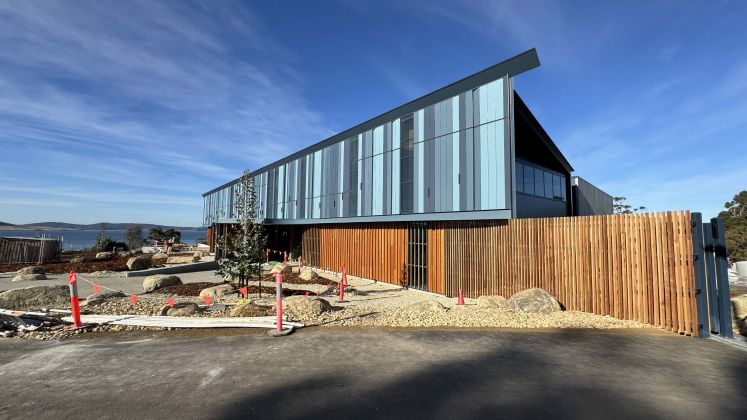


Last year, the University of Tasmania announced our $500M plan to greatly improve facilities for the Science, Technology, Engineering and Mathematics (STEM) disciplines at Sandy Bay. Our future success on what is a much-loved but outdated campus requires a fresh vision for Tasmania’s ambitions as an island of science, engineering and innovation.
While we do much world-class research and our teaching programs are essential to the development of future generations, we struggle against the limitations of the Sandy Bay campus, built for the pre-Internet age and under very different social and economic conditions.
We are deeply committed to advancing our disciplines and nurturing talent. Our STEM work demands connection to schools, business, and government, and to an island-wide network of collaborators and partners. We know that today, sadly, too few young Tasmanians are on a path to scientific and engineering success.
In today’s national academic landscape, the reality is that we need to compete for students, for top-quality staff, and for the precious grant money that sustains our research endeavours. High-quality science and innovation is expensive, but Tasmania simply cannot afford to lose its competitive position in the important fields of geology, biology, engineering, chemistry, physics, maths, geography, conservation, agriculture and more.
Our current teams make an outsized contribution in these fields, and we are proud that we have been the world’s top-ranked University globally for climate action over the past three years. We have a huge responsibility, especially to future generations, to both mitigate and adapt to the increasingly devastating impacts of environmental change.
Investing in STEM facilities is investing in Tasmanians and our collective future. We want to see more Tasmanians studying these vital fields so they can not just fill the high-paying jobs of the future but also create them. Growing STEM is how we lift productivity in our state, ensure we have the ability to deliver major projects like Marinus and support our manufacturing industry. It is through STEM that we can drive real wage growth in Tasmania, help close the income gap and keep young people on the island.

The re-development of the Sandy Bay campus is, therefore, a project of great significance for all of Tasmania, and we have a once-in-a-century opportunity to reshape what has become an outdated campus. We want a coherent, welcoming, lively, accessible, and energising academic and community precinct that speaks to the high ambitions of our staff and students to do world-leading scientific and engineering research right here in Hobart.
We have inherited impressive traditions across our disciplines and seek to build a future where we can connect knowledge and breakthroughs in new ways. Scientific endeavour this century is by necessity collaborative —with teams, universities and, indeed, whole countries grappling with the biggest challenges of our time.

The plans for STEM at Sandy Bay are our investment in the next generations of Tasmanian scientists, engineers and innovators. We already enjoy close links and offer unique capability and expertise to other organisations on the island where many of our graduates work. We have particularly valuable ties with the CSIRO, the Australian Antarctic Division, Hydro Tasmania and the state government’s Department of Natural Resources and Environment, as well as with industry, including across Tasmania’s mining, agriculture and growing technology and energy sectors.
The next generation of Tasmanian scientists, engineers and innovators at Sandy Bay will benefit greatly from collocation with industry and advanced enterprises, allowing critical partnerships to form as we tackle problems and create new opportunities on our island, together. And we are excited that new fit-for-purpose facilities will allow for greater collaboration with schools and education providers to support STEM education at all levels, helping to inspire future generations of scientists and engineers.
Our plan for re-imagining the Sandy Bay campus includes a Tasmanian science and environment interpretation centre, tailor-made to build the enthusiasm of our young people who we want to get excited about the possibilities of scientific exploration right here in Hobart.
For example, because it’s hidden away in shabby, uninspiring spaces, not many people know that our university already has a super-computing facility. In that cutting-edge area, we obviously want to make the most of the advances in artificial intelligence while also giving the Tasmanian community a chance to see what we do up close.
Our plan has plenty of space for all our essential facilities – bespoke laboratories, state-of-the-art teaching space, glasshouses, data centres, specialised research centres, high-end analytical facilities, workshops, innovation hubs, and more. This plan for STEM at Sandy Bay is, quite simply, a one-off opportunity to design what we will need for the 2030s and the decades beyond.
With strong support from our local, state and federal governments, the Sandy Bay campus can be fully re-imagined as Tasmania’s home of science and innovation. Our plan is for a large-scale, multi-year development that deserves full community backing.
Without any major new investment, we will, of course, continue to train the next generation and make the very best of what we already have. But our aged and lacklustre facilities limit our ability to do even better, and we run the risk of our young people missing out on the chance to get inspired and get involved.
The facts are that without significant uplift and investment, Tasmanians in our fields will struggle to stay competitive, nationally and globally. Our job is to provide the pathways for Tasmania’s future scientists, engineers and innovators to make the most of our special place in the world. Building a 21st-century STEM precinct at Sandy Bay is integral to that task.
Professor Julianne O’Reilly-Wapstra and Professor Tim Finnigan are the Heads of the Schools of Natural Sciences and Engineering respectively at the University of Tasmania.
This opinion piece first appeared in The Mercury newspaper on Friday, 2 May 2025.