


What if your design skills could help solve Tasmania’s sea urchin crisis, improve literacy rates, or create artificial reefs that regenerate kelp forests?
The redesigned Bachelor of Design prepares you for exactly these kinds of challenges.
Being a designer means having to be deeply attuned to human needs and experiences. So, it is fitting that our Bachelor of Design has, itself, been redesigned to better reflect the changing needs of this creative industry.
While people generally associate this field with careers in graphic design and product design, it is now increasingly concerned with solving different kinds of problems.

Designers are increasingly finding careers as sustainability consultants within corporations, community engagement specialists in government agencies, and innovation coordinators in healthcare organisations, not just in traditional design studios.
Course Co-ordinator and Lecturer Dr Vanessa Ward said it was time to adapt the degree to focus more closely on future and emerging careers in regenerative innovation and sustainable design.
“Where design is going as a discipline, is far more systems-focused and far more strategic,” she said.
“The previous program focused on traditional design domains – visual communication, product design, digital media. Whilst these skills remain important, the job market has evolved.
“Today’s designers need to understand systems thinking, collaborate with communities, and work across disciplines. We’re not abandoning traditional design skills; we’re expanding what designers can do with them.”
The redesigned Bachelor of Design, starting in 2026, has a stronger focus on the theme of regeneration, circularity, and using design principles and skills to solve a broader range of societal and environmental problems.
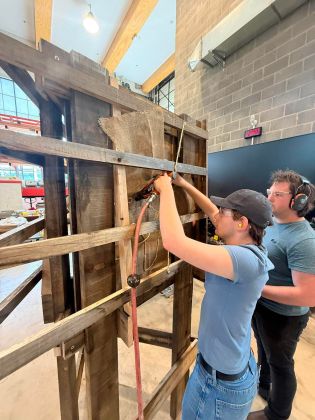
Students will work on real-world challenges and projects such as climate adaptation, waste reduction, designing experiences that improve wellbeing, and developing new materials from local resources.
Tasmania’s struggles with sea urchins – an invasive species – is one example.
“We can harvest them but less than 20% of a sea urchin is a marketable product, which gets shipped across to Japan and China,” Vanessa said. “The rest is waste.”
“There’s five tons of sea urchin waste every week. What are we doing with that? That is a resource which we could do something with.
“So, we're asking, what can design do with this? Is it a material replacement for something, a product replacement?”
A cross-disciplinary approach is actively fostered in the design degree, with students encouraged to include majors from other fields, like marine biology, engineering or sustainability.
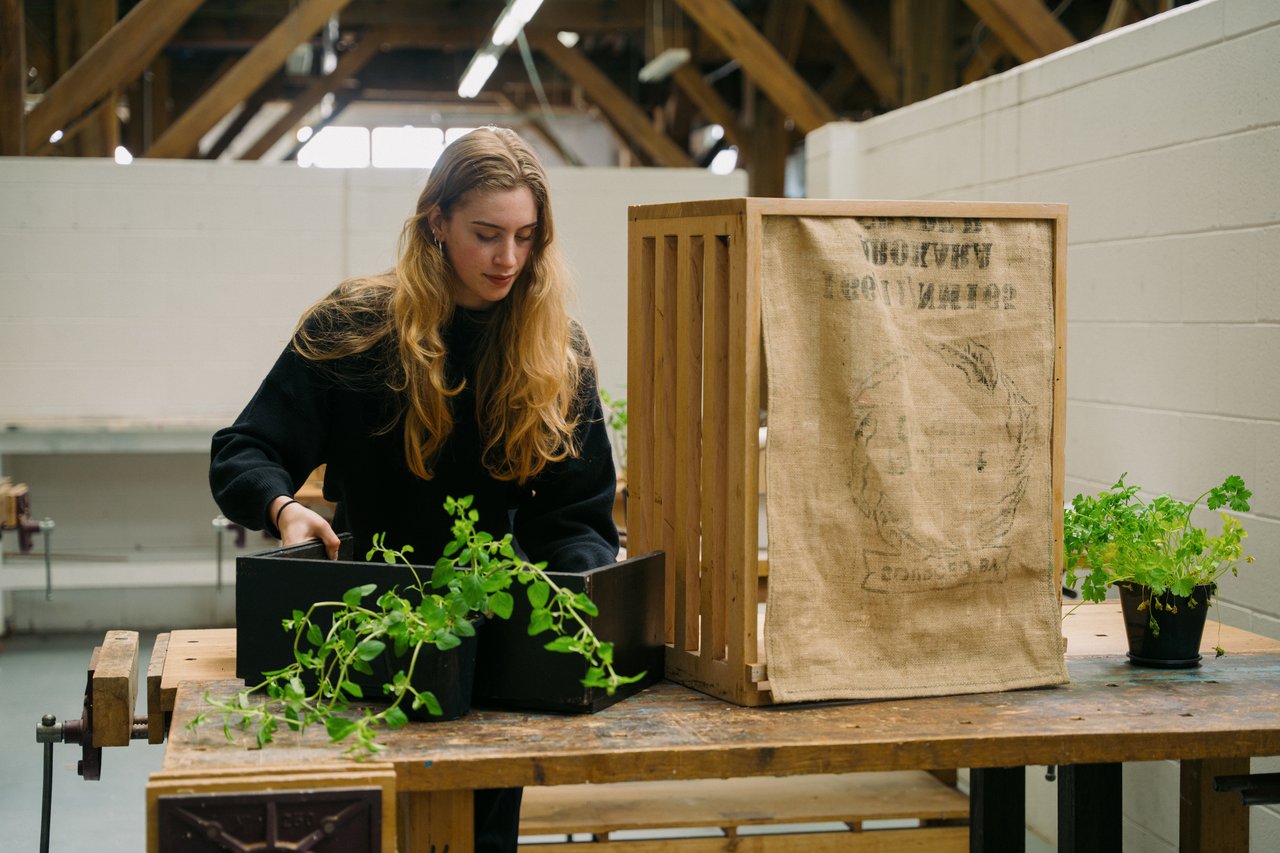
And those studying other degrees are also encouraged to incorporate a design major into their degree, equipping them with that design-driven, problem-solving perspective.
Vanessa cited the example of a design student who was doing a major in marine biology and started pondering the issue of Tasmania’s declining kelp forests.
“She started asking the question: can we create or design artificial reefs that can protect the kelp and help it grow?
“She started working with crushed up oyster shells and we've continued that work with the sea urchin waste project, looking at taking crushed-up sea urchins and 3D printing with them to create substrates that can become houses for giant kelp to grow on.
“So, the sea urchins which feed on the kelp then become the material that helps grow the new kelp. It’s pure regeneration, pure circularity.”
As generative AI increasingly handles routine design tasks, the new design course focuses on the uniquely human capabilities that technology cannot replicate: understanding community needs, collaborating with diverse stakeholders, and designing for complex social and environmental systems.
And, according to Vanessa, Tasmania has some innate advantages for students looking to collaborate with real businesses and organisations as part of their studies.
“In Tasmania there's two degrees of separation between everyone. So, if we want to work with anyone, or we want to do a project which is deeply connected to a particular place, Tasmania’s small scale means we can connect directly with organisations, communities and experts.
“We can work on live projects in real contexts. That's incredibly beneficial, and that's a strength which we'd like to draw on.”
Bachelor of Design
Learn more about the Bachelor of Design and the ways you can use your creativity to help solve some of society's most pressing challenges.
Learn more