

A team of University of Tasmania design students has won an international prize at New York’s Museum of Modern Art for a project responding to the decline of Tasmania’s kelp forests.
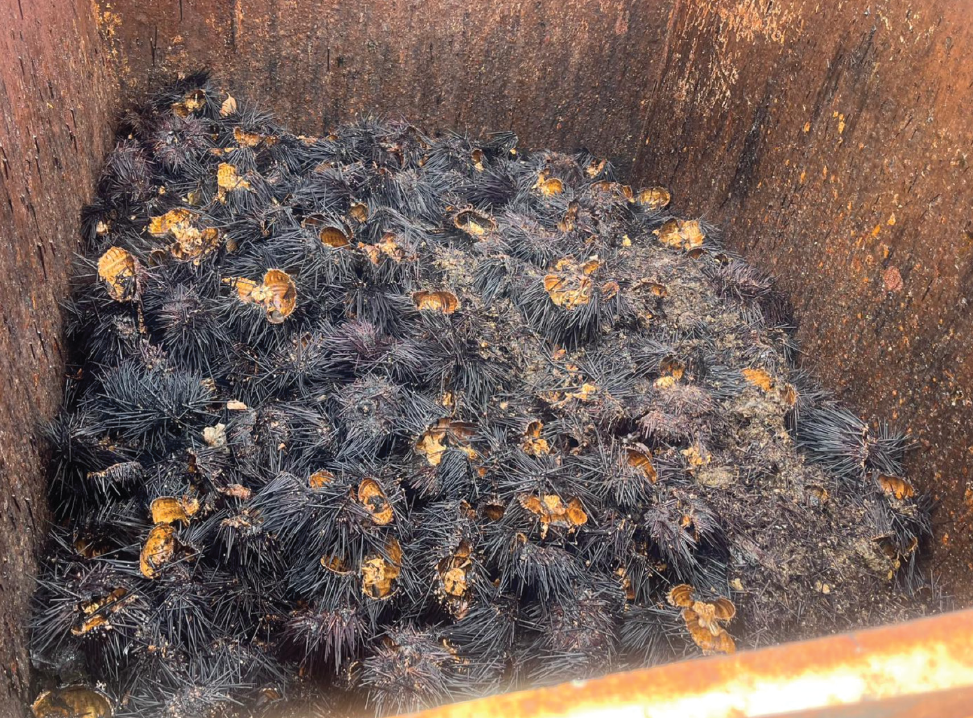
Their project, Upsurge, proposes turning invasive sea urchin shell waste into a material that could help young kelp survive.
The team won the Outstanding Digital Submission prize, supported by New York based digital creative agency Terra, at the 2026 Biodesign Challenge Summit. It was the University’s first year entering the global competition, now in its tenth year.
The competition drew 58 institutions from more than 20 countries.
Developed by Bachelor of Design students Emily Brown, Alice Wilkinson, Fay Harjanto and Jasmine Fast, Upsurge centres on bioconcrete frames called UrchCrete.
The frames would be seeded with kelp spores and placed in Tasmanian waters, giving kelp a better chance of surviving its most vulnerable early stage.
The concept responds to decades of change along Tasmania’s east coast, where warming oceans and expanding urchin populations have stripped once-thriving kelp beds down to bare rock.
Known as urchin barrens, these bare reefs mark the loss of kelp forests that once sheltered hundreds of species, stored carbon and helped buffer coastlines.
Finalists presented over two days at Parsons School of Design and the Museum of Modern Art, where Upsurge was named the winning digital submission.
For team member Emily Brown, seeing a Tasmanian project recognised in New York made the moment feel surreal.
“Watching our project play in New York from Tasmania felt a bit surreal,” she said.
“I feel even more eager to continue exploring biodesign within my broader regenerative design studies.”
Nikhil Kumar, co-founder of 5x5 Collective and a board member of the Biodesign Challenge, presented the award at the Summit.
He said the project stood out because it was “deeply shaped by Tasmania itself” and offered a genuine biodesign response to kelp forest regeneration.
“This is what BDC is all about,” he said.
Judges described the project as well researched and praised its potential; while noting it would need to be tested in real sea conditions to confirm whether the structures could support kelp restoration at scale.
Upsurge remains a concept, not an active restoration program, and the students have been clear about that from the start.
Ms Brown said learning to work with uncertainty became one of the project’s most valuable lessons.
“Many, if not most, elements of Upsurge remain speculative,” she said.
“But we gained knowledge and experience around biodesign, systems thinking, kelp restoration, and collaboration, demonstrating that we can have a design outcome without all the answers. The deepest learning was that innovation requires comfort with uncertainty.”
Sophia Holmes, Lecturer in Design at the University of Tasmania, said the result reflected the ambition behind the Bachelor of Design.
“The Bachelor of Design is founded on the idea that designing from this place, with its materials, its communities, and its ecological challenges, is not a limitation,” she said.
“Upsurge proves that. Our students turned invasive sea urchin waste into an internationally recognised design response to one of Tasmania’s most pressing environmental problems.”
It is the second year in a row that a University of Tasmania student team has won a major biodesign award for work centred on sea urchin shell waste.
In 2025, the team behind ReURCHIN won the Outstanding Science Prize at the Biodesign Sprint: Ocean Futures for a project that turned discarded shells into biodegradable reef structures to support kelp regrowth.
Both projects start from the same persistent Tasmanian question: could the species contributing to the decline of kelp forests also help restore them?