


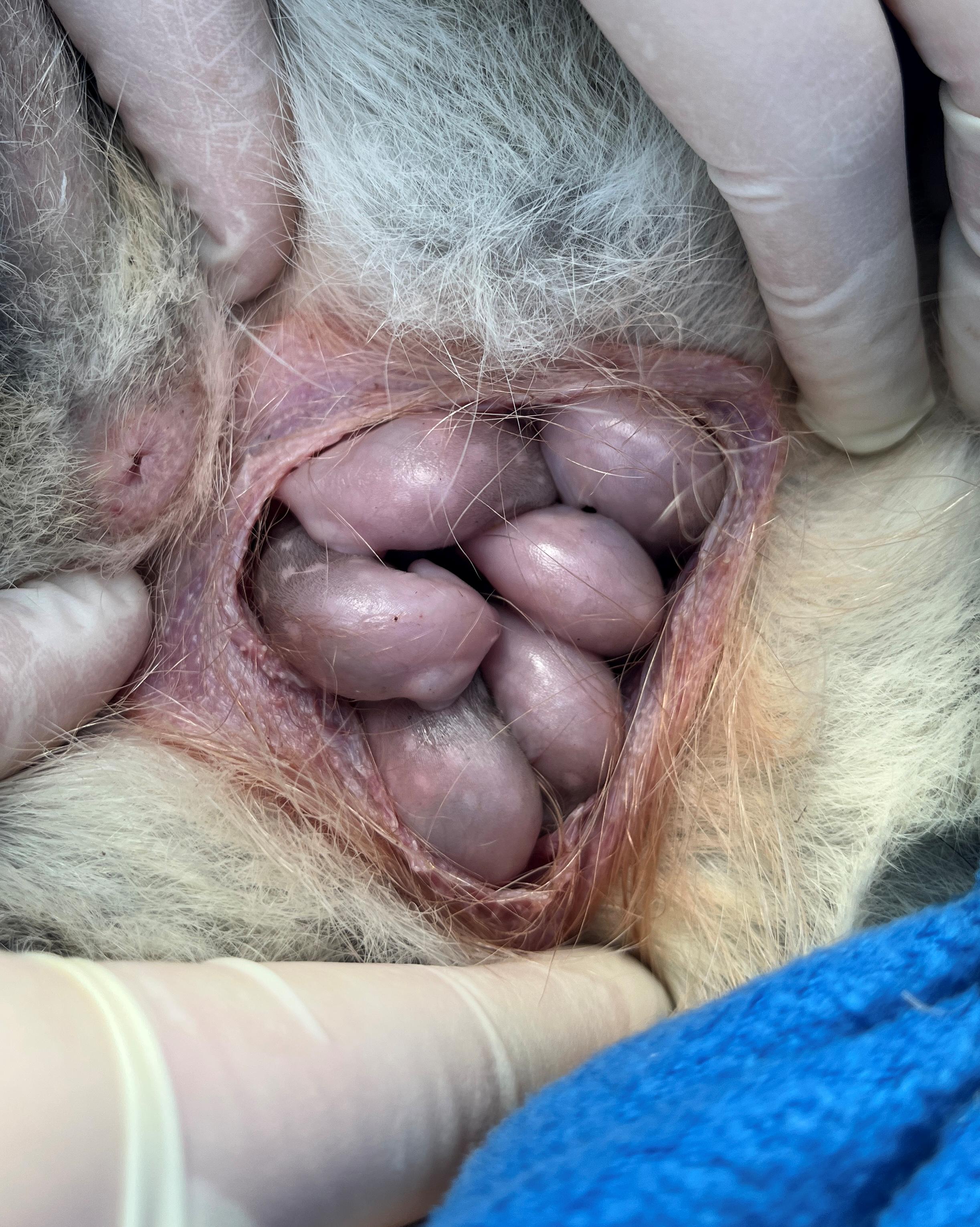
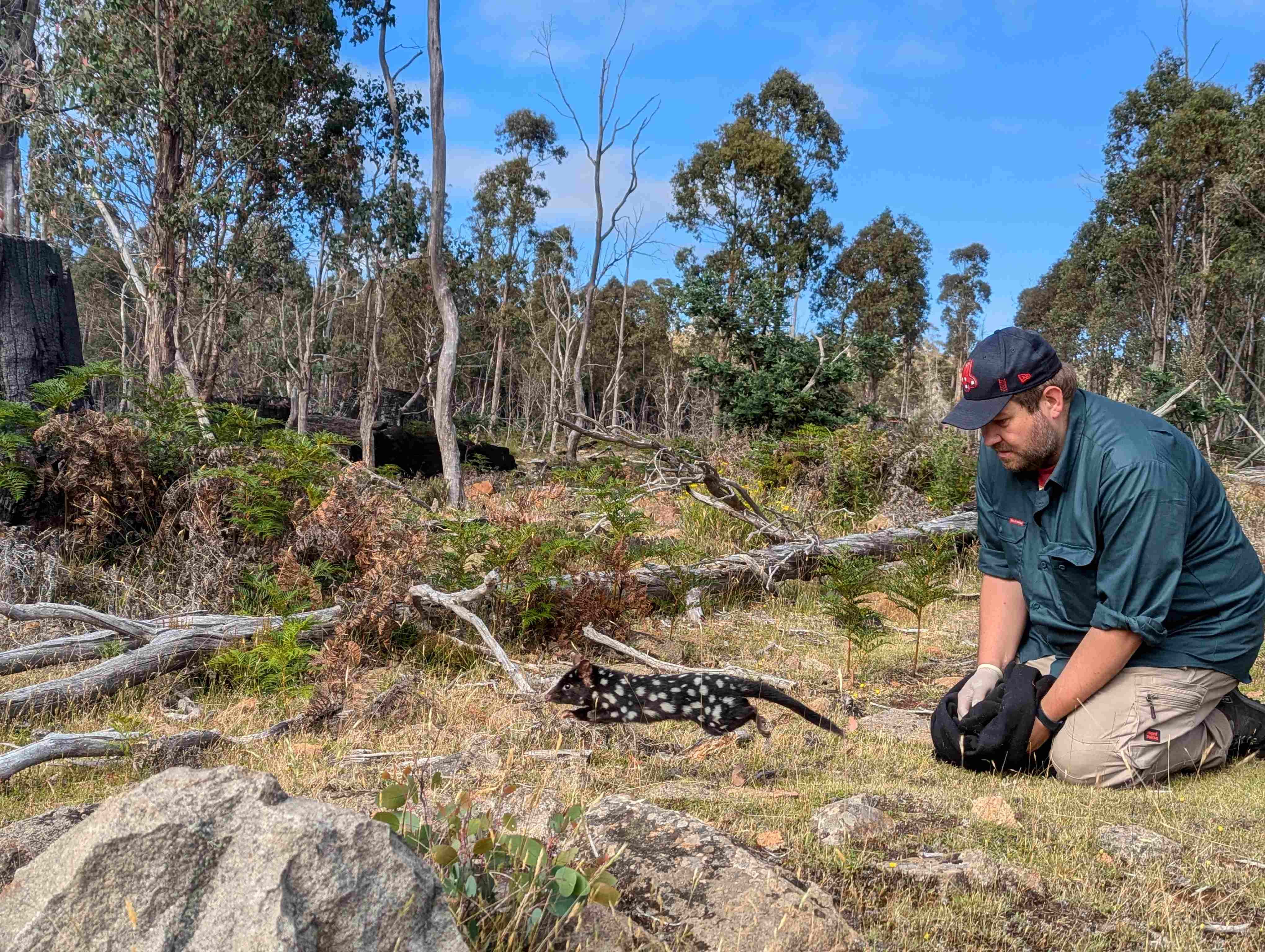
At The Quoin in the Tasmanian Midlands, a winter morning brings a flurry of activity. Motion-sensing cameras click as eastern quolls move through long grass and peppermint woodland. Among them are several recently released females, and for the first time this year, they carry a remarkable sign of success: pouch young.
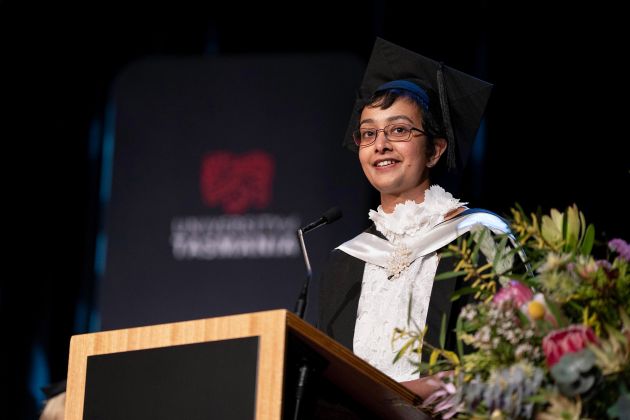
Dr Rowena Hamer (PhD 2019), Research Associate in Ecology at the University of Tasmania, and conservation ecologist Dr David Hamilton (PhD 2020) from the Tasmanian Land Conservancy are leading a long-term project that has achieved a milestone many thought years away.
“Several of the females we released earlier this year are carrying joeys, including three with six healthy young,” David said. “Seeing them thriving in the wild is hugely encouraging.”
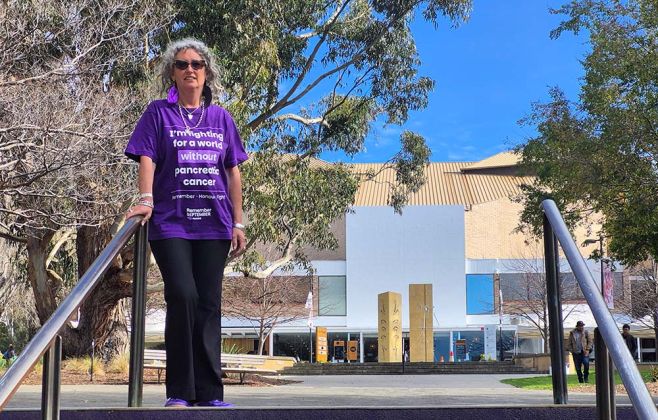
The five-year project, backed by $2.7 million in funding from the Australian Research Council Linkage program, the National Environmental Science Program, partner organisations and the Holsworth Wildlife Research Endowment, combines large-scale monitoring with experimental management. Cameras across 14 sites, 30 at each location, generate millions of images that reveal quoll presence alongside environmental factors such as climate, vegetation structure, prey availability and feral cat activity. Sorting this data has been a massive team effort, with staff, students and volunteers all contributing. Rowena’s mother has personally tagged more than two million images.
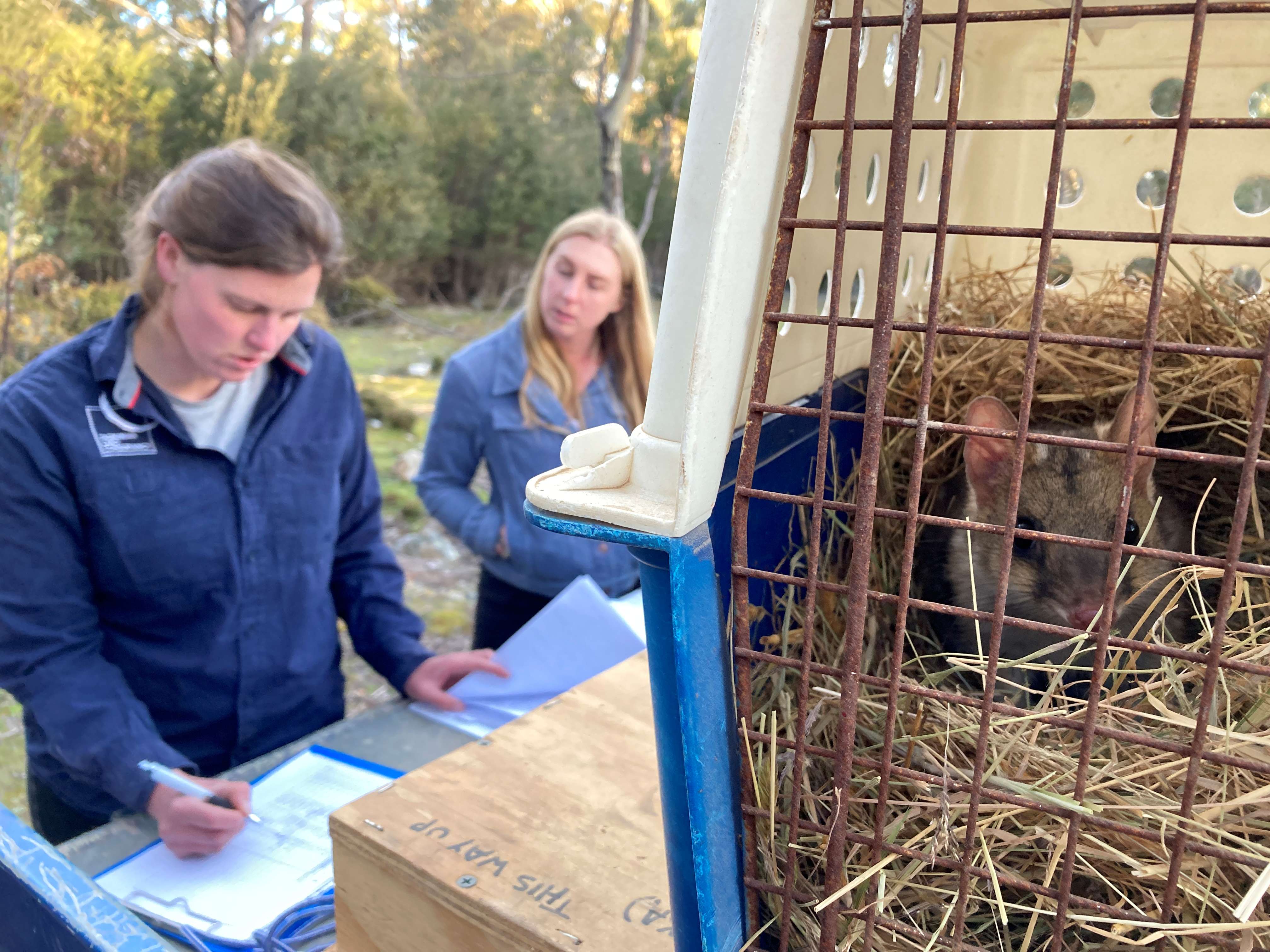
Earlier this year, 24 captive-bred quolls were released at The Quoin, a 5,000-hectare property near Ross managed by Wedgetail.
“Releasing them was exciting and nerve-wracking,” Rowena said.
“We had to be confident in the habitat, prey availability and predator management. The results so far show that our approach is working.”
Professor Menna Jones (PhD 1996), the project’s Chief Investigator, mentor and a leading authority on Tasmanian marsupials, sees the project as a model for applied conservation. “We now have evidence that these interventions can work,” she said.
“Seeing breeding success in multiple females is a milestone that gives us real cause for optimism.”
David agrees, highlighting the collaborative nature of the work. “By bringing together the University, the Tasmanian Land Conservancy, WWF-Australia, The Quoin and the Tasmanian Quoll Conservation Program, we are able to create functional landscapes where quolls can survive, breed and play their role in the ecosystem.”
Up to six translocations are planned over the life of the project, with the next scheduled for summer on the East Coast and in the Midlands. Each release will test different conditions, including how eastern quolls interact with various competitors, what habitats best support breeding, and the level of predation pressure they can tolerate.
These mid-sized marsupials are vital to ecosystem health, keeping rodent and insect populations in check. The current results demonstrate that, with careful planning, their populations can recover and – hopefully – one day thrive.
David reflects on the significance of the project. “Eastern quolls are incredibly charismatic,” he said.
"Seeing them settling into a life in the wild reminds us why this work matters. The hope is that by acting now, we can ensure they remain part of Tasmania’s landscapes for generations to come. " Dr David Hamilton
The project’s success highlights the power of collaboration, with the University of Tasmania, Tasmanian Land Conservancy, WWF-Australia, The Quoin and the Tasmanian Quoll Conservation Program, which includes Bonorong, Devils@Cradle, East Coast Natureworld and Trowunna Wildlife Sanctuary, all contributing to the positive outcomes.
Written by Cassie Harrex for Alumni Magazine Issue 56, 2025.
Connect with our alumni community to discover more.
Top right: Eastern quoll | Photo: David Hamilton