


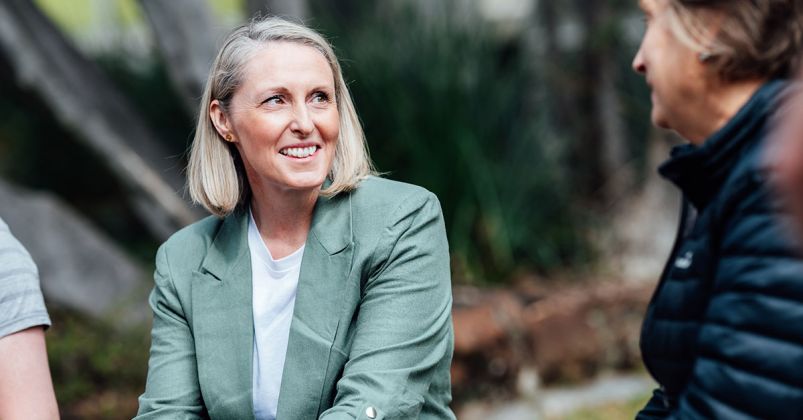
When people think about cancer care, they often picture doctors, chemotherapy chairs, and humming machines. But in Tasmania’s north-west, where distance and isolation can make healthcare delivery more complex, there is another essential person at the centre of it all: the social worker.
Constant calm in challenging times
Evan Kemp, Senior Social Worker at the Northern Cancer Service in Burnie, works with patients on active cancer treatment, with patients who have finished treatment and need extra support, and their families. At a fundamental level, he provides a friendly, accessible point of contact for people who are reeling from the worst news of their lives.
Logistical hurdles and structural inequities place a premium on social workers like Evan who can navigate systems, advocate for patients, and bridge gaps between medical care and everyday life.
Evan supports patients, their partners and their children on both a practical and emotional level within the context of a wider, multidisciplinary team. “There’s no way I could do my job without the support of the other social workers, nurses, doctors, RTs and allied health assistants,” he said.
“So a patient might present to emergency department. They might then get sent off to a scan and the scan has shown a cancer. Either a nurse or a doctor or a cancer care coordinator will refer to social work and say, ‘Evan, can you meet with this person?’”
The regional reliance on locum doctors means continuity of care can be difficult, and patients may not have the same medical team throughout their treatment. Amid that uncertainty, Evan sees the social workers as the most consistent point of contact.
“I see myself as a constant because I’m there full time. If they have a medical question, sometimes they won’t be able to speak to the doctor, so they’ll go through me.”
Preparing graduates for the realities and rewards of regional care
Evan has always had a passion for improving outcomes for others, whether the disadvantaged young people he worked with while studying in Ballarat, or the ageing family members he moved to Tasmania to advocate and care for. “It's been a focus of my working life, to be honest,” he said.
After moving to Launceston, he decided he wanted a career change and enrolled in the Master of Social Work at the University of Tasmania. Halfway through his degree, he was able to put his learning straight into practice, balancing study with a job at the Ashley Youth Detention Centre in Deloraine.
“A lot of the other employees didn't have a social work background,” he said. “I really was encouraged by Ashley to use my talents and the skills I was gaining from uni [like] strength-based theories, that sort of thing.”
He credits the University’s teaching staff with giving him the grounding needed to step into emotionally demanding work. His course coordinators took the time to understand Evan’s strengths and experience working with adolescents and matched him to environments where he could thrive.
“The part of the degree that equipped me the best was going through the assessments and the placements,” he said. “They placed me in roles they thought I’d be best at, which I appreciated.”
Evan gained valuable experience just through observing the different approaches used by his lecturers during placements. He especially appreciated their honesty when discussing the realities of the industry.
“They kept us grounded and were realistic about it; it can be tough. You're going to have some ordinary days. But you'll have some great days as well and you'll have some rewarding moments, and that's why you're doing this course.”
This thoughtful, localised training model is part of how the University of Tasmania is addressing regional health challenges, by preparing graduates who understand Tasmania’s unique pressures and who are more likely to stay and work within the community after graduation.
Making a human connection
No two work days are the same for Evan. On any given day, he may reassure someone navigating treatment alone, find a solution for someone who can’t afford petrol to get home, or help someone trying to explain a terrifying diagnosis to their children.
Despite the intensity of the work, the most powerful moments for Evan are often not clinical at all.
“Some patients, they won't listen to you if you talk about anything that's too clinical,” Evan said. “Coming in and just talking about how his or her [footy] team went on the weekend, just helps alleviate some of their stress.”
He recalls working with a young woman with a terminal cancer diagnosis. “She's from the West Coast, a passionate North Melbourne Football Club supporter. She told me she was going over to round one in Melbourne to see North play, so I just decided to try and contact North, use a few contacts…the CEO's organised for two passes for her to meet the players after the game.”
Then there are the quieter gestures, where a supportive presence can make all the difference to a patient’s treatment experience.
“One patient had to actually go right inside the treatment machine with a mask, but was claustrophobic,” Evan said. He made sure to be present before and after the treatment sessions to reassure and support the patient. The already established connection between them meant that the patient was able to get through the treatment with much less stress.
A profession the north-west can't do without
From oncology to palliative care, mental health to aged care, demand for social workers across the region keeps growing.
“There’s definitely a need for more support roles like mine…palliative, acute, oncology, eating disorders. There’s such a diverse population on the North West Coast with diverse needs.”
For anyone considering a career in social work, Evan recommends getting a sense of the job’s demands from those in the know. “Reach out to social workers currently in the industry. Ask questions of the lecturers because they've got a wealth of experience.”
Evan’s story is not just about one social worker. It is about healthcare in places where continuity is rare, and humanity in systems that can feel overwhelming. It is about what happens when skilled, compassionate people are embedded in regional communities.
Are you looking for a meaningful and impactful career?
Social workers support people to address challenges and improve their overall wellbeing. You could be working one-on-one offering direct counselling, helping families, facilitating rehabilitation groups, supporting community awareness, or advocating for policy changes.
Find out more about our social work courses