



This article was first published in the Spring 2026 edition of AFG.
Tasmanian research is evaluating ACC treatments on thinning efficacy under local conditions, as well as the potential of RIMpro® to support thinning decisions.
Chemical thinning remains one of the most important tools for managing crop load in modern apple production. While Australian growers currently have access to several thinning options, the recent availability of ACC (1-aminocyclopropane-1-carboxylic acid) provides an additional tool for managing fruit set and improving crop load precision. The PIPS 4 Profit program’s Optimising apple production systems (AP22004) project is undertaking trials in Tasmania to assess its suitability and effectiveness for Australian production systems.
ACC is a naturally occurring amino acid and the direct precursor of ethylene, a plant hormone involved in fruit abscission. Following application, ACC is converted to ethylene within plant tissues, promoting the natural shedding of fruitlets and reducing crop load. One of the unique characteristics of ACC is its flexibility within the thinning program. ACC can be applied during flowering as a primary thinner and remains effective later in the season as a secondary thinner. This wider application window provides growers with greater flexibility when weather conditions are not favourable for thinning during traditional application periods.
Increased interest in ACC is currently driven by its potential to simplify thinning programs. Overseas research suggests it may reduce the reliance on multiple bloom thinning applications, such as sequential ammonium thiosulfate (ATS) sprays or 1-naphthaleneacetic acid (NAA)-based thinning programs, while providing growers with greater flexibility in application timing.
ACC has been tested as a chemical thinning agent for apples from petal fall to approximately 30mm fruitlet diameter, with efficacy influenced by application timing, rate and cultivar. Research conducted in the United States, Canada and Germany (see References) has demonstrated that ACC can effectively reduce fruit set and crop load across a range of apple cultivars. However, thinning responses have varied among cultivars, application timing and seasonal conditions. This variability highlights the importance of evaluating optimal use strategies for ACC under Australian growing conditions.
Although ACC is now available to Australian growers, limited information exists on cultivar sensitivity, optimum application timing, rate responses and seasonal performance within local production systems.
Evaluating ACC under Tasmanian conditions
To better understand how ACC performs under Tasmanian growing conditions, a field trial was established during the 2025–26 season at Montague Farms’ Legana Orchard in Tasmania. The trial was conducted in a Buckeye® Gala/M9 orchard and evaluated ACC as both a bloom thinner and a rescue thinning option. The six treatments were:
- untreated control
- ACC 200 ppm applied at 80% bloom
- ACC 300 ppm applied at 80% bloom
- ACC 400 ppm applied at 80% bloom
- ACC 300 ppm applied when king fruitlets reached approximately 18mm in diameter
- ACC 400 ppm applied when king fruitlets reached approximately 18mm in diameter.
First season results
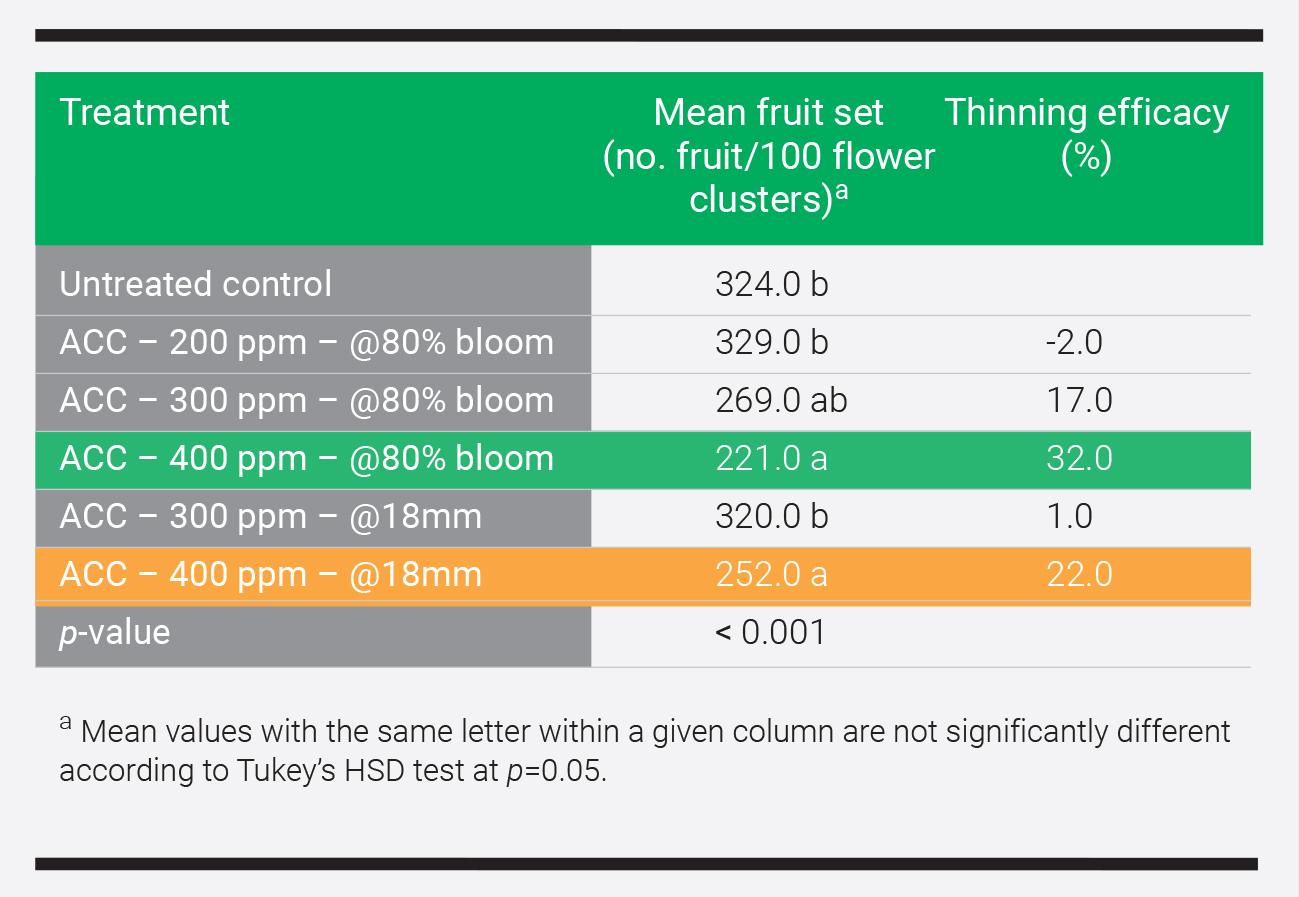
As shown in Table 1, ACC reduced fruit set under Tasmanian growing conditions, although the magnitude of the response depended on both application timing and rate. The strongest thinning response was achieved with ACC applied at 400 ppm during bloom, reducing fruit set from 324 fruit per 100 flower clusters (untreated control) to 221 fruit per 100 flower clusters. This was a thinning efficacy improvement of 32 per cent. The 400 ppm rescue thinning treatment applied at 18mm fruitlet diameter also reduced fruit set to 252 fruit per 100 flower clusters, achieving a thinning efficacy of 22 per cent. Together, these results indicate that ACC remained effective beyond the traditional thinning window, although bloom applications generally produced stronger responses than applications made at 18mm fruit diameter.
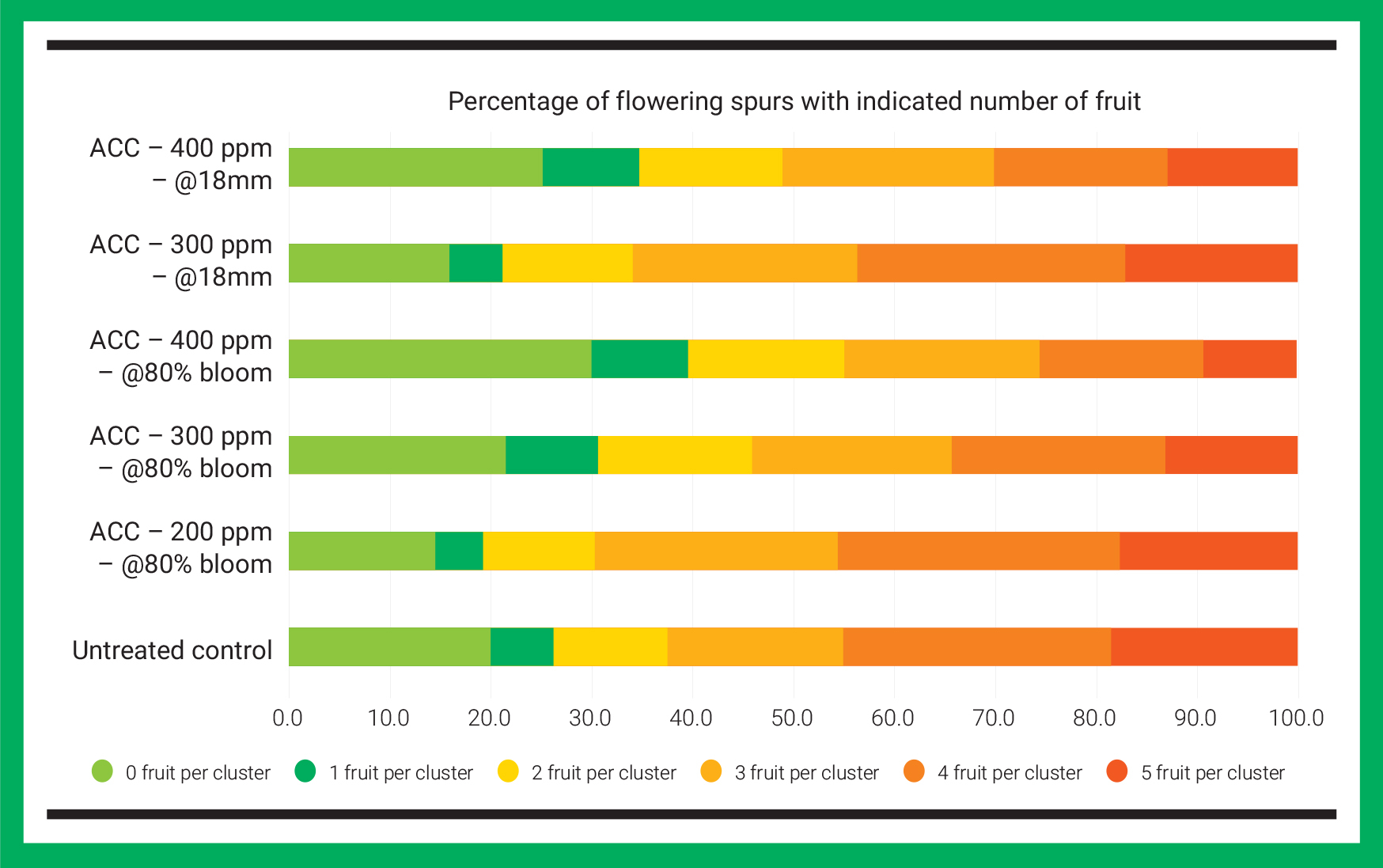
Changes in spur fruit distribution were also observed (Figure 1). The 400 ppm bloom treatment increased the proportion of empty spurs from 20 per cent to 30 per cent. It also reduced the proportion of heavily cropped spurs carrying four to five fruits from 45 per cent to 26 per cent. Similar trends were observed across the other ACC treatments, with reductions in heavily cropped spurs and increases in lightly cropped or empty spurs.
These shifts in spur fruit distribution are important because optimised crop load management relies upon balancing fruit retention across the tree and reducing competition between developing fruit. It is not simply about reducing fruit numbers.
Conclusion
These first season results indicate that ACC can effectively reduce fruit set under Tasmanian conditions and that both application timing and rate influence thinning efficacy. However, additional seasons of research under the PIPS 4 Profit program are required to determine how cultivar, seasonal conditions and environmental factors influence ACC performance before robust recommendations can be developed for Australian growers.
Evaluating RIMpro as a decision-support tool
While the ACC treatments provided valuable information on thinning efficacy under Tasmanian conditions, another objective of the study was to evaluate the potential of RIMpro® to support thinning decisions. RIMpro is a decision-support tool that combines weather data and tree development to help growers identify favourable conditions for chemical thinning. For this study, the RIMpro combined model was used to assess whether it could assist with selecting the appropriate timing and application rate for ACC under Tasmanian conditions.
Bloom application (primary thinner)
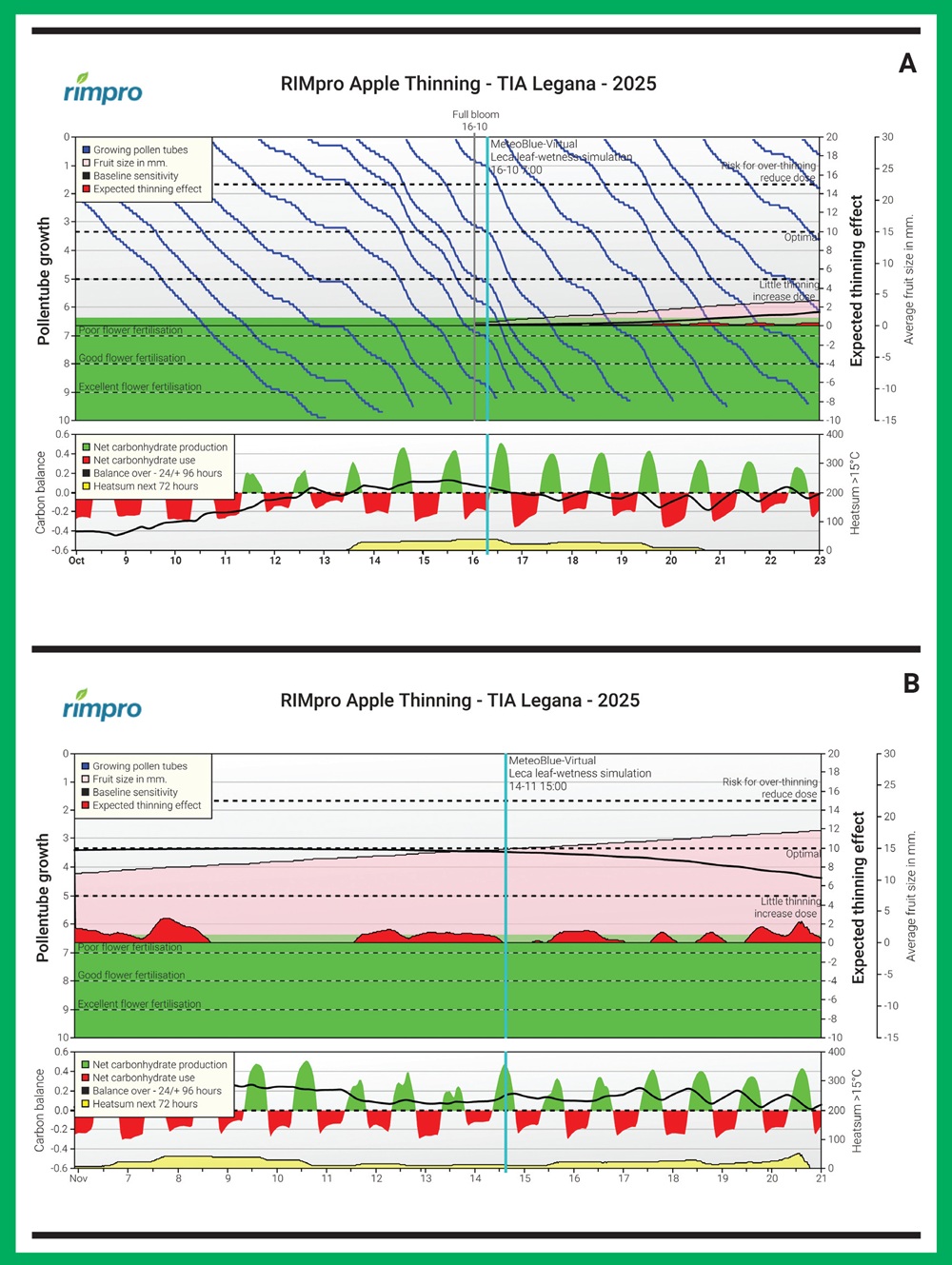
For the bloom treatments, the combined model was used, with particular emphasis on the pollen tube model (Figure 2A). The pollen tube model uses pollen tube growth, simulated from prevailing weather conditions, to estimate flower fertilisation and help identify whether conditions are favourable for blossom thinning. On 16 October 2025, the combined model indicated that flower fertilisation was progressing under favourable conditions and classified as excellent, suggesting that the bloom application was well timed and that a thinning response was likely. The ACC window for the product application was made at approximately 80 per cent bloom, which was also within the recommended application.
Based on the model output, the standard RIMpro ACC rate of 300 ppm was expected to provide an effective thinning response. Consistent with this prediction, ACC applied at 300 ppm during bloom did reduce fruit set by 17 per cent (Table 1) but this reduction was intermediate and was not statistically different from the untreated control. Findings from the thinning trial showed that the strongest thinning response was achieved with ACC applied at 400 ppm during bloom, resulting in a thinning efficacy of 32 per cent which was significantly different from the untreated control.
Post-bloom rescue application
RIMpro was also evaluated for the rescue thinning applications made on 14 November 2025 when king fruitlets reached approximately 18mm in diameter (Figure 2B). For the post-bloom rescue application (secondary thinner), the combined model was again used. At this stage, the model places greater emphasis on tree carbohydrate balance, fruitlet development, heat accumulation and weather conditions to estimate the expected thinning response. Based on these factors, the model classifies conditions as likely to result in little thinning, an optimal thinning response, or a risk of over-thinning. This information helps growers decide whether the standard application rate is appropriate or whether the application rate should be adjusted according to orchard conditions.
On 14 November 2025, when king fruitlets were approximately 18mm in diameter, the combined model indicated conditions favourable for thinning using the standard RIMpro ACC rate of 300 ppm. However, this rate only reduced fruit numbers by 1 per cent whereas a significant thinning efficacy of 22 per cent was achieved at 400 ppm (Table 1).
Practical implications
The comparison between model predictions and field observations highlights the potential value of RIMpro as a tool for identifying favourable thinning windows. In both the bloom and rescue thinning applications, the combined model identified conditions favourable for thinning and measurable reductions in fruit set were subsequently observed. However, the magnitude of the thinning response varied according to application rate and fruitlet developmental stage, indicating differences in ACC thinning efficiency in relation to rate under Tasmanian growing conditions.
RIMpro is a valuable decision-support tool, but it should not replace grower experience. Model outputs should always be interpreted alongside orchard history, cultivar characteristics and seasonal conditions when selecting the most appropriate application timing and application rate. Additional seasons of validation will be undertaken under the PIPS 4 Profit program to determine whether RIMpro can be used not only to identify suitable application periods, but also to help refine ACC rate selection and improve thinning consistency under Australian growing conditions.
Trials give firsthand look at new thinning tools at Legana
Thinning Gala is a perennial challenge for Tasmanian orchard manager Rod Hogan, at Montague Farms’ Legana Orchard in the state’s north. So, hosting the PIPS 4 Profit trial evaluating the ethylene precursor ACC – which recently gained Australian registration – in his 10-year-old Buckeye Gala/M9 block was a welcome opportunity to assess the potential of a new tool firsthand.
“We struggle here in Tasmania from flowering time onwards with lack of heat, with wet and we really struggle to remove anything in the Gala blocks,” Rod said.
The need for multiple applications, time taken to see a response from some products and difficulty finding a window to follow up all add to time and cost.
“We’ve used the blossom burner ATS (ammonium thiosulphate), then gone in with MaxCel® (6-benzyladenine, 6-BA), we’ve used Brevis® (metamitron), NAA (naphthalene acetic acid) and ethephon. We’ve thrown everything at it. Gala is difficult to thin, and we’ve been struggling with it for years.”
Given the good response to bloom applications of ACC in the first season trials at Legana, Rod said it might open an opportunity to get crop load down early with fewer applications and increase fruit size and yield.
“The ACC at 80 per cent bloom looks really promising,” Rod said. “Gala really struggles to size. If we can remove the crop early, it could add two to three weeks of growth to the Gala, or 3–5mm to fruit size.”
The ACC trial will continue for a second year this season.
At Legana Rod said the current season is around 5–6 days late and he is looking at applying his first thinners in early October.
“Crop load management starts at pruning,” Rod said. “That’s when I manage the number of flower buds I leave on the tree based on the crop load I’m aiming for. As the season progresses, I assess fruit set and make thinning decisions to bring the crop closer to my target. By hand thinning, I know how many fruit I want to leave on each tree. For Gala, that’s around 150 apples per tree.”
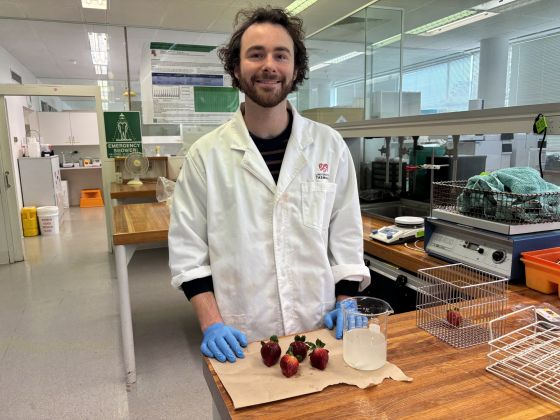
Photo: Jacqui Beven Photography
Further reading
References
“Thinning apples with 1-aminocyclopropane carboxylic acid: Influence of cultivar, rate and timing”, https://doi.org/rjsf
“Effects of the bioregulators ACC, 6-BA, ABA, and NAA as thinning agents on Gala apples”, https://doi.org/rjsg
“1-aminocyclopropane-1-carboxylic acid (ACC) increases ethylene evolution and fruit abscission in developing apple spurs (Malus × domestica Borkh.)”, https://doi.org/rjsj
“Impacts of 1-aminocyclopropane-1-carboxylic acid as a late post-bloom thinner on fruit set, yield, and fruit quality in ‘Gala’ and ‘Fuji’ apples”, https://doi.org/rjsm
“Fruit thinning and flower induction with 1-aminocyclopropane-1-carboxylic acid (ACC Accede)”, https://doi.org/rjsn
“Uses of 1-aminocyclopane-1-carboxylic acid (ACC): Flower and fruit thinning and flower induction”, https://doi.org/rjsp
“Effects of 1-aminocyclopane-1-carboxylic acid on the rate of ethylene release from detached fruiting spurs and on fruit abscission in apple”, https://doi.org/rjsq
“Use of 1-aminocyclopane-1-carboxylic acid and metamitron for delayed thinning of apple fruit”, https://doi.org/rjsr
Acknowledgements
Thank you to Rod and Adam Hogan, Montague Farms, Jack Bartels and Poliana Francescatto, Sumitomo Chemical, and Dr John Cline, University of Guelph, for their valuable contributions to this work. Their knowledge, support and collaboration were important in designing the experiment and bringing it to reality in a commercial orchard.
The PIPS 4 Profit Optimising apple production systems (AP22004) project has been funded by Hort Innovation using the apple and pear research and development levy, contributions from the Australian Government and co-investment from the Tasmanian Institute of Agriculture, Agriculture Victoria, NSW Department of Primary Industries and Regional Development, and Department of Primary Industries and Regional Development WA. Hort Innovation is the grower-owned, not-for-profit research and development corporation for Australian horticulture.