

Andrew Orange completed his Bachelor of Computing with Honours in 2008 and returned to the University of Tasmania in 2026 to start his PhD in Environmental Studies with the School of Geography, Planning, and Spatial Sciences.
Andrew always wanted to return to return to research, in particular if he could contribute to something that benefits communities. Appling his skills in computing and technology to real-world problems. It enabled him to enter the field of environmental studies whilst providing a challenge.
Completing a doctorate fulfilled those ambitions, and with the ability to study part-time, Andrew was able to balance study with work and family commitments.
“Here I am, 18 years after completing my Honours degree, and that gap wasn't a disadvantage. In many ways, my professional experience gave me valuable perspectives and skills that I might not have had otherwise”.
Andrew worked in technology industry prior to starting his PhD and was interested in how digital tools could support environmental and community challenges. Initially Andrew was considering a citizen science approach focused on monitoring fuel loads and bushfire risk, but after coming across the advertised PhD project he realised there could be scope to explore something broader. Which was, how could technology help communities become better prepared for bushfires.
Many people understand the importance of bushfire preparedness, but maintaining that preparedness over time can be challenging. People know what to do, but don’t always do it or do it consistently. That gap between knowing and doing was the focus of his PhD.
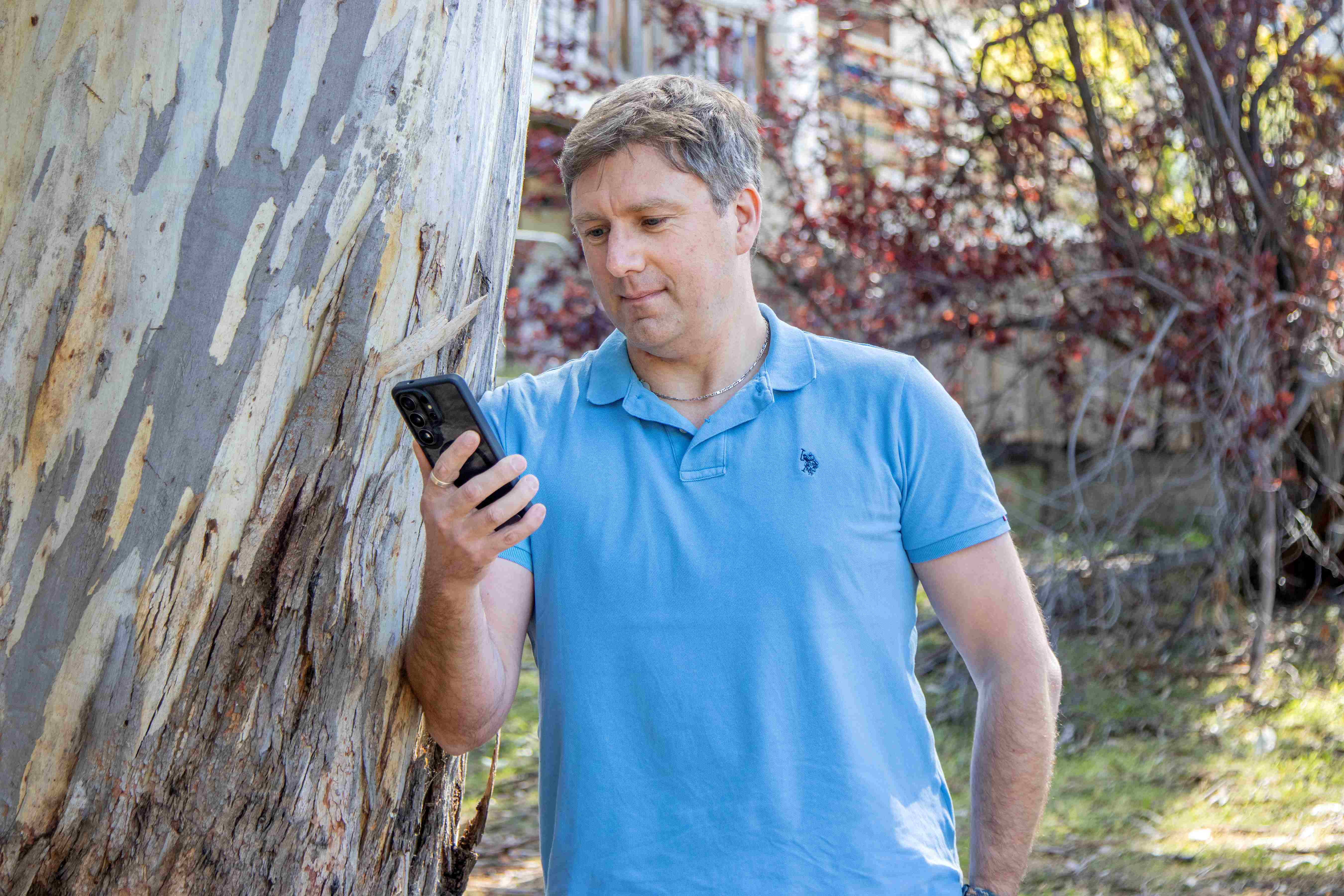
Tapping into his background, Andrew thought about how technology could connect people to take action and support positive behaviour change. This was the guiding belief that shaped the project from the beginning, so rather than simply providing an app with information, the app was designed to keep people engaged ongoing, rather than prompting action when the fire season begins.
For communities, the goal was to help people prepare earlier, stay on top of important preparedness activities, and be more aware of what's happening in their local area.
From a research perspective, it was also an opportunity to learn what works and what doesn't. Drawing on design approaches that have been successful in other contexts and testing whether they can help improve bushfire preparedness.
Andrew had the skills and confidence to design and build the application himself, drawing on both his university education and industry experience. Though the app wasn’t the primary focus of his research, it was the tool that enabled the research.
This meant Andrew could focus on creating a research platform that allowed him to study how people interact with it, what motivates engagement, and what outcomes it might produce. Andrew said having those technical skills was a significant advantage throughout the project.
“I'd absolutely encourage anyone who's curious and passionate about a topic to consider it. One thing I've learned is that there's no perfect time to start a doctorate, and you don't have to follow a traditional academic pathway”.
A PhD is a long journey, but it's also an opportunity to explore a topic deeply, develop new skills, and contribute something meaningful. If you're genuinely interested in the research question, the experience can be incredibly rewarding.
http://www.resilientstreet.com
Read Andrew’s article about how the Resilient Street app works and the university’s media story on the app
Resilient Street is free to download through the Apple App Store and Google Play.
Find out more about our Information, Communication and Technology (ICT) and Geography, Planning, and Spatial Sciences courses.