



This article was published in PototoLink Magazine Issue 22.
A new approach could make it possible to measure the physiological age of seed potatoes in less than a day, potentially giving growers a much faster way to assess how seed is likely to perform.
Physiological age can have a significant influence on seed potato performance, but determining exactly where a seed lot sits on the physiological-age spectrum has been difficult. Existing methods can take weeks to deliver a result.
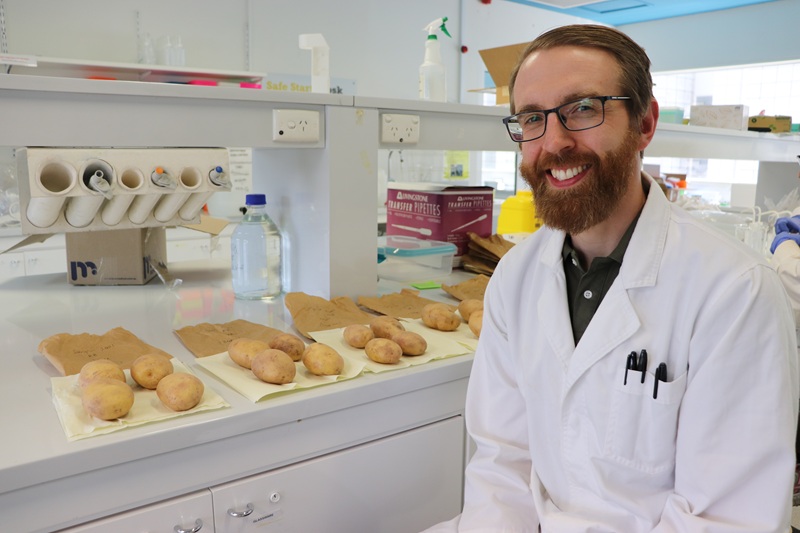
Dr Nathan Tivendale and a team from the Tasmanian Institute of Agriculture (TIA) is working to change that.
Presenting his research at the PotatoLink R&D Forum in Ballarat in July 2026, Dr Tivendale outlined progress towards a new physiological-age assay based on biomarkers that could provide a result in less than a day, at a time when the information can still be useful for production and planting decisions.
A quick back to basics on potato age
While chronological age is measured by the passage of time, physiological age reflects changes occurring within the tuber.
Physiological age progresses throughout the life of a seed tuber, from crop growth through to storage, and can affect crop performance, including yield, canopy development and tuber size distribution. Understanding the physiological status of a seed lot can provide a better indication of how it may perform once planted.
Physiological ageing is influenced by a combination of environmental, internal and agronomic factors.
During crop growth, temperature, rainfall and water availability, light and day length, and the cropping season length can all play a role. Storage conditions are also important. Storage temperature and duration, humidity, oxygen concentration, and light intensity can influence how physiological age progresses.
The characteristics of the tuber itself also matter, including genetic background, dormancy duration and maturity when it enters storage. Planting date, irrigation and fertiliser, crop protection, and harvesting and post-harvest handling can also contribute.
The result is that two seed lots of the same chronological age may not necessarily have the same physiological age – or perform in the same way.
The problem with measuring age
There are currently several approaches for estimating physiological age, including sprouting assays, heat accumulation, and the physiological age index (PAI).
Sprouting assays measure characteristics such as apical dominance and sprout dry weight, but can take several weeks and are influenced by factors including genotype, environment, location and storage history.
Heat accumulation uses storage temperature and time to estimate physiological age, but does not capture all aspects of ageing. For example, it does not account for ageing occurring at or below 4°C, or for differences in temperature responses between storage phases and cultivars.
The PAI compares the time from vine kill to potential planting with the time required for tubers to sprout and develop new tubers under standard conditions. While it has been found to be a useful measure in some research, other studies have found that it does not always reflect the physiological age of seed produced in different environments. It can also take around a month to complete.
For growers, this creates a practical limitation: a physiological-age assessment is most useful when it can inform decisions, rather than arriving after those decisions have already been made.
Searching for biomarkers
This is where Dr Tivendale’s research takes a different approach. Rather than measuring physiological age indirectly through sprouting or accumulated heat, the research team is looking for biomarkers. Biomarkers are measurable biochemical characteristics that change as physiological age progresses.
The concept is already used in human health, where biomarkers can provide an indication of physiological age. For seed potatoes, the challenge is identifying markers that are closely associated with physiological ageing and can eventually be measured quickly and practically.
The research has established three key criteria for a useful seed potato biomarker. It needs to be:
- Abundant
- Sensitive to changes in physiological age
- Readily measurable at farms and storage facilities
The team has screened thousands of potential candidates (G0, Russet Burbank). Of around 6000 initially investigated, 13 have so far passed the project’s strict statistical filtering criteria. These candidates showed changes in accumulation or depletion during storage associated with physiological-age priming.
This represents an important step towards developing a practical physiological-age test.
Towards a result in less than a day
The ultimate goal of the research is a new physiological-age assay that can provide a result in less than one day.
For growers, a faster test would enable well-informed pre-plant and crop management decisions, leading to better economic and sustainability outcomes.
The Sustainably growing horticulture value in cool climate Australia (AS20004) program is funded through Hort Innovation Frontiers with contributions from the Australian Government, and co-investment from the Tasmanian Institute of Agriculture-University of Tasmania.