

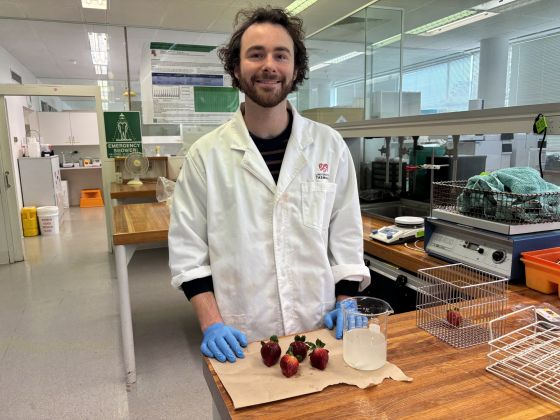

Take Hannah. As a young child, she was fascinated by the way a glass prism can split sunlight into different colours. At university she studied the way light can interact with liquids.
Now Hannah works in the food industry, using light to study how oat milk changes when mixed with hot coffee. The reason your barista can make a great plant-based flat white is thanks to knowledge developed by people like Hannah.
Her example shows how curiosity about the world can translate into an interest in science, a discipline that’s vital to understanding – and improving – our modern world.
However, in Australia not enough people are studying science. So we stand to lose a future where we can use the tools of science to understand why things happen.
Science is not just for scientists
Science literacy isn’t just about knowledge. It’s about the ability to reason, evaluate evidence, and make informed decisions in a complex, changing world.
Thinking like a scientist is a vital skill in a world of misinformation about climate change, renewable energy, generative artificial intelligence (AI), and more.
Employers value willingness to learn, problem-solving, communication and digital literacy.
But science has a marketing problem. The Australian government has shifted to focusing on vocations and “job ready” thinking.
Paired with parental attitudes towards occupational aspirations (“you should attend uni so you can get a good job”), it means students are increasingly attracted to degrees with clear career outcomes such as nursing, engineering or law.
Jobs for science graduates go beyond science
There’s a widening gap between training and employment, because students can’t see how areas of study connect with industry or improve their daily lives.
There are some areas of science where the employment path is clear, and those can be just as popular with students. A good example is agricultural science degrees, which have good industry engagement (including internships and placements) and good career prospects.
But many young people in Australia are not aware of the diverse career pathways that are possible with science degrees. Demand for material scientists is growing as new technologies develop in electronics, medicine, energy production and space science. But enrolments in the subjects that underpin materials science, such as chemistry and physics, are declining.
The number of science students at Australian universities has remained stable over recent years, but has fallen as a proportion of all university enrolments.
This highlights a problem. It takes a long time for students to respond to job market changes and to enter the science pipeline. There is a significant time lag to build the workforce in critical areas.
A recent government report shows that in the next five years, professional, scientific and technical services will grow faster than any other industry except healthcare. The time to bolster the science pipeline is now.
Not all scientists wear white coats
Unlike paths of study that are highly directed towards particular jobs – such as nursing – if you study science it doesn’t necessarily mean you’ll end up working in a lab. The old adage “not all scientists wear white coats” is undeniably true. In fact, the vast majority of science graduates work in business, government, policy, education and technology.
A 2019 study revealed a surprisingly high number of Fortune 100 chief executives have Bachelor of Science degrees.
On the other hand, it’s not all that surprising. The key reason why science graduates show up in unexpected places is their skill set rather than just their knowledge.
Science graduates don’t follow a linear path. Instead, they evolve throughout their careers and learn new interdisciplinary skills to solve complex problems. That’s precisely the point of a science degree.
Science graduates wanted
Science has direct and measurable effects on Australia’s economy. Even areas of study considered highly theoretical can have a major impact. For example, advanced physical and mathematical sciences contribute directly around 11% of GDP to the Australian economy.
To turn the trajectory of science around we need to encourage students to engage with science early. That includes providing engaging and inspiring activities in primary school.
But we should also insist young people continue to study science in high school without consideration of gaming ATAR scores or university entrance.
Many universities are removing or lowering prerequisite subjects as entry requirements, which sends a signal that students don’t need to engage with “difficult” areas of study.
Universities need to do a better job of explaining the variety of job and career options available to science students. Students need to show employers how their science skills are valuable in different workplaces. Governments need to have policies that encourage industry to invest in research and development so careers using the tools of science become more common, and contribute to productivity.
All students need to be exposed to science. Talk to the kids in your life about science, take part in a National Science Week activity, visit a science centre, or encourage them to keep studying science. You’ll likely have a lot of fun and help to prepare them for an uncertain future.
This article is republished from The Conversation under a Creative Commons license:
- Read the original article
- Author: Nathan Kilah, Associate Professor in Chemistry and Associate Head Learning and Teaching, University of Tasmania
- Author: Brian Yates, Emeritus Professor, University of Tasmania; Australian Council of Deans of Science (ACDS), University of Tasmania