





By Craig Elliott, Biosecurity Engagement Lead at TIA and the TAS Farm Innovaiton Hub
Why is this pest a concern?
The brown marmorated stink bug (BMSB; Halyomorpha halys) is one of Australia’s highest priority pests. It appears in both the National Priority Plant Pests and the National Priority List of Exotic Environmental Pests, Weeds and Diseases, because it could cause major impacts to agriculture and the environment, while also becoming a nuisance in gardens and homes. It is not established here, so finding it early matters and Australia has successfully intercepted many BMSB at the national border over recent years.
BMSB feeds on over 300 plant species including apples, pears, stone fruit, berries, grapes, hazelnuts, vegetables, citrus and grains. The bug feeds by piercing fruit, nuts and seeds to feed. On tree fruit, the feeding will cause sunken, misshapen or depressed areas as the fruit grows. Later in the season it causes corky spots, and feeding can make fruit drop early. Damaged produce often can’t be sold. In grapes, it has been shown to cause wine taints when BMSB is caught in the crush during the winemaking process.
Where it has become established, the costs of BMSB incursions have been large:
- United States: apple growers in the mid-Atlantic states suffered more than USD37 million in damage in 2010. They responded by spraying four times as often. The extra spraying disrupted integrated pest management programs, making it harder for growers to rely on natural predators and other pest-control methods. This led to secondary outbreaks of mites, aphids and scale insects. Some stonefruit growers reported 90% production losses in some years.
- Italy: BMSB quickly became one of the most damaging pests in fruit orchards, and fruit losses in 2019 were estimated at €588 million.
- Georgia (Caucasus): the bug caused an estimated USD60-75 million in losses each year.
- In Australia, NSW DPIRD has estimated BMSB establishment could cause up to $1.2 billion a year in damage to that state’s fruit and vegetable sectors.
BMSB is also a household pest. As BMSB spread through the north-eastern USA, it also invaded households looking for warm shelter during the winter and infested wardrobes, beds and cupboards. The scale of household invasions can be considerable.
One Maryland scientist recorded 26,205 adult stink bugs inside his home over 181 days. BMSB don’t bite and don’t breed indoors, but they give off an unpleasant smell when crushed or vacuumed.
Tasmania’s mild, temperate climate and long summer days mean much of our horticultural production area could provide suitable conditions for BMSB.
The pest is not established in Tasmania, but a single BMSB was detected at Bell Bay in February 2025, demonstrating the value of Tasmania's biosecurity surveillance and response systems.
How it could get here
BMSB is what we call a hitchhiker pest. In the northern autumn, adults look for sheltered places to spend the winter, and they often end up in cargo. It is known to hide in all kinds of cargo, including vehicles and machinery, and a live bug was recently found in luggage at Brisbane airport. Online parcels from overseas are another way for BMSB to get into Australia. BMSB often stow away in cargo from the northern hemisphere and arrive between September and April, which is our risk season and when Australia’s biosecurity agencies increase import requirements and surveillance efforts.
How to identify it, and how it differs from our native stink bugs
Australia has many native stink bugs, and most of them are harmless. BMSB can be hard to tell apart. Look for:
- Size: adult BMSB are about the size of a five-cent coin (12–17 mm long)
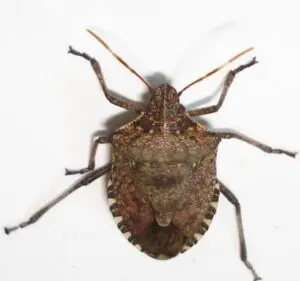
- Colour: a mottled brown colour and a faint reddish tinge with distinctive white bands on the antennae and white banding around the edge of the abdomen. The underside is white or pale tan and there are pale bands on the legs as well.
Did you know the term ‘marmorated’ means marbled or blotchy?
Native look-alikes include brown shield bugs, spined predatory shield bugs and glossy shield bugs. The closest match is the brown soldier bug, which looks a lot like BMSB but has no wide white band on its antennae. No single feature is enough on its own. The banding on the abdomen, legs and antennae also appears in other stink bugs, so check the features together. Behaviour is another clue: our native stink bugs don’t typically gather in large numbers inside houses.
What to do
If you think that you’ve found an unusual brown coloured stinkbug, especially in or near imported goods, a parcel or luggage, don’t squash it. Catch it in a container, take a photo, and report it straight away to the Exotic Plant Pest Hotline on 1800 084 881.