

It was on a different small island that Robert Hortle’s appreciation for his life in Tasmania first began to really form.
Now working as deputy director of the University of Tasmania’s Tasmanian Policy Exchange (TPE), Robert was only seven years old when he, his brother, and their parents moved to Tonga for two and a half years.
His parents were part of the Australian Volunteers program, an initiative that sends Australians overseas to support locally led development.
In Tonga, Robert spent his mornings at a local school, and his afternoons being homeschooled by his mother. His classmates didn’t have TVs, computers, or fancy holidays, and many of them lived in one-room dwellings.
But when he returned to Tasmania – a place his family had called home for seven generations – he found the kids at school weren’t as interested in his experiences as he had expected.
“I found it quite hard that people weren't necessarily that interested in what I had seen overseas,” he said. “I was probably far too self-righteous about that for a while.”
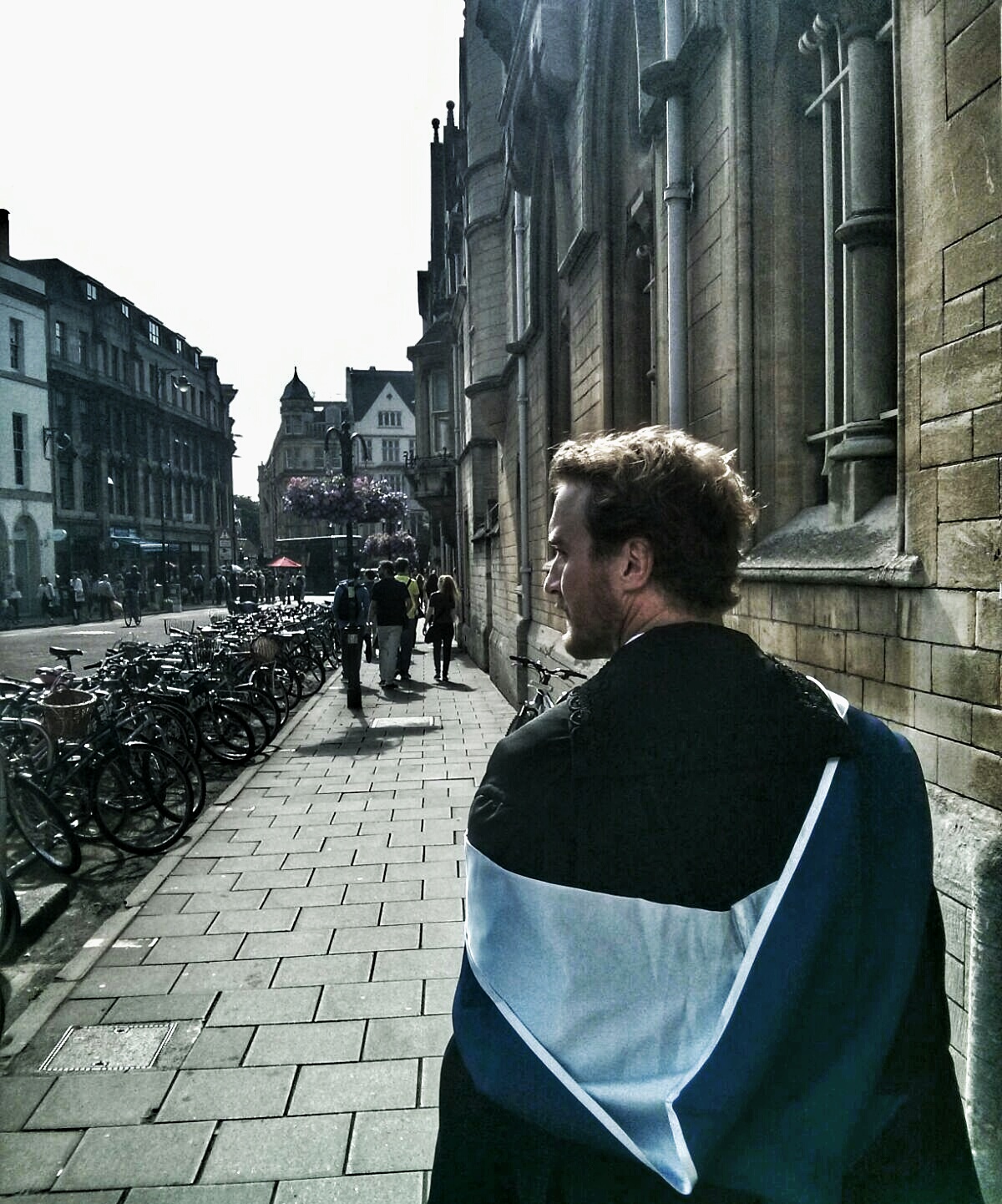
Years later, Robert completed his Bachelor of Arts at the University of Tasmania and received a Rhodes Scholarship to study at Oxford University, where he completed a master’s degree and a doctorate in international development.
His studies at Oxford focused on understanding the colonial roots of international development, and closely examining the power structures within that system.
If his time in Tonga had shown him how lucky he was to grow up in Tasmania, his studies at Oxford pushed him to think more critically about the life he enjoyed in his home state, and how this influenced his perspective on international development.
This forced him to reflect on his own role: how could he contribute meaningfully without falling into the trap of the white saviour complex?

This question remained with him throughout his postgraduate studies, and his fieldwork in the Pacific introduced him to accomplished local scholars and activists, which further challenged his assumptions.
“It's got to be more of a two-way thing, you know,” he said about international development.
“People on both sides can learn a huge amount from each other when relationships are built on humility and mutual respect.
“[But] I certainly think in development there's still a perception that it's about ‘going over there’ and helping people with our ‘superior’ skills and knowledge.”
Robert returned to Tasmania in 2023 and now works at the TPE as deputy director and senior research fellow, leading independent research and analysis to create better public policy for Tasmania and enable informed community discussions.
The theory he learned through studying international development – along with his own personal experiences – has proved invaluable for his work interpreting and understanding politics, and community and economic development in Tasmania.
Robert sees great potential for community-driven change in Tasmania, pointing to debates over issues like salmon farming, the proposed new stadium, and lesser-known causes like the push to have parts of the state recognised as a dark sky sanctuary internationally.
“There's so many bits and pieces of really exciting stuff that maybe people don't think of as politics, but they are very political at that level of community engagement,” he said.
Tasmania’s electoral donation laws – for declaring donations to political parties and candidates – were once the most lax in the country. Reforms were made in 2023 but were criticized for not going far enough.
The TPE has been involved in providing evidence to a Parliamentary Committee on some amendments to the law, which Robert says links to their aim to advocate for more transparency and accountability.
“So that people can really see what's going on, and how a democracy works, as much as possible.”
Between Tasmania, a Tongan village, Oxford University, and the TPE, Robert has developed a career focused on helping people to see past their differences, in order to come together as a community and look for common ground.
And he still believes Tasmania is the best place to be.
“I love Tassie and, in all my travels and all the places I've lived and worked, I haven't really found anywhere else I think that lets you live in the same way as you can here.”
Costs should never be a barrier to university study. That's why we offer scholarships and other forms of financial assistance to make pursuing your dream affordable and accessible. A Rhodes Scholarship took Robert to Oxford, so imagine where a scholarship could take you.
- University of Tasmania Scholarships for semester 1, 2027, will open for applications on 29 August 2026.
- Applications for the Tasmanian Rhodes Scholarship are now open and close on 11 August, 2026.