

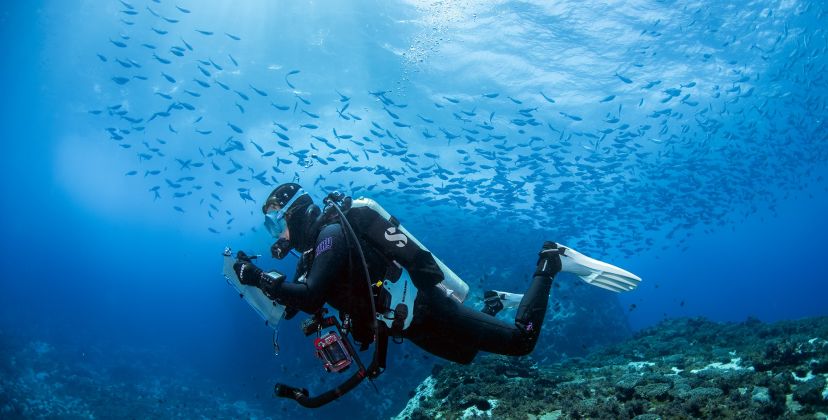
After diving in oceans across the world, Lara Denis-Roy says there is something very special about Tasmanian waters.
Beyond the reefs and diverse marine life, what makes it truly enriching is the opportunity for Lara to connect the vast underwater world directly to her research.
“Diving is where I feel most connected to my work. I love it,” said Lara, who recently completed her PhD at the University of Tasmania’s Institute for Marine and Antarctic Studies (IMAS).
“I feel very lucky that I got to use diving as a tool during my PhD. Marine science is a passion of mine, and I appreciate that I am able to directly observe the reefs that I study thanks to scuba diving.”
Lara’s PhD research investigated how environmental DNA (eDNA) – genetic material released by organisms into water – compares with traditional underwater visual surveys conducted by divers.
While eDNA is widely used in forensic science, its application in marine environments is relatively new and rapidly growing.
“For my PhD, we wanted to compare an established method like underwater visual surveys such as Reef Life Survey, which has been running since 2008, with an emerging approach,” said Lara, who now works as a postdoctoral researcher at IMAS.
"There are already large data sets informing us about coastal biodiversity. But eDNA has the potential to reveal even more.”
Traditional dive surveys rely on what divers can see and identify, meaning they often miss small or hidden organisms such as tiny crustaceans, worms, and microscopic life living within sediments, algae, or reef surfaces, as well as species that pass through the reef and are not present when divers are in the water.
“With eDNA, we can detect trace genetic material in water samples, even from species that are small, hidden or active at different times of day,” Lara said.
“It gives us a broader picture of what is living in these ecosystems, including species we would otherwise miss.”
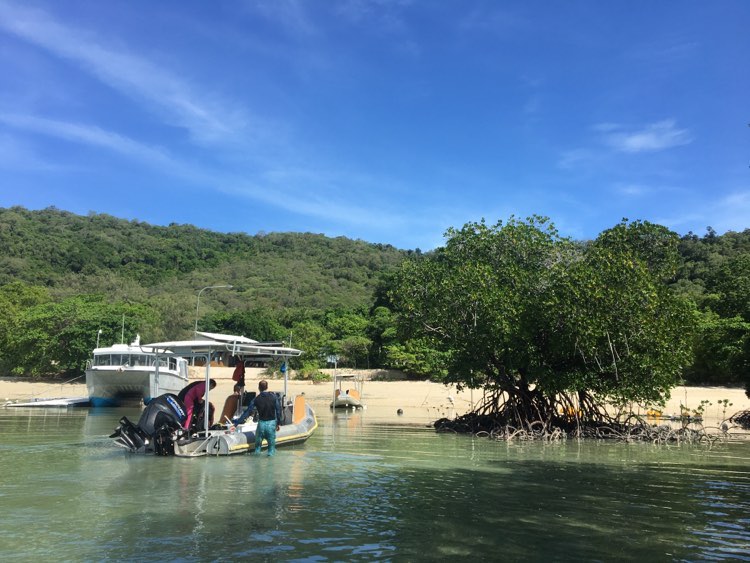
Lara surveyed tropical and temperate reefs during the day and night and looked at how diving and eDNA methods aligned. At depths of two to twelve metres, she collected water samples at the same locations where dive teams conducted visual surveys (RLS) and recorded fish and invertebrates encountered.
“eDNA captures more of a signal through time. It can detect nocturnal species in both day and night samples because those species shed DNA," she said. "But it doesn’t tell you when they were active or if they were alive and not simply decomposing, and that’s one of eDNA’s limitations.”
While eDNA is unlikely to replace dive surveys, it is a useful addition to our toolkit as marine ecologists to track biodiversity.
Lara said it’s important to collect data using multiple methods.
“If we can monitor our ecosystems, we can understand them and we can look after them,” Lara said.
“That responsibility is important. Coastal biodiversity underpins local economies, tourism and fisheries. Most of the world’s population lives near the ocean. People love being in and around the water. We rely on it economically, culturally and environmentally.
“Indigenous communities have been caring for these environments for generations, and tools like eDNA and visual surveys can help support ongoing efforts to monitor and protect them.”
Discover more about Scientific Diving at the University of Tasmania
Cover image: Lara’s PhD research investigated how environmental DNA (eDNA) compares with traditional underwater visual surveys conducted by divers. Photo: Yann Herrera Fuchs