

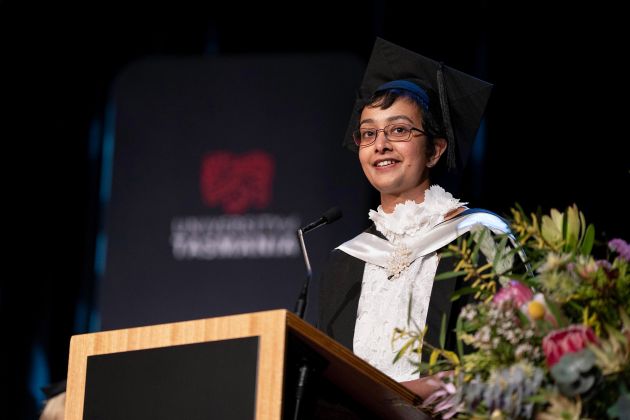
Dr Landowski, a Senior Lecturer in Biomedical Sciences, has received the Celestino Eureka Prize for Promoting Understanding of Science, one of Australia’s leading honours for excellence in science communication.
The award recognises her ability to translate complex neuroscience into clear, compelling and practical information for the public through TEDx talks, viral videos, media appearances and community engagement.
In the past year, Lila has appeared in hundreds of media stories, reaching more than 46 million people. Her work has helped people better understand the brain, challenged misinformation, and inspired audiences from diverse backgrounds to see themselves in science, technology, engineering and mathematics.
She is also a World Health Organisation Fides ambassador, contributing to efforts to combat health misinformation and strengthen public trust in evidence-based information. She graduated from the University of Tasmania with a Bachelor of Medical Research (Honours) in 2009 and was awarded a PhD in neuroscience in 2014.
Here we ask Lila some questions about her career and what winning this award means to her:
Your Eureka award recognises your role in promoting an understanding of science. It is one of Australia’s leading honours for excellence in science communication. How important do you believe good science communication is in society right now?
In a world where misinformation is at our fingertips, good science communication has never been more important.
Knowledge is the great equaliser; it allows us to create opportunities for ourselves. But knowledge about the brain in particular? That’s a superpower for all of us. It helps us understand why we are the way we are, it helps us have more empathy for ourselves and others, and it gives us the tools to be the best versions of ourselves.
What drives you in your science communication? And when did your interest start?
I decided I was going to be a scientist in Grade 4 (excited by the thought of working in medical research and developing treatments for diseases). But, growing up, I didn't know any scientists. I didn't have mentors. I didn't go to the “right” school, or have connections with the "right" kind of people. The only "sciencey" kind of person I 'd seen was David Attenborough. So I genuinely thought: Well, if I'm going to be a scientist, apparently I'm going to have to learn public speaking. To help me build those skills, in Grade 7, I decided to try out to join a debating team. Spoiler alert, I was so bad, I didn't get in. I tried again the next year. Didn't get in then either. Eventually enough people dropped out that they got to me at the end of the back-up list. Over the decades, I continued to build those skills, forcing myself into uncomfortable speaking situations wherever possible. I had a fear of public speaking and really wanted to overcome it,and I eventually did.
Our brain arrives into this world unfinished – a little bit like a smartphone before you’ve downloaded all the apps. But that might actually be why it’s so incredible. It's been built to learn and adapt. Think of things like crocodiles: they swim, make sounds and feed from the moment they crack their way out of an egg. We’re the opposite. We come into the world as a clean slate and rather than being pre-programmed to survive one environment, our brain develops in response to this changing world around us – learning from things like danger or stress or relationships – and it is continually shaped by our experiences and things like social media and AI. It keeps changing throughout our lives. There’s so much we are still learning about the brain, and I love sharing that knowledge with as many people as I can.
What is your top tip for young graduates entering the workforce?
I think excellent social skills will be the most coveted skill for the next generation. In a generation where most people are spending a lot of time on their phones, the part of your brain that's great at understanding written communication, emojis etc, gets really well developed. But the flipside is that without spending as much time engaging in face-to-face conversation, social skills suffer. I think those with great face-to-face interpersonal skills will really stand out in the job market.
Is there a fun fact from you’re understanding of the world of neuroscience that you think we should all try to apply in our daily lives?
I wish everyone knew about the neuroscience of belief effects.
Listen to me chat about this on the ABC Science Show last weekend here:
For more on the awards see this earlier article about Lila’s win.
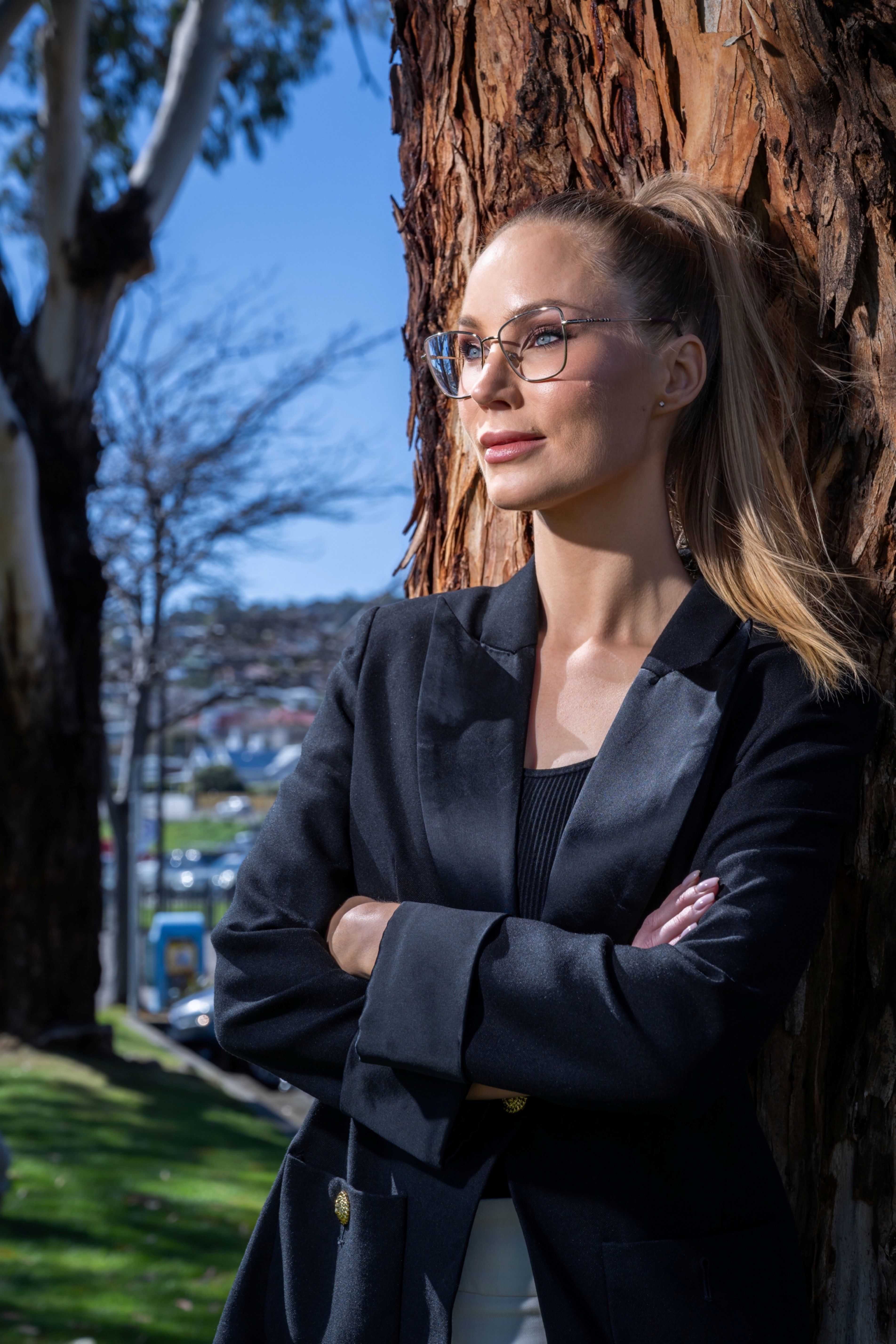
Image credit: Caroline Tan
Image top right: Dr Lila Landwoski
Image credit: Caroline Tan
This article featured in the monthly eNews Alumni and Friends. If you are a member of the University of Tasmania community and would like to receive this publication, please provide or update your email address.