



The increasing frequency and intensity of heat stress due to climate change poses a significant threat to global wheat production. That’s why it’s crucial to improve heat tolerance to mitigate the impact of high temperatures on the important cereal grain.
Tasmanian Institute of Agriculture (TIA) PhD candidate, Abu Bakar Siddique, is one of the recipients of a prestigious Grains Research and Development Corporation Research Scholarship to do just that.
The scholarships are awarded to support PhD candidates in delivering innovative research that addresses constraints in the Australian grain industry or builds opportunities for Australian grain growers to help improve their sustainability and profitability. This year there were more than 130 domestic and international applicants.
The scholarship provides high achieving students with the financial and industry support to complete their PhD. It’s set to make a big difference to Mr Siddique’s research that’s paving the way for more resilient crops in the future.
“Research to understand how heat impacts wheat is vital,” he said.
“This project aims to understand how wheat survives heat, focussing on pollen survival, staying green, and spikelet fertility controlled by genetics,” he said.
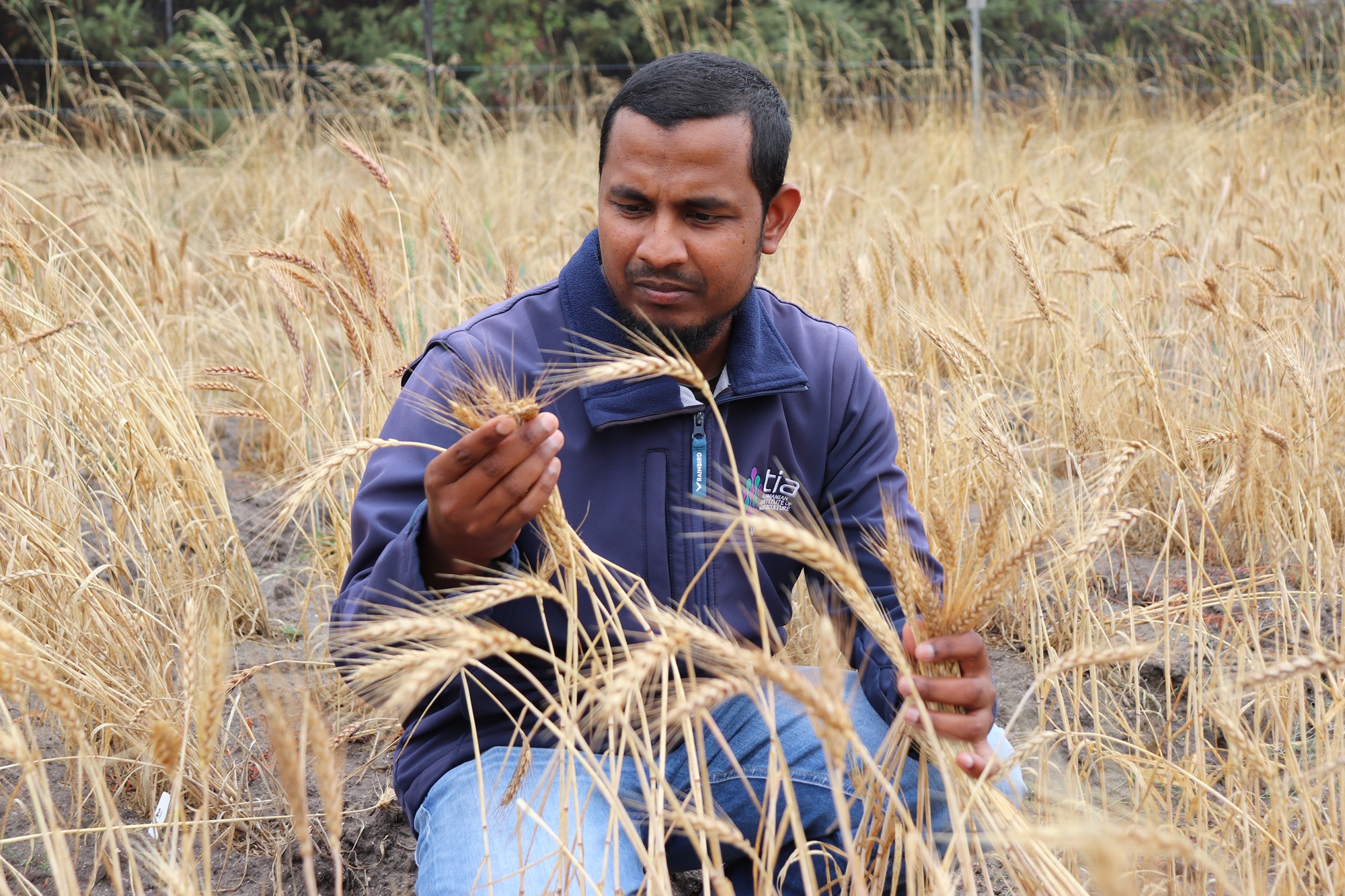
Mr Siddique’s project is studying 319 diverse wheat lines under glasshouse, controlled growth room, and field conditions. Plants are exposed to heat stress at key reproductive stages.
Using detailed data, Mr Siddique has identified important genetic traits linked to heat tolerance through extensive studies.
A key achievement of this research is the development of a test, through the use of a thermal cycler, that quickly and reliably measures pollen heat survival. This provides a practical and scalable method for screening wheat for heat tolerance.
“To check these results, populations from heat-tolerant and heat-sensitive commercial wheat varieties are currently being studied. Once valuable genetic traits are identified under heat stress conditions, these traits can be introduced into high-performing but heat-sensitive wheat varieties,” Mr Siddique said.
“This will create improved wheat cultivars that farmers can grow in hot conditions.”
This research supports GRDC’s priority areas by delivering genetic targets and knowledge to accelerate the development of heat-resistant wheat cultivars for Australian environments.
“The scholarship is greatly appreciated. It will make a big difference to my PhD study and enable me to make further investigations,” Mr Siddique said.
“I sincerely appreciate my primary supervisor Dr Chenchen Zhao for his mentorship and guidance in winning this top-up scholarship.”