


Years of collaboration between fishers, scientists and fisheries managers have helped ensure Tasmania’s Banded morwong fishery remains sustainable.
It comes as the University of Tasmania’s Institute for Marine and Antarctic Studies (IMAS) released the Tasmanian Banded Morwong Fishery Assessment for 2024/25.
“The sustainability of the Banded morwong has been enabled by an ongoing strong collaboration between industry, fishers, and scientists who are jointly driving the success of this fishery,” IMAS researcher and co-author Dr Nils Krueck said.
“Fishers regularly share local knowledge and participate in annual fishery forums, which has led to industry support of research through gear innovation and direct participation.”
The assessment shows stocks remain sustainable based on data collected between March 2023 and February 2025, with fishers catching 99.1% of the 33.4 tonne Total Allowable Catch (TAC) for the season.
"The Banded morwong fishery is one of Tasmania’s best-managed fisheries, with annual TAC setting, biannual biological surveys to inform stock assessments, minimum and maximum size limits to protect juveniles and large breeders, and a seasonal spawning closure to safeguard reproduction," said IMAS senior researcher and lead-author, Dr Katie Cresswell.
"The fishery is sustainable, with spawning stock biomass currently estimated at 40% of virgin levels (36%–44%), which is close to common target levels safely above the limit reference point, which is set at 30% for this fishery.
"Following a history of heavy fishing in the early years of the fishery, catch rates have steadily increased over the past 12 years, which supports the assumption of positive stock trends."
Further research is underway into the Banded morwong, aiming to better understand potential depth refuges for the species.
“We’re using remotely operated vehicles (ROVs) and acoustic telemetry to study fish abundance and movements across reefs along the coastline of south-eastern Tasmania,” Dr Krueck said.
“We also have work underway employing electronic measuring boards and artificial intelligence tools for efficient data collection.”
The Tasmanian Banded Morwong Fishery Assessment was funded by the Department of Natural Resources and Environment Tasmania (NRE Tas) and the University of Tasmania’s Institute for Marine and Antarctic Studies (IMAS) through the Sustainable Marine Research Collaboration Agreement (SMRCA).
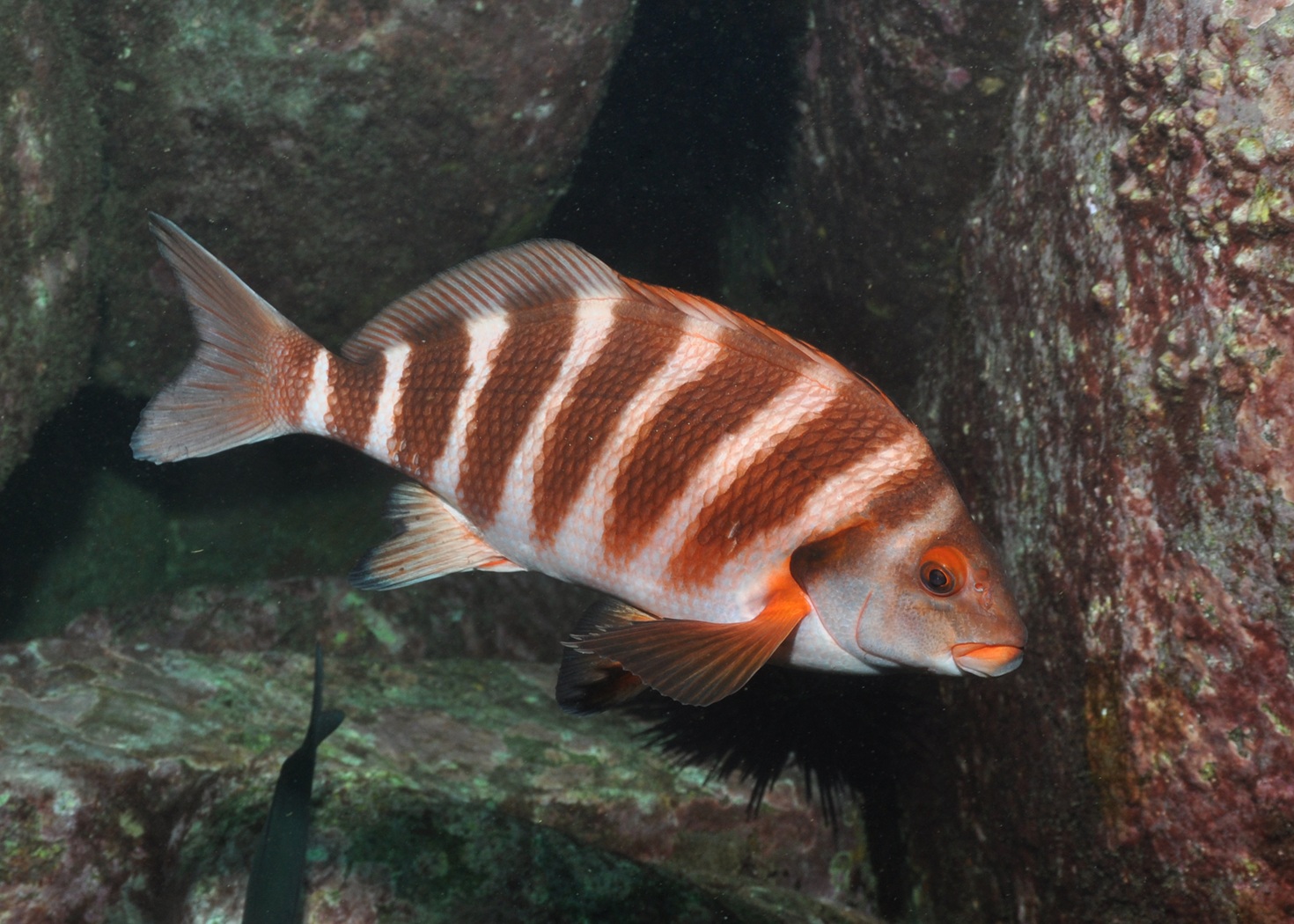
Cover image: Banded morwong at Schouten Island.
Credit: Maya Lovelock-Dodos