

Our team integrates palaeoeological and biogeographic research and applies multiple proxies to reconstruct environmental change through time.
Palaeoenvironmental records are key to understanding ecosystem resilience and biodiversity, especially in sensitive alpine and island ecosystems impacted by rapid global change.
Our researchers use sedimentary archives from terrestrial wetlands and dendrochronology to reconstruct past environmental change in Australia. We apply a range of biological and geochemical proxies to reconstruct landscape evolution, long-term fire regimes, and palaeoclimate.
At the PalaeoLab our team is currently working on late-Pleistocene, Holocene, and Anthropocene records from alpine regions of Australia, with a focus on sites across Tasmania.
We are based in the School of Geography, Planning and Spatial Sciences at the University of Tasmania. If you would like to learn more about working with the PalaeoLab to understand and protect Australia’s unique ecosystems, we invite you to get in touch. Deans Summer Scholarships, Honours, and PhD projects focusing on palaeoecology, biogeography and palaeoclimate are also available.
What we do
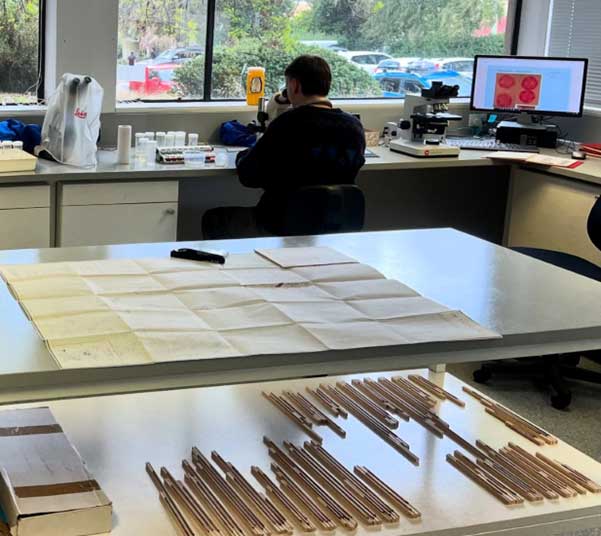
Palaeoecology and biogeography apply multidisciplinary approaches to understand landscape evolution and species distribution in the past and present. In the PalaeoLab we analyse sediment cores from terrestrial archives and use fossilised pollen as a key indicator of past vegetation distribution through time.
Fire plays an important role in shaping the Australian landscape, and charcoal fragments stored in sediments can be used to reconstruct past fire regimes and anthropogenic land use, especially in fire-sensitive environments such as Tasmania.
At the PalaeoLab we integrate ecological studies and palaeoecological records to understand our unique Tasmanian ecosystems through time.
The Geochemistry Lab and Palaeoecology & Biogeography Lab are located on the Sandy Bay campus in Hobart.
Our labs have the capacity to investigate sediment cores, extract microfossils, and analyse tree rings.
Our current projects
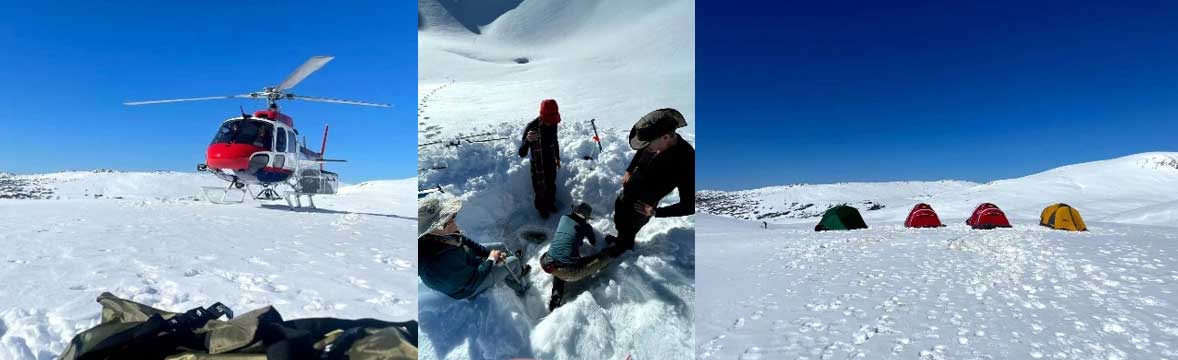
This project aims to test ideas on late-Pleistocene through late-Holocene climate change in southeastern Australia based on multiproxy analyses of sediment cores collected from three alpine lakes in the highest portions of the Snowy Mountains, New South Wales, Australia.
Despite recent efforts to reconstruct the magnitude and spatial distribution of major post-glacial climate events in the Southern Hemisphere, critical gaps in proxy data, most notably in Australia, hinder these reconstructions; this gap reflects a shortage of sites on the continent that preserve high-resolution, continuous paleoclimate records.
The alpine lakes in Kosciuszko National represent notable exceptions to this problem with the lakes trapping sediments since deglaciation 18,000-20,000 years ago.
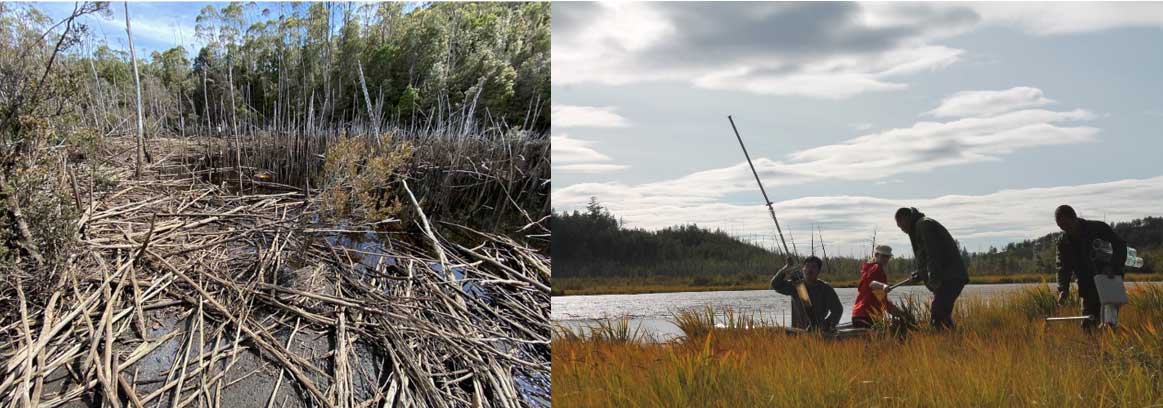
This is a joint project between the PalaeoLab and the Department of Natural Resources and Environment Tasmania to understand past environmental change in Tasmania’s Wilderness World Heritage Area (TWWHA). Our project aims to explore sites across TWWHA to build a regional synthesis of fire regimes, vegetation change, and climate during the last 10,000 years.
Our people
Contact us
For enquiries, please email Dr Lydia Mackenzie.