

Welcome to our sustainable hydrogen certification project
Certifying hydrogen as ‘clean’, ‘green’, or ‘renewable’ will be insufficient on its own to achieve sustainability, the term referencing the need for deep, deliberative, and participatory policy integration across its three economic, social, and environmental dimensions.
Guided by this premise, our interdisciplinary team is researching how public and private standards, certification, and labelling schemes (SCLs) contribute to the sustainable governance of hydrogen production and hydrogen-based fuels.
We employ a sustainability systems perspective that recognises the complexity of hydrogen’s economic, social, and environmental impacts across the diverse supply chains and pathways involved in its production, transportation, and use.
While we recognise the need for urgent and deep decarbonisation of energy systems and broadly support a scaling up of hydrogen from renewable energy (particularly for use in hard-to-abate sectors), we caution that there are numerous potential negative impacts that require consideration and mitigation to the satisfaction of those affected. These include:
- Increased greenhouse gas emissions when grid renewable energy is not additional to that already produced.
- Increased greenhouse gas emissions when less-efficient hydrogen is substituted for direct electrification.
- Increased greenhouse gas emissions when hydrogen is deployed and there are more strategic energy use and conservation options.
- Loss of productive land and amenity and biodiversity impacts when new large-scale energy production and transmission infrastructure is built to connect rural producers to urban consumers.
- Competition for scarce water resources, particularly in dryland locations.
- Labour disadvantage when workers are under-skilled, underpaid, or otherwise exploited.
- Community disadvantage when governments and industry impose large-scale developments in the face of significant opposition.
- Indigenous Peoples disadvantaged when hydrogen projects are located on traditional lands without free prior informed consent.
- Safety issues when the production, transportation, and storage of hydrogen, occurs in built-up areas.
We investigate SCLs around the globe to reveal how they are conceptualising the nature of ‘renewable’, ‘green’, and ‘sustainable’ hydrogen. We also study the scope of the system boundaries they include (for GHG emissions and other indicators of sustainability), whether additionality is required, and the degree to which issues like water, labour, and community acceptance are included.
Our research provides benefits to policy makers, industry executives, civil society organisations, and community groups interested in ongoing and urgent efforts to decarbonise economies fairly and systemically by balancing sustainability’s social, economic, and environmental dimensions.
Current research
A range of existing and newly developed hydrogen standards, certification and labelling (SCL) schemes aim to promote the role of 'renewable', 'clean' or 'green' hydrogen in decarbonising energy transitions.
Abstract 1 - Renewable hydrogen standards, certifications, and labels, International Journal of Hydrogen Energy (2024)
A range of existing and newly developed hydrogen standards, certification and labelling (SCL) schemes aim to promote the role of ‘renewable’, ‘clean’ or ‘green’ hydrogen in decarbonising energy transitions.
This paper analyses a sample of these SCLs to assess their role in the scaling up of renewable hydrogen and its derivatives. To analyse these hydrogen SCLs, we embellish a novel conceptual framework that brings together Sustainability, Systems Thinking, and Governance (SSG) literature.
The results reveal noteworthy scheme differences in motivation, approach, criteria, and governance; highlighting the complex, interconnected, and dynamic reality within which energy systems are embedded. We consider whether the sustainable utilisation of renewable hydrogen is well-served by the proliferation of SCLs and recommend an SSG-informed approach.
An SSG approach will better promote collaboration towards an authoritative, global, multistakeholder, compromise on hydrogen certification that balances economic considerations with social, and environmental dimensions.
Publications
Abstract 2 - Sustainability certification for renewable hydrogen, Energy Policy (2024)
Hydrogen produced from renewable energy is being promoted to decarbonise global energy systems.
To support this energy transition, standards, certification, and labelling schemes (SCLs) aim to differentiate hydrogen products based on their system-wide carbon emissions and method of production characteristics. However, being certified as low-carbon, clean, or green hydrogen does not guarantee broader sustainability across economic, environmental, social, or governance dimensions. Through an international survey of energy-sector and sustainability professionals (n = 179), we investigated the desirable sustainability features for renewable hydrogen SCLs and the perceived advantages and disadvantages of sustainability certification.
Our mixed-method study revealed general accordance on the feasible inclusion of diverse sustainability criteria in SCLs, albeit with varying degrees of perceived essentiality. Within the confines of the data, some differences in viewpoints emerged based on respondents’ geographical and supply chain locations, which were associated with the sharing of costs and benefits. Qualitatively, respondents found the idea of SCL harmonisation attractive but weighed this against the risks of duplication, complicated administrative procedures, and contradictory regulation.
The implications of this research centre on the need for further studies to inform policy recommendations for an overarching SCL sustainability framework that embodies the principles of harmonisation in the context of multistakeholder governance.
Publications
Abstract 3 - Expert views on the legitimacy of renewable hydrogen certification schemes, Energy Research & Social Sciences (2025)
In this article, we draw on findings from a mixed-methods international survey of experts in the energy sector (n = 179) to better understand the role of legitimacy theory in informing the development of renewable hydrogen standards, certification, and labelling (SCL).
The investigation is viewed through two conceptions of legitimacy: the sociological legitimacy of increasing the availability of renewable hydrogen technologies and the normative legitimacy of democratic SCL governance. Results revealed that respondents reacted positively to survey statements representing sociological legitimacy, whereas qualitative data exposed some concerns with pragmatic and cognitive legitimacy such as a lack of immediate benefits and poor comprehensibility stemming from sources including economics and energy strategy. Respondents’ ratings of the democratic legitimacy of hydrogen SCLs indicated inputs were perceived to have the most legitimacy followed by throughputs, then outputs.
The analysis revealed some evidence that features of scheme design and governance may influence experts’ evaluations of schemes. Moreover, results indicated an opportunity to increase awareness and knowledge of SCLs within the expert community and societally. This study provides evidence to support the premise that hydrogen SCLs would benefit from pursuing diversity in stakeholder participation, enhancing process transparency, and judging the efficacy of outputs against both decarbonisation and sustainability goals.
Attention to these democratic factors, amongst others, would enhance the capacity of SCLs to contribute to the sociological legitimation of renewable hydrogen technologies.
Publications
Abstract 4 - Unknowing Standards: Expert Ignorance in the Governance of Green Hydrogen
In recent years, green hydrogen standards, certificates and labels (SCLs) have proliferated, with approximately fifty schemes now in circulation worldwide. Yet despite this proliferation, a recent survey of international energy professionals working on green hydrogen found that over one-third (34%) could not name a single SCL.
We argue that this surprising finding reflects a form of situated ignorance, arising from a combination of the rapid pace of low-carbon energy transitions and the multiple epistemic communities working on green hydrogen.
Drawing on interdisciplinary scholarship from ignorance studies, political science, and transition studies, we show how expert ignorance is shaped not by the strategic withholding of knowledge, but rather by the structural and temporal dynamics of socio-technical change. In this way our empirical case of green hydrogen illustrates how ignorance and unknowing are constitutive features of energy transition governance.
Publications
- TBA
Abstract 1 - Governing community engagement towards social acceptance
The urgency and demands of carbon reduction efforts in Australia have hastened governmental efforts to embark on renewable energy transition strategies. A major aspect of promoting success of such undertakings is not simply technical and scientific, but inherently social. As numerous large infrastructure projects in Australia illustrate, without sufficient social acceptance from a range of community groups, governments and commercial proponents have struggled to advance their goals and many projects have either stalled or been abandoned. In this paper we review the latest understandings within the literature on the governance of community consultation/social license/social acceptance, particularly in relation to large infrastructure projects. We are interested in understanding how governments are conducting community engagement for such large-scale projects, the contributions of civil society actors involved, and the risks and opportunities involved that may potentially affect a project’s progress or even stall it permanently. We contribute to understandings of this by examining the case of the Tasmanian Government’s first declared Renewable Energy Zone (REZ) in North West Tasmania. The REZ announcement is an important development in the path towards building capacity for the roll out of sizeable renewable energy production such as green hydrogen in Australia.
We analyse the community engagement and stakeholder management aspects of the REZ. We outline and analyse the key planks of the governmental approach to building social acceptance and the responses and contributions of key business and civil society actors that have coalesced around the issue. Drawing upon publicly available government documentation and semi-structured interviews with stakeholders, we highlight the messaging, narratives and framing of the government’s approach. Our key findings indicate the significance of governments’ educative strategies in engaging community actors and individual citizens and the necessity of enhancing coordination across state, local, and federal governments to enhance the pursuit of social acceptance for large infrastructure projects. Our analysis highlights the need for improved government strategies to bring the community along for large-scale energy transitions and planning, which are vital if governments are to meet their carbon reduction targets. The article also contributes knowledge towards the skills required by governments and their public servants to design and preside over successful consultation arrangements, which are increasingly essential in 21st century governance arrangements.
Publications
- Paper presented at the Australian Political Science Association Conference, Perth, WA (2024)
Abstract 1 - Political Science’s Engagement with the Sustainability Challenge: A Semi-Systematic Review of the Voluntary Sustainability Standards (VSS) Literature, Sustainable Development (2025)
The implications of sustainable development are far reaching, and yet many areas of academic scholarship were slow to deeply engage with it.
This is a problem because, in practical terms, it can generate a false sense of calm, of business as usual, and a failure to rise to the integrative challenge of balancing the trade-offs across sustainability's economic, social, and environmental dimensions.
Conceptually it is also problematic as, properly understood, sustainability is highly disruptive of many longstanding bodies of theory. In this article we demonstrate how a lack of attention to sustainability's deeper meanings operates within the discipline of Political Science, focusing on private governance through Voluntary Sustainability Standards (VSS).
We use a semi-systematic literature review to generate a corpus of highly cited literature to reveal how the discipline of political science drew on ill-defined and relative conceptions of sustainability during VSS' formative period. In the Conclusion, we consider the implications of this for contemporary politics and policy and propose possible remedies.
Publications
Abstract 2 - Governance Solutions to the Greenwashing of Sustainability
Decision makers face ever-increasing options for demonstrating sustainability credentials. One pathway is through employing standards, certification and labelling schemes (SCLs), yet determining their credibility has become a fraught exercise given recent negative publicity around schemes exposed as ineffective. Poor scheme design and implementation have led to accusations of ‘sustainability greenwashing’: the making of false and misleading claims about the sustainability benefits of a product, service, or organisation by corporations, governments and even some civil society organisations (CSOs). In this chapter, we use the term ‘greenwashing’ broadly to refer to false or misleading claims relating to any aspect of sustainability while noting its original meaning relates to environmental claims. Other terms in circulation include ‘social-washing’ (misleading social responsibility claims), ‘green hushing’ (avoiding publicising environmental or climate-related activity to avoid scrutiny) and so on (Governance Institute, 2023).
To minimise the risks and harms arising from adopting ‘low bar’ schemes, decision makers need guidance on how to distinguish effective SCLs from counterfeits. Drawing on examples from the climate, energy, aquaculture, and forestry sectors that include schemes like Climate Active, the International Partnership on Hydrogen and Fuel Cells in the Economy (IPHE), Aquaculture Stewardship Council (ASC) and the Programme for the Endorsement of Forest Certification (PEFC), we show how attention to SCL governance can help minimise greenwashing. Specifically, we identify four easy-to-assess SCL governance attributes that underpin low-bar schemes that risk greenwashing. These attributes are (i) single-interest ownership and management; (ii) first- and -second-party certification; (iii) low informational transparency; and (iv) a lack of sustainability specificity. In order to address these issues, we discuss the antitheses as means of minimising greenwashing (Figure 10-1). These attributes can be cross referenced with the iSEAL credibility principles (iSEAL, 2021) that seek to achieve measurable sustainability impacts through collaborative working and inclusive stakeholder engagement via transparent, reliable, and impartial processes that seek continual improvement.
Decision-makers must also be aware of the system-wide context of SCLs, in particular, their proclivity to focus only on within-site impacts, to ignore multi-site cumulative impacts, and to externalise the costs of unsustainable practices onto other actors, ecosystems, or economies. Decision makers should evaluate relevant schemes in a sector of interest according to these attributes whilst also referring to the best available evidence on each scheme’s track record. Armed with that information, decision makers can then determine whether an appropriate SCL exists, whether a new SCL may need to be developed, and whether and how they might be combined. Decision makers should also consider whether other governance levers such as political advocacy or regulation may result in processes and outcomes that meaningfully embody sustainability and thus guard against greenwashing.
Publication: Chapter in Sustainability for Decisionmakers, Edited by Rachel Baird (Forthcoming with Thomson Reuters).
Our team organises occasional webinars and undertakes other outreach. Our inaugural webinar was held on 26 November 2024 on the theme Sustainable Hydrogen Certification in Tasmania. Further Webinars are planned for 2025. To register your interest in future webinars please email Daniel Goodwin.
Webinar 1 (November 2024): Sustainable Hydrogen Certification in Tasmania
Presentations by:
- Professor Fred Gale, University of Tasmania, on Standards, certification and labelling schemes (SCLs) and sustainability governance (PDF 1.4 MB)
- Ms Kim Enkalaar, Renewables, Climate, and Future Industries Tasmania (ReCFIT), on The state of play for hydrogen in Tasmania (PDF 1.7 MB)
- Dr Daniel Goodwin, University of Tasmania, on Sustainable hydrogen certification perspectives (PDF 1.1 MB) - Tasmanian stakeholder interviews
- Dr Stephanie Baasch, University of Bremen, on Hydrogen energy transitions in Germany (PDF 5.6 MB)
- Dr Hannah Murphy, University of Tasmania, on Community engagement and participation in Tasmania’s energy transition (PDF 470.6 KB)
Webinar 2 (December 2025): Sustainable Hydrogen Certification: Launch of Final Report
Presentations by:
- Professor Fred Gale, University of Tasmania, on Standards, Certification and Labelling Schemes (SCLs)
- Mr Declan Cutler, Renewables, Climate, and Future Industries Tasmania (ReCFIT), on Renewable Hydrogen: The Tasmanian Context
- Dr Daniel Goodwin, University of Tasmania, on Summary of Social Science Research Findings from Expert Survey and Q-Sort Interviews.
- Dr Hannah Murphy and Ms Marion Schoen, University of Tasmania, Community Engagement and Participation in Tasmania’s Energy Transition
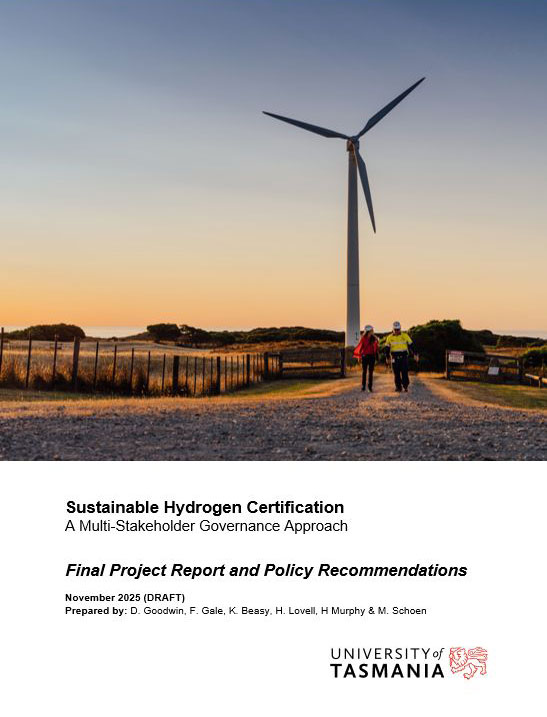
Project Report: Sustainable Hydrogen Certification: A Multi-Stakeholder Governance Approach (December 2025)
Our team
-
Professor Fred Gale
Professor in Politics and International Relations
-
Professor Heather Lovell
Professor of Energy & Society
-
Dr Hannah Murphy
Senior Lecturer in Public Policy
-
Dr Daniel Goodwin
Post-Doctoral Fellow, Renewable Energy Governance
-
Dr Kim Beasy
Senior Lecturer in Curriculum and Pedagogy
-
Ms Marian Schoen
PhD Candidate
Funding
This project is funded through an Australian Research Council Linkage Grant.

