

What started as a dream turned into reality for George Hamaty, who has just returned home to Hobart after being aboard CSIRO research vessel (RV) Investigator researching life in the aftermath of Tonga’s explosive volcanic eruption.

George joined the voyage as a co-biologist, working alongside an international team of scientists investigating the aftermath of the Hunga Tonga–Hunga Ha’apai eruption.
That 2022 eruption sent ash 58 kilometres into the atmosphere, triggered a Pacific-wide tsunami, and dramatically reshaped the surrounding seafloor.
“I feel very lucky. I didn’t expect to get an opportunity like this so early in my studies,” said George, a University of Tasmania and Institute for Marine and Antarctic Studies (IMAS) undergraduate student majoring in marine biology and geology.
“It was incredible to be part of such a diverse science team, collecting data and studying marine species in a completely unique environment.”
One of the highlights for George was witnessing marine life reclaim the seafloor around and inside the volcano through deep-water tow cameras.
“We saw so many shrimps down there, it was hectic. There were also some beautiful Corymorphidae and Holothurians, and a deep-sea batfish inside the volcano caldera.
"The batfish ‘sits’ on the seafloor with modified fins, just like the handfish in Tasmania. It’s called a batfish because of the way it awkwardly swims, like a bat crawls along the ground,” George said.

George, who is in the final year of their degree, first heard about the voyage after attending a talk at an event earlier in the year, where voyage chief scientist Associate Professor Rebecca Carey spoke about the eruption and the expedition.
Now the experience will shape the next stage of George’s academic studies.
“I’m planning to use the environmental DNA (eDNA) data from the deep-tow cameras for my Honours project. I want to explore how ecosystems recover after such a major eruption, which species recolonise first, where they settle, and how fast.”
Growing up bushwalking, snorkelling and scuba diving, George has always had a curiosity of the natural environment – but it’s their double degree that helped them see the bigger picture during the voyage.
“Combining geology and marine biology has given me so much context. When you understand the earth systems, you really start to see how everything is connected especially after a volcanic eruption,” George said.
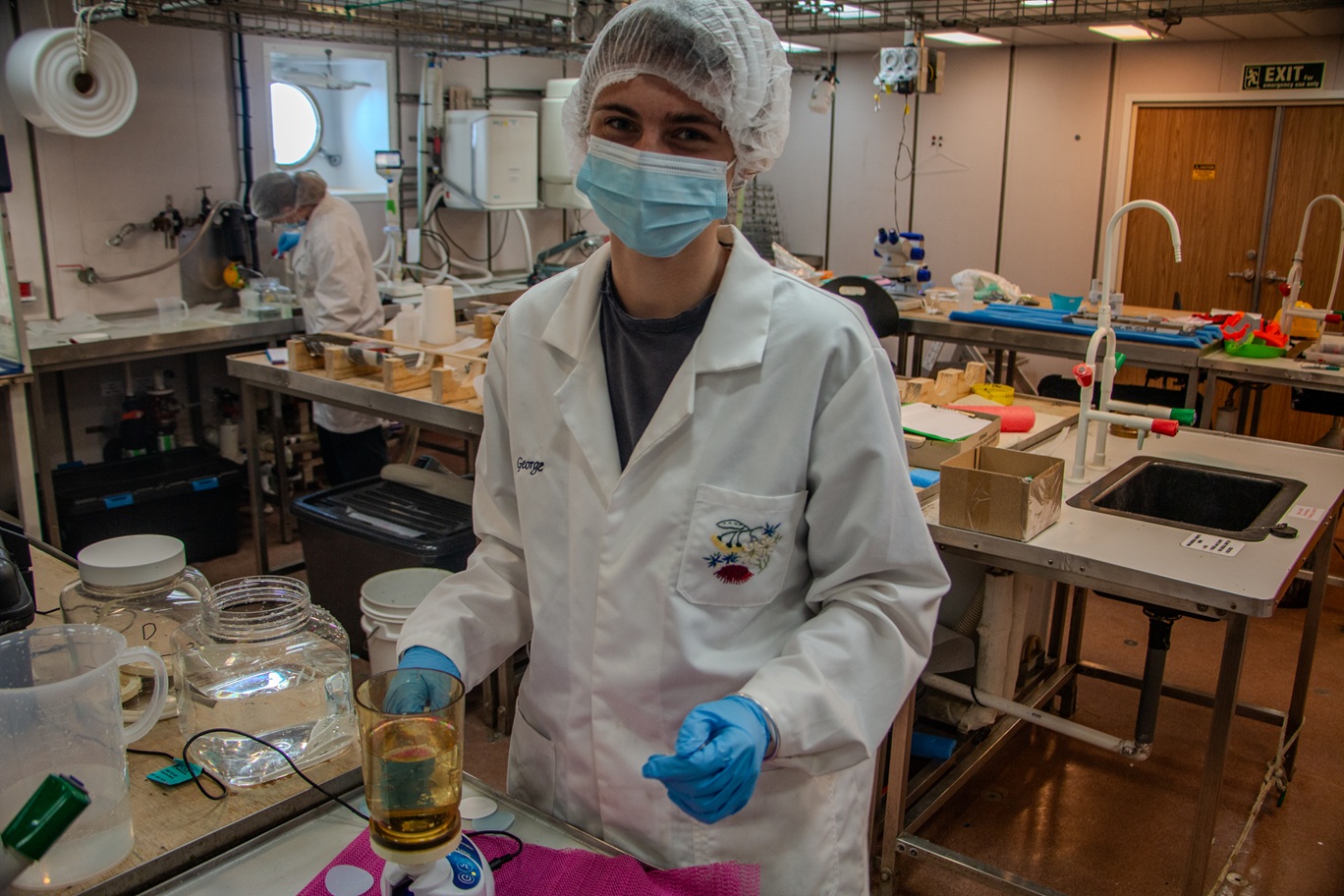
This research was supported by a grant of sea time on RV Investigator from the CSIRO Marine National Facility.
Cover image: An image of a Stalked hydroid (Corymorphidae) in the Hunga Tonga–Hunga Ha’apai region was captured using a deep-water towed camera deployed from the RV Investigator. Credit: CSIRO