




Written by Associate Professor Kara Barry, Tasmanian Institute of Agriculture
The project, 'New On-farm Strategies for the Prevention and Control of Blueberry rust in Tasmania', was funded by the Tasmanian Government and was undertaken to explore strategies and options for Tasmanian blueberry growers to manage blueberry rust.
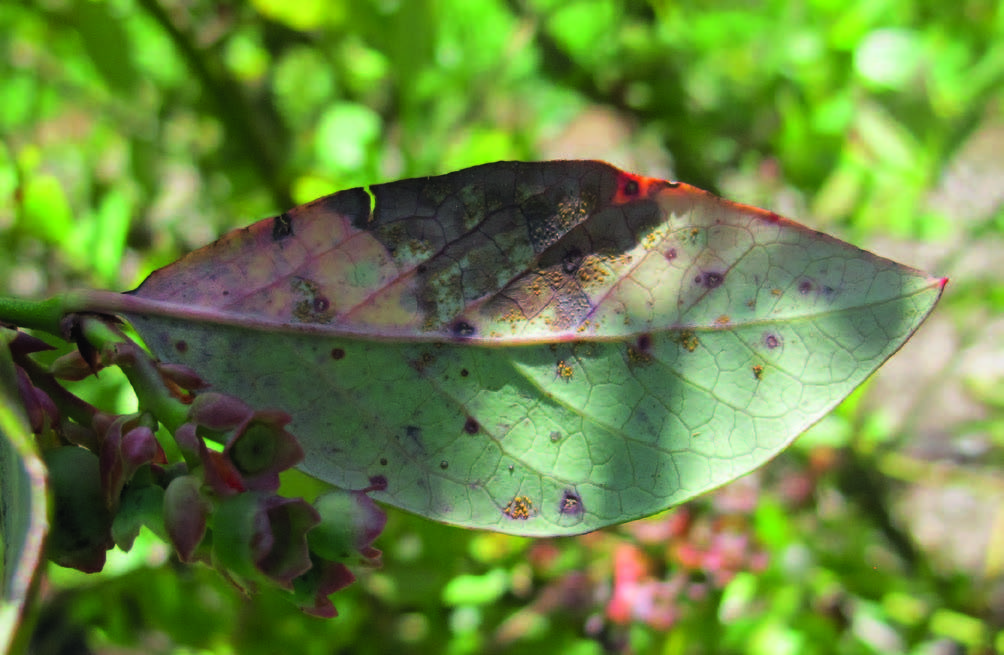
This disease, caused by the rust fungus Pucciniastrum minimum, is relatively new to Tasmania. After several years of containment, it was declared endemic in 2022. The rust infects blueberry foliage and fruit, and only survives on living plant tissue.
While the disease can be well controlled in most environments with a range of management practices, including fungicides, options to effectively reduce the disease or manage it with additional or alternative methods in a cool climate were of interest to the industry.
The project aimed to address two main goals, which are summarised in this article.
Goal 1: Breaking the pathogen life cycle over winter
This goal explored options that may prevent the rust overwintering on evergreen and semi-evergreen blueberry cultivars, in order to break the rust life cycle. This firstly included determining whether cold winter conditions would naturally break the life cycle.
Urediniospores are the ‘summer’ spore in regions of the world where the rust has originated, and it is other spore types that are able to overwinter. In Australia, only the urediniospore form have been found.
Urediniospore survival was tested in controlled conditions with a range of cold temperatures, with NSW populations of blueberry rust (which were demonstrated by gene sequencing to be genetically the same as the Tasmanian populations).
These studies concluded that blueberry rust spores can survive and continue to germinate after exposure to extended temperatures as low at -5°C (colder than typical Tasmanian winters), whether on detached leaves or on living plants. While there was evidence that pustule activity may be slowed down by -5°C exposure on detached leaves, whether this occurs on attached leaves could not be determined. The findings that the pathogen can survive sub-zero temperatures align with field observations across Tasmania.
Another aspect of pathogen overwintering explored was the potential to defoliate blueberry cultivars that maintain foliage over winter (and therefore sustain rust inoculum). Defoliation trials were conducted with the most popular semi-deciduous cultivar, ‘Legacy’, in a commercial orchard. Replicated field trials were conducted over 3 years, which compared hand defoliation to a range of chemical defoliants (including urea, zinc sulphate, copper sulphate, copper chelate, synthetic abscisic acid product ProTone™, ethylene promoter VBC Accede, and ethephon).
Results demonstrated that while several of the chemical options tested could result in efficient defoliation, the impact on yield was substantial. Application of ProTone™ in late autumn (mid-May) had the least impact on yield (84% compared to undefoliated controls in the first season, and 95% in the second season). However, two applications of ProTone™ were needed to obtain full defoliation, and it is the most expensive of the chemical options trialled; therefore, it may not be financially viable.
Further trials are needed to explore different rates of chemical defoliants and optimal timing of application. Hand defoliation, when conducted in winter, was shown to have no impact on yield, and while very labour-intensive, may be a viable option for small, highly infected areas of orchards.
Goal 2: Understanding how environmental conditions influence infection risk
While blueberry rust disease may survive winter, it is optimal infection conditions that lead to increased disease incidence and severity, which then impacts crop yield. Optimal conditions include the combination of susceptible leaves and warm, wet weather. Knowing
when those optimal conditions occur enables management efforts to be well timed.
The project aimed to characterise the timing of leaf development in spring, which determines when susceptible leaves are present to start the new infection cycle. For two widely grown blueberry cultivars, ‘Brigitta’ and ‘Legacy’, leaf development was assessed weekly from July to November over two years, at five commercial orchards.
Using weather data obtained at each site, models were developed that could best predict the leaf development. To find a model that was the best fit across all sites (i.e. a statewide model), several options were tested, including temperature (growing degree days), humidity and photoperiod (daylength). The photoperiod model was the best fit to the data.
With this model, a calendar-based guide to estimate leaf development was generated, which has the advantage of not requiring blueberry growers to collect and upload weather data. The calendar-based guide is useful for planning disease management in the early
stages of the season, and we expect infection risk to increase once leaves are 2-3 weeks old.
Once leaves have expanded and are susceptible, the infection risk then depends on weather conditions. An existing model for spore germination was validated with laboratory experiments using Tasmanian rust spores. The optimal spore germination and infection
occur when moisture is available for at least 2 hours at 21°C, with no germination below 12°C or above 30°C.
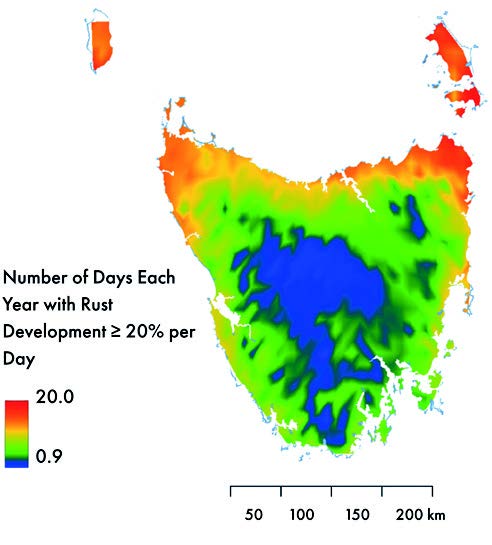
This model was then used to create spatial maps for infection risk in Tasmania, based on observed weather (1986-2015), including both temperature and humidity (modelled to leaf wetness), for grids of 10 km2. For example, the map shown (Figure 1) highlights that all regions of Tasmania have one day per year where at least 20% of rust spores will germinate, while some regions (particularly the North of the state) could have up to 20 days per year where at least 20% of rust spores will germinate. Data for the whole state is based on interpolation between grid points, and it is important to note that as site microclimate may vary between grid points, these maps are indicative only.
Conclusion
This project demonstrated that overwintering rust remains a challenge for non-deciduous varieties, and supports emphasis on preventing and controlling blueberry rust via standard disease management practices (including cultural and chemical controls).
For blueberry growers with non-deciduous blueberry cultivars, managing the disease well during the season should be a high priority. This includes orchard hygiene, disease monitoring, maintaining open canopies, effective fungicide applications (product choice and timing to align with infection risk) and considering varietal susceptibility.
In areas of higher blueberry infection risk, planting deciduous cultivars is a recommended option.
This article first appeared in the Winter 2026 edition of the Australian Berry Journal, the berry industry’s magazine funded by Hort Innovation using the Berry research and development levies and contributions from the Australian Government. Hort Innovation is the grower- owned, not-for-profit research and development corporation for Australian horticulture.