


Researchers say a commercially valuable seaweed could offer a natural solution to nitrogen pollution, while supporting a growing aquaculture industry.
A type of red seaweed already attracting attention for reducing methane emissions from cattle could soon have another important job – helping clean up Australia's coastal waters.
A new study from the University of Tasmania’s Institute for Marine and Antarctic Studies (IMAS) published in Ecological Modelling has found that two seaweed species native to Australia, Asparagopsis armata and Asparagopsis taxiformis, could be good candidates for managers looking to remove excess nitrogen from the ocean.
Nitrogen is a major cause of water pollution and declining marine health. It enters coastal waters through sources such as agricultural runoff, wastewater treatment plants, fish farming, urban stormwater, and many other human activities.
Scientists are increasingly exploring natural ways to remove excess nutrients before they cause environmental harm.
“While nitrogen is an essential nutrient, too much of it can trigger harmful algal blooms, reduce oxygen levels and damage marine ecosystems,” said IMAS researcher and lead author Dr Tormey Reimer.
“One promising approach is cultivating seaweed, which is very effective at absorbing nitrogen as it grows,” Dr Reimer said.
“Growing seaweed is relatively low impact and, after harvesting, it can be processed into useful products like food additives, cosmetics and fertilisers.”
A seaweed with two environmental benefits...
Asparagopsis has already gained significant attention as a livestock feed additive that can reduce methane emissions. As demand for the seaweed grows, researchers wanted to know whether commercial farms could also improve water quality by removing nitrogen from surrounding waters.
Two species of Asparagopsis, A. armata and A. taxiformis, occur naturally in Australia, so commercial farming would not need to introduce any new species.
Using computer models, the researchers simulated how these two species would grow in coastal waters around Australia under a range of environmental conditions, including both normal and elevated nitrogen levels.
The study used an established seaweed growth and nitrogen removal model to find that both Asparagopsis species can effectively remove nitrogen from coastal waters, although their performance depends on location and environmental conditions.
The modelling showed that the cooler-water species, A. armata, performed best in southern Australia, particularly in South Australia, Victoria and Tasmania. Meanwhile, the warmer-water species, A. taxiformis, was shown to be more effective in Queensland, the Northern Territory, and northern Western Australia.
Importantly, both species became much more effective in removing nitrogen when levels were consistently elevated, simulating conditions similar to those found near fish farms or wastewater outfalls. In these nutrient-supplemented environments, modelled nitrogen removal increased by as much as 30 times in some locations.
Unlike some seaweeds that rapidly soak up sudden bursts of nutrients, Asparagopsis absorbs nitrogen relatively slowly. However, it can store large amounts of nitrogen in its tissues, allowing it to steadily remove nitrogen over time.
This makes it particularly well suited to Australian conditions, where nitrogen concentrations in coastal waters are relatively low in a global context. This also means that Asparagopsis is likely to be effective in locations where nitrogen pollution is continuous rather than occasional, such as around aquaculture operations or wastewater discharge points.
Opportunities for Australia's growing seaweed industry
Australia's seaweed industry is expected to grow rapidly over the coming decades, with Asparagopsis production driven largely by demand for methane-reducing livestock feed.
“We suggest that strategically locating Asparagopsis farms in nutrient-elevated coastal areas could deliver a valuable ‘three-for-one’ outcome – producing a commercially valuable harvest and reducing methane emissions from livestock, while simultaneously improving water quality,” said IMAS researcher and co-author, Dr Katie Cresswell.
“In some regions, farmers could try alternating between the two Asparagopsis species throughout the year to maximise nitrogen removal.”
The framework used in this study is now freely available for assessing existing or prospective cultivation sites for both their commercial and bioremediation potential.
While the findings are promising, the researchers highlight that the study is based on computer modelling rather than field trials.
“More research is needed to better understand how Asparagopsis grows under different environmental conditions on a more site-specific basis, and particularly how temperature, light and nutrient availability interact in real-world farming systems,” Dr Reimer said.
Despite its increasing public profile, there has been relatively little research on the basic growth behaviours of Asparagopsis. Further information on the species is needed to enable future strategic planning for Asparagopsis aquaculture.
Future work could also identify the best locations for seaweed farms and investigate cultivation methods that maximise both harvest yields and environmental benefits.
“The potential is huge,” Dr Reimer said.
“Australia has so many unique seaweed species and we're just scratching the surface of what we can do with them. There's so much left to explore."
This study suggests that farming native Asparagopsis seaweeds could become an important tool for improving coastal water quality while supporting Australia's expanding seaweed aquaculture industry.
“Although more testing is needed, our research highlights an opportunity to combine environmental restoration with commercial seaweed production, which would help tackle two major challenges with a single solution,” Dr Cresswell said.
This research was funded by an Australian Government’s Fisheries Research and Development Corporation (FRDC) project: Investigating the bioremediation potential of seaweed aquaculture across Australia (2023-193)
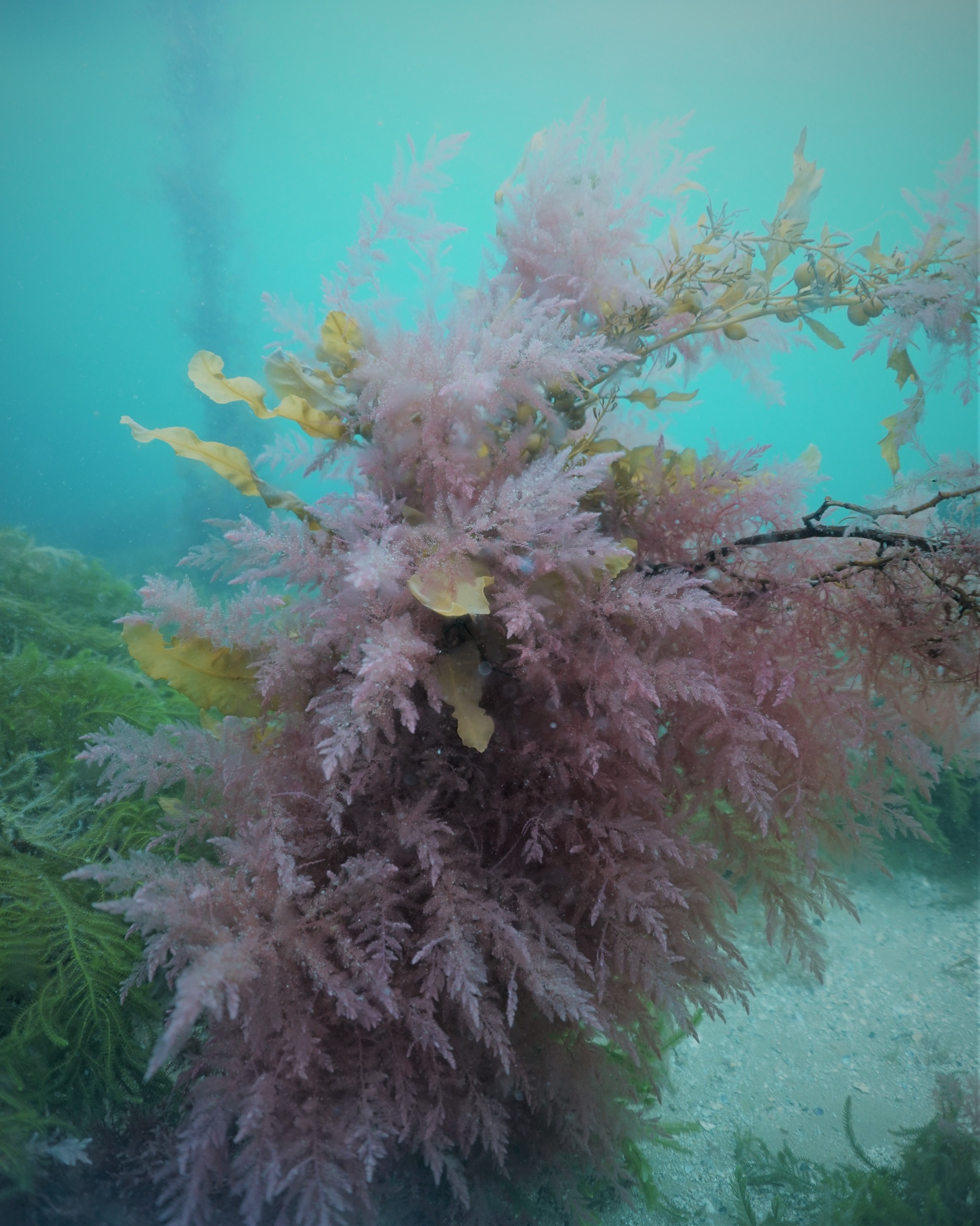
Cover image: Asparagopsis growing in
Charlotte Cove, Tasmania. Credit IMAS