Transforming our southern campus

The University of Tasmania is revitalising teaching, learning and research facilities in the south to help meet the needs of the community and its future.

A future direction for our Hobart campus

The University of Tasmania has embarked on a mission to bring contemporary campus facilities to life in Hobart that offer an exceptional educational setting for students while contributing to an important future for Southern Tasmania. Our plan is to create a Hobart campus comprising four key sites that provide students with experiences built around the best the city has to offer. This plan is contingent on securing significant government funding and, if realised, would see our university embedded across the Hobart community in the following way:

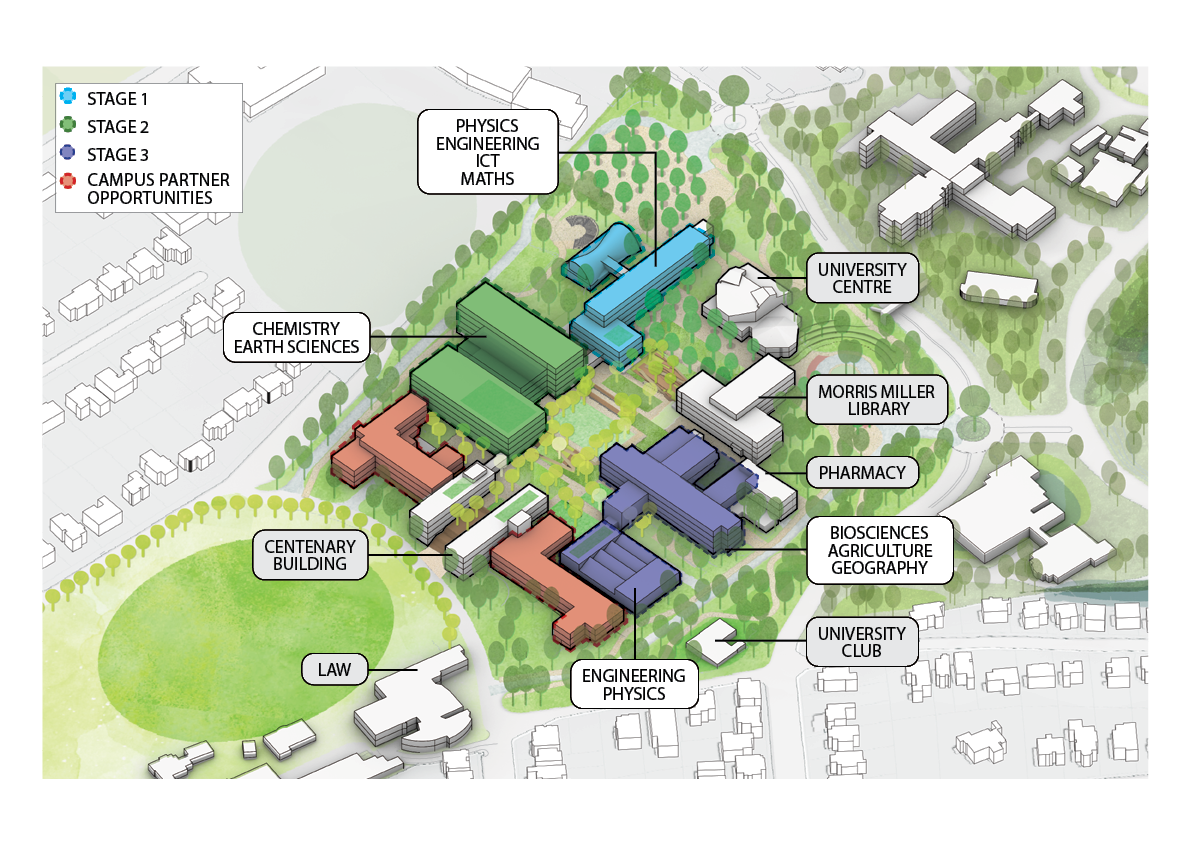
  • A Science, Technology, Engineering and Mathematics (STEM) Campus at Sandy Bay. This would see a complete retrofit of some existing science buildings, the addition of new buildings and the enhancement of the natural landscape of the campus. It would provide opportunities for industry co-location, and school and community engagement.
  • A City Campus that incorporates our existing medical sciences and creative arts teaching, learning and research spaces and The Forest, the new home for the Schools of Business and Economics, Humanities and Social Sciences and Social Work.
  • A Historic Campus on the Domain, the University’s original home, which now hosts special offerings like our International School, Outdoor Education Program and aspects of our health offering.
  • A Waterfront Campus comprising the Institute for Marine and Antarctic Studies facilities at Salamanca and Taroona.

This future direction for our Hobart campus has been informed and shaped by a range of factors – the evolving educational needs of Tasmania, staff and student requirements, feedback from our community, new major policy and funding directions for higher education set by the Federal Government, the State Government’s legislative plans regarding the Sandy Bay site and its desire to see STEM remain there, as well as the City of Hobart’s planning directions. Read the story.
Frequently asked questions Get in touch

A future plan for the Sandy Bay campus

We’re seeking support from all levels of government to transform our Sandy Bay campus into a precinct for Science, Technology, Engineering and Mathematics (STEM). It would host critically needed, specialised facilities supporting STEM education and the workforce into the future. Read more.

Building our Hobart University presence since 2007

The University of Tasmania has been enhancing its city-based presence for over 15 years. With support of Federal and State governments, the University has been transforming its southern campuses to provide critical teaching and research facilities in the heart of Hobart CBD.

Find out more

Discover our newest Hobart campus buildings

Watch: Philip Smith Centre building tour

Philip Smith Centre

The Philip Smith Centre on Hobart’s Domain – the site of the University’s original home – has been carefully restored to honour its educational past. It features modern and accessible technology-enabled learning spaces that are now hosting teaching programs that serve the community’s needs.

An image of The Forest
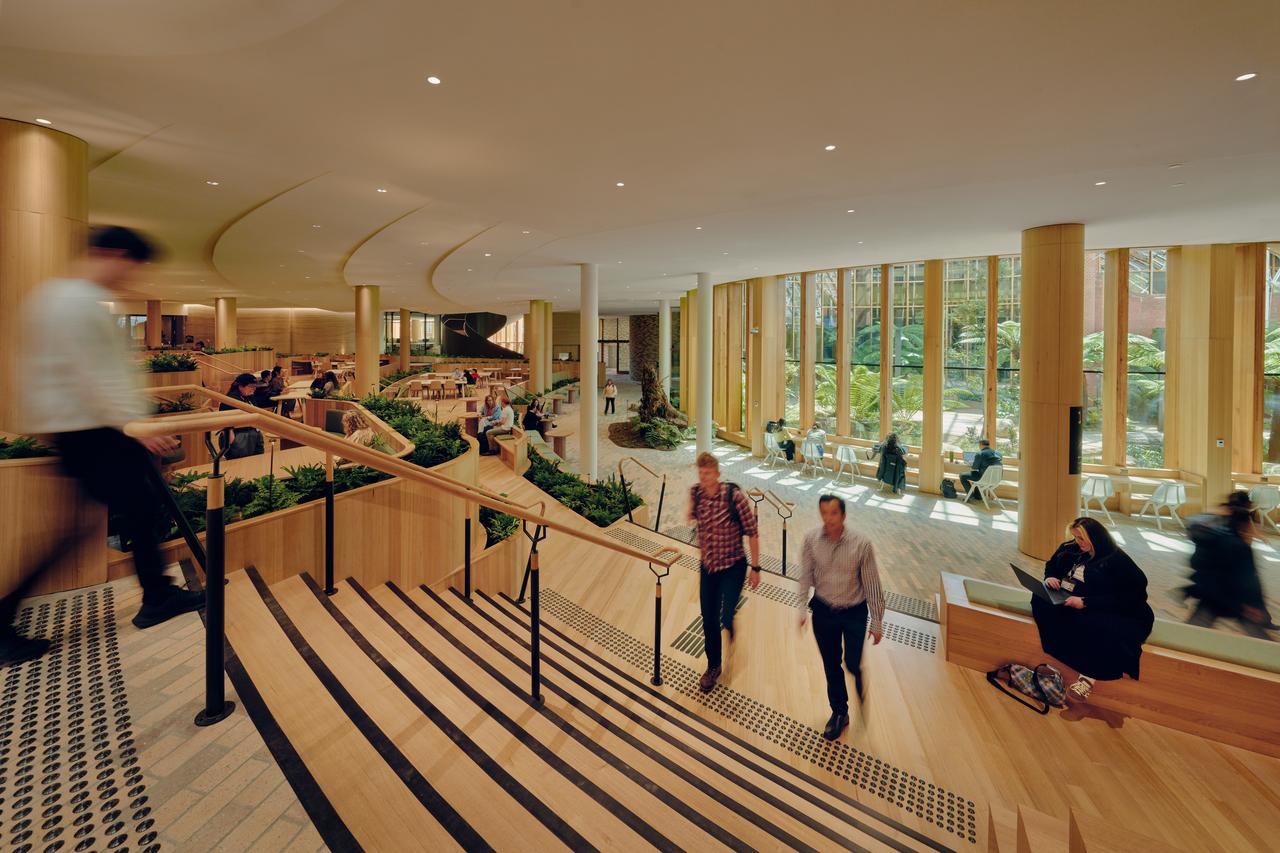
An image of the central learning landscape inside The Forest.

The Forest

The Forest has now opened as an inner-city learning hub. Designed by architects Woods Bagot and delivered by construction company Hansen Yuncken, its transformation into a place of education, research and community honours the legacy of adaptive reuse and rejuvenation previously realised on-site by Morris-Nunn and Associates. Register for a community tour.

Save UTAS campus

Frequently asked questions

Since 2007 we have been growing our presence in Hobart’s CBD. In 2024, we completed a much-needed restoration of the heritage Philip Smith Centre on Hobart’s Domain – the site of the University’s original home – where teaching programs have since commenced inside. We have also transformed the former Forestry building on Melville Street, now known as The Forest, into a site of learning and research. It's home to functions of the University which include the Schools of Business and Economics, Humanities and Social Sciences, and Social Work. Under our connected campus model, our University has a presence in central Hobart across three key sites:

  • A City Campus that incorporates our existing medical sciences and creative arts teaching, learning and research spaces, and The Forest - the new home for the Schools of Business and Economics, Humanities and Social Sciences, and Social Work.
  • A Historic Campus on the Domain, the University’s original home, which hosts special offerings like our International School, Outdoor Education Program and some disciplines within Health.
  • A Waterfront Campus comprising the Institute for Marine and Antarctic Studies facilities at Salamanca and Taroona

From 2026, 70% of the University’s Southern Tasmanian on-campus students will study in the Hobart CBD. Music and Creative Arts have long been established in the CBD. The Medical School moved from Sandy Bay to the new Medical Sciences Precinct, which was built between 2009 and 2013, and the Institute for Marine and Antarctic Studies (IMAS) moved into its new CBD building in 2014. Student accommodation has grown since 2015 and the Media School and Business and Economics moved into the city in 2019 and 2021 respectively.

We remain deeply invested in Sandy Bay and a range of courses are being delivered here with teaching and learning activities, along with student services, organised around a central and vibrant campus heart to ensure our students continue having a dynamic and enjoyable university experience. Under our future direction, Sandy Bay will play an important role for higher education as our STEM campus in Hobart. Our planning for the site’s future also considers Hobart City Council’s Mt Nelson and Sandy Bay Neighbourhood Plan.

Developing specialised STEM facilities at our existing site in Sandy Bay provides opportunities to create a precinct that enables other education providers and industry to co-locate and collaborate, along with opportunities for school and community engagement. The positive engagement we’ve had with a range of stakeholders, including our colleagues and students in Sciences and Engineering, is also supportive of developing a specialised STEM campus at Sandy Bay. The State Government – which recognises the need for this investment – has expressed a desire for STEM to remain at Sandy Bay, and the recent legislation it introduced requiring the University to seek approval from Tasmania’s Parliament to sell or lease land at the Sandy Bay campus has been a factor in our position. The City of Hobart Council also recently passed a motion to formally advocate for government funding to create a ‘new world class STEM Hub’ at Sandy Bay.

We are seeking to work with the Tasmanian and Australian Governments to develop a plan to fund new STEM facilities below Churchill Avenue. If funding can be secured, this would involve complete retrofits of some existing science buildings, the construction of some new buildings, and enhancement of the natural landscape of the campus. There is a considerable process we will need to work through to inform how this development takes shape in a way that best supports our community and minimises disruption to existing activities happening on site.

Our need for contemporary STEM facilities is critical. As the only university for Tasmania, we have a role to play in ensuring equity of higher education access to everyone in our community, providing our students with a university experience that’s as good as you would find anywhere else and delivering this in contemporary, fit-for-purpose facilities that enable the best learning outcomes.

Contemporary STEM facilities in the South are important for our students and staff to ensure that future STEM education in Tasmania delivers on workforce needs, and our State is able to meet the significant challenges we face. Renewing our STEM infrastructure will enable our University to deliver the kind of teaching and research that both graduates and society will need into the future, while attracting new students and the next generation of science educators and researchers. Upgraded facilities will also help us attract the best researchers to Tasmania and ensure we retain the high performing academic staff we already have. Future proofing the Sandy Bay campus is also an important part of our connected campus model for southern Tasmania. Read more in our STEM Precinct Detailed Business Case.

The new STEM precinct that Tasmania needs will cost in the order of $500 million to deliver the specialist, contemporary facilities to educate and train professionals across these disciplines into the future, and support from all levels of government in addition to the University’s contribution will be critical. We are seeking a coordinated, collaborative path to fund new STEM facilities in the South, similar to the successful approach we took in the North and North-West that has helped us deliver new campus precincts for the community at Inveresk in Launceston and Burnie’s West Park.

Yes, the STEM Precinct Detailed Business Case outlines why this project is critical for Tasmania and how the University would approach delivering a Science, Technology Engineering and Mathematics (STEM) Precinct at the Sandy Bay campus. For several years now, we have been advocating for STEM investment for Southern Tasmania, with an earlier iteration of our Business Case approved and listed on Infrastructure Australia’s priority list since 2017. Contemporary STEM facilities in the South are important for our students and staff, and for the future of STEM education in Tasmania, to meet workforce needs, and for our State’s ability to meet the challenges we face here and around the globe.

The concept plan for a STEM precinct at the Sandy Bay campus can be found on our website. Developed with input from our staff, students and stakeholders, it followed a STEM Appreciative Inquiry workshop we held in 2024 bringing together 65 students, University staff, government, industry and community representatives to begin shaping our plans for a new STEM facility. Prior to this, the University led extensive engagement activities with students and staff, including surveys and workshops, to identify and understand the future needs of STEM facilities in Southern Tasmania.

Our concept plan outlines a staged approach for establishing a STEM precinct at the Sandy Bay campus to ensure continuity of teaching and research activities on site as the project is delivered, while supporting students and staff who might be transitioning from facilities from above Churchill Avenue to the lower part of the campus.

The Building our Hobart presence website outlines how our University’s southern campus model has evolved over the years. It also includes a number of key documents, reports and summaries. Further information relating to establishing a STEM precinct at the Sandy Bay campus, including the STEM Precinct Detailed Business Case, can be found within the 2024 onwards section.

Our mission as a university is to make a difference for and from Tasmania through education and research. Making sure we have the facilities and infrastructure to support our students and staff is central to our ability to deliver on that mission. Investing in contemporary STEM education and research infrastructure will create opportunities for young Tasmanians and help build a sustainable, prosperous and inclusive future for our community.

We cannot achieve the STEM Precinct alone and we look forward to working collaboratively with all levels of government to navigate this challenging path. In the meantime, we will remain focused on ensuring students and staff can enjoy a rich and vibrant experience at our Sandy Bay campus in its current form.

This approach is outlined in the STEM Precinct Detailed Business Case.

While John Fisher College and Christ College do sit within the land area for rezoning, these would be excluded from any development as they will continue to be utilised as student accommodation by the University and operate as normal. The University’s future STEM plans will benefit student accommodation activities and support the ongoing vibrant living community offered in Sandy Bay.

The Bill does three things. Firstly, it protects and supports the long-term future of the University campus between Churchill Avenue and Sandy Bay Road. This has been an important heart of the University’s operations since we first moved from the city to Sandy Bay in the 1960s and is the home of our proposed STEM precinct.

Secondly, passage of the Bill enables us to move forward with plans to secure the stewardship of the bushland above Churchill Avenue, which forms the majority of the Upper Campus, by working with the Aboriginal Land Council of Tasmania (ALCT) to give back land to the Aboriginal community. This is part of our ongoing work to be a truly place-based university, which requires us to honour and support the flourishing of Aboriginal people. Returning this land to its traditional owners is an important step in giving weight and meaning to the formal apology the University made to Tasmanian Aboriginal people in 2019. Now that we have legislative certainty, we will restart work with the ALCT on a Memorandum of Understanding to facilitate this handback.

Finally, two parcels of land above Churchill Avenue, which are adjacent to existing residential areas and roughly half the size of the bushland area, have been rezoned as inner residential. This means we now could sensitively develop part of the campus and use the funds to support much needed investment in STEM facilities.

Existing teaching and research facilities above Churchill Avenue, including the Life Sciences building, would remain open and operational until improved facilities became available at the Sandy Bay campus, ensuring activities and the student and staff experience would not be impacted. The transition to future facilities would be carefully planned with the close guidance of our Sciences and Engineering leadership ensuring we organise this across the campus in a way that delivers the teaching and research Tasmania needs. A future location for teaching and research facilities including the FireLab and the glass houses will be determined in consultation with key staff. It has always been our intention to retain many existing facilities including student residential accommodation (John Fisher College and Christ College) and the sporting fields.

Our current STEM facilities date back to the 1960s, and while they remain in use, these buildings continue to age and require urgent renewal. Our STEM Business Case (page 29) shows much of our STEM infrastructure as being rated poorly for both building condition and functionality. Sandy Bay STEM facilities are some of the oldest the University has, which is why we require critical investment to deliver new, modernised facilities that ensure the quality of STEM teaching, education and research meets our State’s needs into the future.

Get in touch

Engage with us

We are very keen to engage with students, families, staff, Hobart residents and business about how we can work together to achieve the best outcomes for everyone.

Questions or feedback?

Email campus.transformation@utas.edu.au and a member of the team will be happy to provide assistance.

Join the mailing list for updates

Complete your details below and you'll receive our Southern Transformation e-Newsletter.

By submitting this form you consent to the University collecting, using, storing and disclosing your personal information in accordance with the University’s Privacy Policy.