

Are you starting your dementia care learning journey? Your first step is the Undergraduate Certificate in Dementia Care. Please visit that course page to learn more.
The below information is for students who have finished the Undergraduate Certificate and are looking to continue their studies into the Diploma.
Overview (2027)

Key Information


Duration
Minimum 1 Year, up to a maximum of 4 years.


Location
Duration
Minimum 1 year, up to a maximum of 4 years.
Location
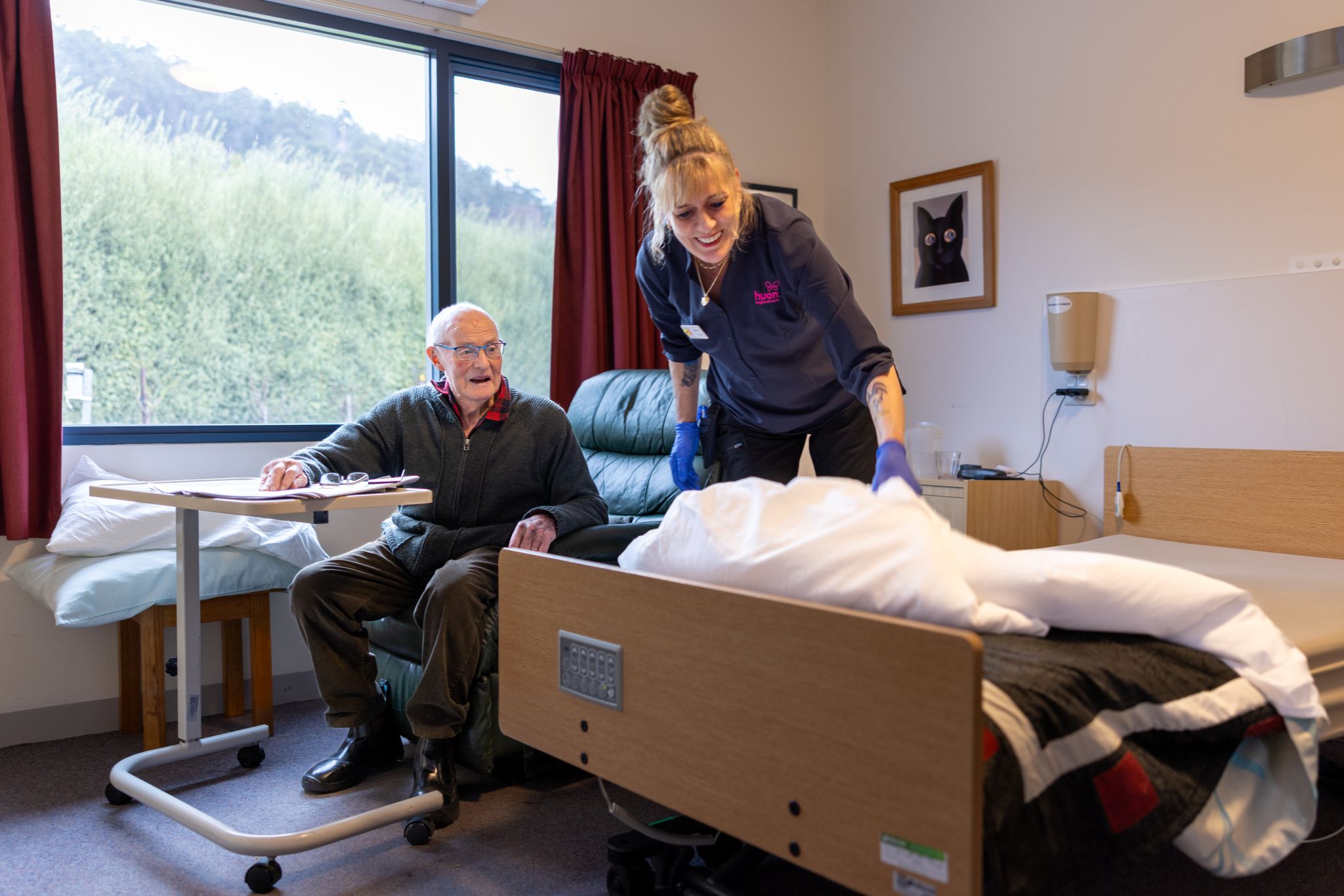
The below information is for students who have finished the Undergraduate Certificate in Dementia Care and are looking to continue their studies into the Diploma.
If you are starting your dementia care learning journey, please visit the undergraduate certificate course page.
In 2026 there are over 450,000 Australians living with dementia, and dementia is now the leading cause of death in the country*. With the scale of dementia diagnosis increasing, the need to provide quality care in the home, community, health care centres, hospitals, and residential care is more important than ever.
It is becoming essential that health care workers in aged care develop specialised knowledge in this field to can make a difference to the lives of people living with dementia. It is also important that the wide range of family, friends, and other personal carers in the community are supported to care for friends and loved ones who are living with dementia.
This course has been developed to meet that that need by the Wicking Dementia Research and Education Centre, global leaders in dementia education with a mission to transform the understanding of dementia worldwide.
You will learn from multidisciplinary lecturers who are active in dementia research, drawing on the latest data as part of your studies.
The course is offered fully online with authentic, varied assessments that do not include exams, face to face sessions, or workplace assessment components. Learning and assessment are supported with the use of real-life case study examples. This course is designed to be undertaken by the wide range of personal and professional carers and others who work and interact with people living with dementia around the globe.
Dedicated Student Advisers are on-hand throughout the course, providing support and guidance throughout your studies, and it can be studied full-time or part-time.
- 1 Describe structure, function and dysfunction of the nervous system in the major diseases causing dementias
- 2 Discuss the multidisciplinary evidence for approaches to optimise the health and social care of older people including those living with dementia
- 3 Explain collaborative, person-centred approaches to inclusion, support and care of diverse people living with dementia and their families
Career outcomes
Over 400,000 Australians are currently living with dementia; this number increases every year. The impact on communities, families, governments and health professionals will be significant as these numbers increase. Our workforce is currently ill equipped to help care for such large numbers of people living with dementia – by 2050, it is estimated that there will be over 900,000 people in Australia living with dementia.*
Individuals with backgrounds in healthcare, community service, and allied health, may find study in this course advantageous. The Diploma of Dementia Care is particularly relevant to aged care workers and health professionals wishing to develop their knowledge of dementia, to increase their confidence when working with people living with dementia and to enhance their practice. Hear from our current students and graduates.
* Dementia Australia (2023) Dementia Prevalence Data 2024-2054, commissioned research undertaken by the Australian Institute of Health and Welfare.
Course structure
Neuroscience is the study of how the nervous system works, how the cells of the nervous system are organised and how they develop and change in the presence of common disease conditions, including dementia. You will learn about the structure…
Credit Points: 12.5
| Location | Study period | Attendance options | Available to | ||
|---|---|---|---|---|---|
| Online | Semester 1 |  |  |  | |
| Semester 2 | | | | ||
- Key:
 On-campus
- Off-Campus
- International students
- Domestic students
This introductory unit will explore the physical and cognitive changes that occur during the ageing process, and age-related pathological changes that can lead to diseases that cause dementia. This unit will introduce fundamental neuroscience concepts in the healthy adult, ageing…
Credit Points: 12.5
| Location | Study period | Attendance options | Available to | ||
|---|---|---|---|---|---|
| Online | Semester 1 | | | | |
| Trimester | | | | ||
- Key:
- On-campus
- Off-Campus
- International students
- Domestic students
This unit provides an overview of the journey through dementia from the perspective of people with dementia and those who provide care and support to them. Students will learn about ways to identify and respond to needs that arise on…
Credit Points: 12.5
| Location | Study period | Attendance options | Available to | ||
|---|---|---|---|---|---|
| Online | Semester 1 | | | | |
- Key:
- On-campus
- Off-Campus
- International students
- Domestic students
View all details for CAD104 Principles of Supportive Care for People With Dementia
In this unit you will examine demographic trends in the ageing population along with social and cultural determinants of health and how these factors continue to shape the needs of older people in society. You will investigate how these needs…
Credit Points: 12.5
| Location | Study period | Attendance options | Available to | ||
|---|---|---|---|---|---|
| Online | Semester 1 | | | | |
- Key:
- On-campus
- Off-Campus
- International students
- Domestic students
View all details for CAD115 Health Services for an Ageing Population
In this unit you will gain knowledge of modifiable and non-modifiable risk factors for dementia, and of contemporary strategies to dementia therapies. You will be introduced to varied approaches to supporting quality of life for people with dementia, including community-based…
Credit Points: 12.5
| Location | Study period | Attendance options | Available to | ||
|---|---|---|---|---|---|
| Online | Semester 2 | | | | |
- Key:
- On-campus
- Off-Campus
- International students
- Domestic students
View all details for CAD116 Introduction to Therapeutic Approaches for Dementia
This unit addresses the importance of communicating effectively and positively with people who have cognitive impairment and/or a diagnosis of dementia, and with those who provide support and care. You will learn about how the changes associated with dementia affect…
Credit Points: 12.5
| Location | Study period | Attendance options | Available to | ||
|---|---|---|---|---|---|
| Online | Semester 1 | | | | |
- Key:
- On-campus
- Off-Campus
- International students
- Domestic students
View all details for CAD117 Effective Communication for Dementia Care
In this unit you will learn the principles of culturally respectful, safe and trauma informed care for Aboriginal and Torres Strait Islander adults, including those people with dementia. In the context of the social determinants of health relevant to Aboriginal…
Credit Points: 12.5
| Location | Study period | Attendance options | Available to | ||
|---|---|---|---|---|---|
| Online | Semester 2 | | | | |
- Key:
- On-campus
- Off-Campus
- International students
- Domestic students
In this unit, you will learn to write for success in tertiary study and develop academic study skills. This unit will develop your self-motivation, time management, planning and organisational skills. In this unit you will also begin to develop learning…
Credit Points: 12.5
| Location | Study period | Attendance options | Available to | ||
|---|---|---|---|---|---|
| Online | Semester 1 | | | | |
| Semester 2 | | | | ||
- Key:
- On-campus
- Off-Campus
- International students
- Domestic students
View all details for CAD003 Foundations of University Study in Dementia Care
The rising prevalence of dementia is one of the most significant health, social and economic issues facing the world. The global challenge of dementia will require innovative solutions to improve the lives of people with dementia and their carers. The…
Credit Points: 12.5
| Location | Study period | Attendance options | Available to | ||
|---|---|---|---|---|---|
| Online | Semester 2 | | | | |
- Key:
- On-campus
- Off-Campus
- International students
- Domestic students
View all details for CAD121 The Global Challenge of Understanding Dementia
Entry requirements
We encourage you to apply for the courses you most want to study. If you are not eligible to enter your chosen course right now, the UTAS admissions team will work with you to find the best pathway option.
Enquire online for advice on the application process and the available pathways to study at UTAS.
Domestic applicants from all educational backgrounds
Admission to the Diploma of Dementia Care requires applicants to first complete the requirements of the Undergraduate Certificate in Dementia Care at the University of Tasmania. This comprises 4 x 12.5% units (50 credit points). Applicants who do no meet this requirement are encouraged to apply for the Undergraduate Certificate in Dementia Care (50F) as a pathway into the Diploma (M1D)
SPECIAL CONSIDERATIONIf your ability to access or participate in education has been affected by circumstances beyond your control, you can apply for special consideration as part of your application. We will consider a range of factors for special consideration, including economic hardship, a serious medical condition or disability.
We can only approve applications for special consideration where we are confident that you have the necessary skills and knowledge to succeed in your studies. If your application is not approved, the UTAS admissions team will work with you to find the best alternative pathway to your chosen course. Special consideration is not available for international applicants.
All international students will need to meet the minimum English Language Requirements, University General Entry Requirements and any course specific requirements such as pre-requisite subjects, if applicable.
English Language Requirements
This degree requires an IELTS (Academic) of 6.5, with no individual band less than 6.5, or a PTE Academic score of 58, with no score lower than 58 or equivalent.
For students who do not meet the English Language Requirement through citizenship, evidence of an approved English language test completed within the last 2 years must be provided. See the English Language Requirements page for more information.
General Entry Requirements
This is an open access course.
Course Specific Requirements
Students must have access to a computer, reliable internet connection, webcam, headset and microphone.
Applications for credit can be made in your course application. Find out more information about how to apply for a credit transfer/advanced standing at Recognition of Prior Learning.
Graduates of the Diploma of Dementia Care are eligible to continue their studies into the Bachelor of Dementia Care with all eight units, or 100 credit points, of advanced standing.
N/A
Detailed admissions information and advice for all undergraduate courses, including comprehensive, course-level student profiles, is available from UTAS Admissions.
Fees & scholarships
Domestic students
Commonwealth supported places (CSP) are available for this course. For eligible domestic students, this means your fees will be subsidised by the Australian Government. You’ll only need to pay the student contribution amount for each unit you study within the course.
Commonwealth Supported Place indicative annual fee: $11,399
How is this calculated?
This is an estimate. The calculation is based on the average full-time enrolment for this course in 2026. All figures are indicative only for 2027. Actual tuition fees will depend on specific unit enrolment, and are subject to annual increases each year. You can find the complete fee details for each unit of study on the individual unit pages. The units for this course are found in the course structure section of this page.
These figures do not include other costs such as the Student Services and Amenities Fee (SSAF). For further information, please visit Scholarships, fees and costs.
HECS-HELP loans
You may be able to defer payment of the student contribution amount by accessing a HECS-HELP loan from the Government. If eligible, you’ll only have to pay your tuition fees once you start earning above a specific amount.
Further information on student loans and a CSP eligibility checker can be found at Australian Government Study Assist.
International students
2027 annual international student tuition fee: $15,250 AUD
The standard year of study for this course is 100 credit points.
Indicative total tuition fee for international students: $ 15,250 AUD.
This total tuition fee is indicative only. Please visit fees and costs for further information on how this is calculated.
International students are charged the Student Services and Amenities Fee but this fee is incorporated in the annual rate. International students do not have to make any additional SSAF payments.
Domestic scholarships
The Diploma of Dementia Care is available with 100% HECS tuition fee scholarship for eligible domestic students studying in 2027. This means you can have NO tuition fees to pay.
Fee scholarship details
For domestic students studying in 2026, we are pleased to offer this degree with a 100% HECS tuition fee scholarship. The scholarship does not include Student Services and Amenities Fees (SSAF). This scholarship is not available for OUA students.
Eligibility
This scholarship is valid for students admitted and commencing this course in 2027 provided the eligibility criteria are met. If you are eligible, the HECS scholarship will be automatically applied upon enrolment. This scholarship is valid for units offered in 2027 only.
1. You are an Australian citizen or permanent resident (i.e. eligible for a Commonwealth Supported Place [CSP]).
2. You are enrolled in the Diploma of Dementia Care and commence study 2027.
3. You must be enrolled in a minimum of one unit and must remain enrolled until after the University Census Date relevant to the semester of study. If you are on an approved Leave of Absence (LOA), you are exempt from this requirement for the duration of your approved LOA.
4. To retain this fee scholarship, you must engage with your enrolled units. If you have not engaged and receive a result of AN (Absent deemed failed) for all enrolled units in a given study period, will not retain the scholarship/discount from the following study period onward. You cannot then apply to have the scholarship/discount reinstated.
5. You are not excluded from the course based on academic progress or misconduct.
If I'm eligible, when will my scholarship be applied?
If eligible, we will endeavour to apply your scholarship within 14 days of your enrolment, and it will be applied no later than census day of your commencing study period. This can mean that between your enrolment and the scholarship being applied, you may see the full unit cost, including SSAF, reflected in eStudent.
If you have questions about your enrolment or scholarship, please contact dementia.care@utas.edu.au.
For information on general scholarships available at the University of Tasmania, please visit the scholarships website.
International scholarships
The University of Tasmania offers a range of scholarships for full fee-paying international students, designed to recognise academic merit and support access to university study.
For many of our international scholarships you will be automatically assessed when you submit your International Student Application, meaning no separate scholarship application is required. Some scholarships may require additional application steps. Explore our International Scholarships to learn more about available opportunities and application requirements.


Share this page
How can we help?
Do you have any questions about choosing a course or applying? Get in touch.