
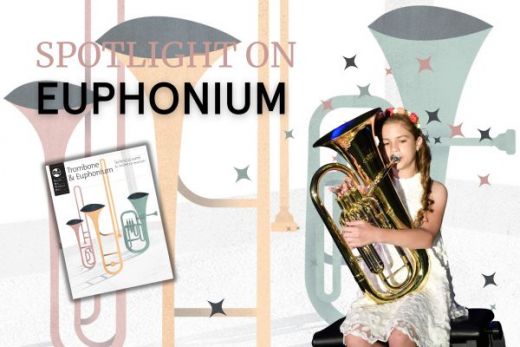
Want to take your Eupho playing from ubiquitous to euphoric? This Syllabus can help.
Euphonium straddles the brass and orchestral worlds and is arguably underutilised in the orchestral setting. But fear not! This syllabus has been developed to help you achieve new heights on your instrument and set you up for success in whatever musical pathway you choose.
As of 2020, the Euphonium Syllabus has expanded to celebrate this instrument with standalone pieces, studies, orchestral excerpts, and technical work. These resources share much in common with the Trombone Syllabus due to extensive similarities, however there is plenty to explore and specialise in where Euphonium is concerned.
What sort of pieces are in the Syllabus?
When we update syllabuses, we give the repertoire a complete refresh but don't worry - your favourites are still there. A broad range of genres, styles, and periods have been included. We aim to include pieces by a diversity of composers where musical merit allowed, but lower brass remains a group of instruments that has traditionally been dominated by male composers. Regardless, there are lots of gems and the pieces align to the technical work. At Level 2, there's a greater diversity of repertoire to support the interests of learners at higher levels. With that, the piano accompaniments are of greater complexity so it's important to note that performances of these works require quality accompanists. The Euphonium Syllabus Lists offer a curated set of pieces for the developing musician. Some works appear in both syllabuses but the majority are particularly composed for the Euphonium. Each Grade has a set of studies and works from various eras from pre twentieth century to today. And finally, there's a set of orchestral excerpts that can be chosen to support you in your career development and help to prepare for life as an orchestral musician.
Who was the brains behind the Euphonium Syllabus?
The amazing Brendan Collins led a team of specialists featuring some of Australia's finest lower brass performers and pedagogues. The Syllabus itself was reviewed along with the other lower brass instruments and one of the key outcomes was giving the Euphonium greater focus as standalone syllabuses.
What's involved in a Euphonium exam?
There are two types of exams you can do: Comprehensive and Repertoire. Just as it suggests, a Comprehensive exam involves demonstrating your learnings across a comprehensive set of components. You'll prepare your program of music and technical work (eg scales), answer questions on general knowledge, and be tested on aural and sight-reading.
Alternatively, you could do a Repertoire exam, where you perform only your pieces, demonstrating your technique and knowledge through the repertoire. Flexibility exists to choose a range of genres and styles through the set lists, and option of Own Choice works broadens your choices even further (Repertoire exams only). As long as the piece is the same standard as your Grade, you can choose pretty much anything. Repertoire Exams are a great way to get a practice run at your TCE or UTAS exams. In addition to the AMEB qualification, you'll receive constructive feedback and guidance to help in guiding your final preparations for your future performance goals.
Repertoire exams are available across all syllabuses except Band.
What is the Certificate of Performance exam?
It's an exam that's designed to help to bridge the gap between Grade 8 and AMusA, and provide a capstone to Level 2. The CoP is a recital-style exam - like the Diplomas - but is a natural continuation of skills from Grade 8. We have a Spotlight article dedicated to Certificate of Performance exams here, if you're keen to find out more.
Are there any other syllabus options available?
Yes! Our Band Syllabus is something you could take a look at. The requirements are really similar and it supports a variety of instruments found in a brass band. This Syllabus is available for Bb Euphonium but, if you're playing in brass bands, you may also want to explore the Bb Baritone option.
What other resources are available?
Each syllabus outlines the objectives and requirements for each exam so that's always the best place to start. We also have books available for cheaper access to sets of List pieces (the Grade books), recorded accompaniment (up to Grade 3 in most syllabuses), Technical Work books, and even practice books to help you with your aural and sight-reading skills. Head to your favourite local music retailer or the AMEB Online Shop for these and more.
Can I get TCE Points for a Euphonium exam?
Yes you can! And that goes for any AMEB syllabus. In fact, all practical exams are eligible for TCE bonus points from Grade 4 onwards, as well as Theory Grade 2+.
I have more questions.
That's great! We'd love to help with those. Please feel free to browse the other great sources of information on our website or get in touch to find out more.
