
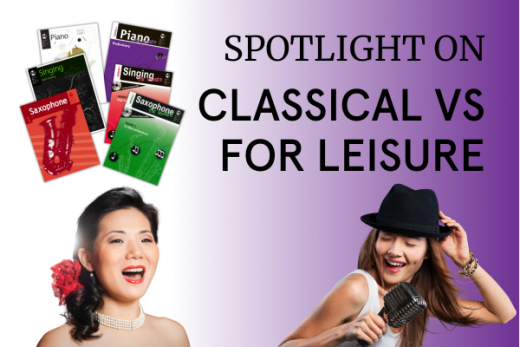
If you're learning Piano, Singing, or Saxophone, you have a veritable smorgasbord of genres and repertoire to choose from! Each of these instrument specialties is supported by the classical syllabus - the traditional syllabus titled simply 'Piano', 'Singing', or 'Saxophone' - as well as the for Leisure syllabus: 'Piano for Leisure', 'Singing for Leisure', and 'Saxophone for Leisure'.
We've put this spotlight together to highlight key similarities and differences to help you choose whichever syllabus will best support you in your learning goals and interests.
Let's look at the similarities first. Both syllabuses are:
- Available as Comprehensive and Repertoire exam formats.
- Equal in qualification.
- Eligible for bonus TCE Points.
- Based on traditional, tried-and-tested, classical technique, supported by the same technical work book.
- The same in terms of level of difficulty of Section III tests.
So what are the differences?
The key difference is the repertoire. The classical syllabuses provide a platform for the development of the classical musician. The for Leisure syllabuses explore more contemporary genres to expand beyond the traditional baroque-to-20th-century range of repertoire.
Apart from the breadth of repertoire and genres available for performance, there are a few other differences between the two:
- Both types of syllabuses exist to offer a structured and systematic progression of study to promote engagement with the instrument and its music in the pursuit of technical and artistic goals. The for Leisure syllabuses, however, explore beyond classical technique and into the popular repertoire, including well-loved standards from the classics, jazz, movie themes, and popular songs.
- When doing a Comprehensive exam, the Technical Work for both Syllabuses come from the same place. For Leisure is aligned to the classical syllabus (ie they both use the same set of scales etc), but only a subset of them are required in that exam.
- 'Own Choice' works can be part of the program of any for Leisure exam. The classical syllabuses also permit Own Choice works but only in the Repertoire exam format. This is in recognition of the breadth of music available under the for Leisure umbrella of genres. If you're looking at a classical Comprehensive exam, you'll need to select an Extra List instead.
- In a for Leisure exam (Preliminary to Grade 8), you can even perform your own composition as your Own Choice work!
- For Leisure (Comprehensive) exams offer the choice of either Aural or Sight-reading tests, whereas both are included in the Classical (Comprehensive) exam.
- Classical syllabuses go all the way up to Level 3 - Diploma exams - whereas for Leisure syllabuses round off at the Certificate of Performance.
- For Grades 6+, for Leisure syllabuses do not have the co-requisite theory requirement: your practical exam alone will earn you your qualification.
- In Level 2, Piano exams can be taken as Solo or Collaborative, however Piano for Leisure is only available as is (ie solo).
- There are slight differences in exam timing and program limits so be sure to read the syllabus thoroughly.
The number of works and their sources vary slightly between each syllabus and grade. We always recommend referring to a current syllabus to ensure you're prepared for all exam requirements.
Can I do both Classical and for Leisure exams?
Yes, you absolutely can! You don't actually have to choose. And why not? If you're keen to explore both genres, go for it! You can even chop and change to suit your passions and learning goals. The grades are benchmarked to be of very similar standard so your technical playing will support you in either. Of course, there are some specific techniques that you'll be expected to know (if you swap over down the track) but that's nothing you can't handle!
Can I use for Leisure List pieces for an exam in the other syllabus?
Yes you can, as an Own Choice piece. Unfortunately, they don't qualify as an Extra List, although some works do appear in the Lists of multiple syllabuses. It's also helpful to know that the grading is approximately consistent across the two types of syllabuses so that should help you to gauge if a piece is of an appropriate standard for your program.
What if I want to learn even more contemporary repertoire?
If you're learning Piano or Singing, we also have some more syllabus options for you.
Piano: Check out our Rockschool syllabuses for the development of contemporary skills on Piano or Keys.
Singing: Musical Theatre has it's own syllabus and Rockschool has a Vocals stream so you're sure to find something to suit your voice type and interests.
Can I do a for Leisure exam on any other instrument?
Unfortunately not. Only Piano, Singing, and Saxophone have these syllabuses in recognition of the variety of genres traditionally performed on them. However, if you're keen to explore works outside of the Lists of your syllabus, consider a Repertoire Exam - the Own Choice pieces give you the chance to tackle a huge variety of pieces and styles. Just make sure that anything you choose for your exam program is of an appropriate standard to your Grade and meets the syllabus requirements. And, if you're working towards a Rockschool exam, don't forget that you have tonnes of options with your Free Choice Pieces!
Can I get TCE bonus points for a Classical or for Leisure exam?
Yes you can! And that goes for any AMEB exam, including all Rockschool and PAA syllabuses. In fact, all practical exams are eligible for TCE bonus points from Grade 4 onwards, as well as Theory Grade 2+.
When can I do a Classical or for Leisure exam?
If you'd like to do a face-to-face exam, we offer exams in two sessions each year: Session 2 is through June and July, and Session 5 is across October and November. Pianists can join us in three other sessions through the year, too. Alternatively, you can do a Video exam absolutely any time that suits you. To find out more about exam dates, head to our Exam information page.
I have more questions.
That's great! We'd love to help with those. Please feel free to browse the other great sources of information on our website or get in touch to find out more.
