
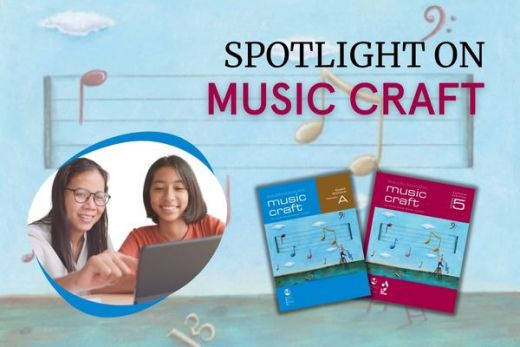
We have lots of options for learning and getting qualifications in music theory so let's explore one of them: Music Craft. It's a great pathway to expand your general music studies and focus on the theoretical and aural aspects of the dots on the page. All our Theory Syllabuses are designed to support emerging artists by enhancing the skills they need for their artistry.
What's in the syllabus?
You'll start by covering the basics - how to read music notation and the various scales, intervals, rhythms, and terminology. Instruments, Set Works, transposition, dynamics, and harmony round out Level 1 concepts. In Level 2, the rudimentary learning is expanded to consolidate and introduce more extended harmonic and structural concepts. Form is explored through topics like counterpoint and voice leading before being applied to analysis.
Alongside all of the written skills, the concepts are reinforced with aural to gain a deeper understanding and appreciation of the rudiments and harmonies.
Music Craft runs from Grade 1 to 6, by which time you're at a university level of knowledge.
How will theory help my practical skills?
This Theory Syllabus is useful to EVERY type of music performance study.
We know that understanding theory can be a huge help when it comes to growing your skills and passion for your craft. By learning theory, you deepen your knowledge and comprehension of your actions, helping inform your artistic choices. By increasing your understanding of the notes and harmonies behind the dots on the page, you gain the tools to bring the notes to life and discover new and interesting layers to your repertoire. Theory will help you to get more out of your performing arts education, and support you in your learning journey.
- You'll gain deeper insight into the composers' intentions and be able to better (and more easily) translate notes into music.
- By improving your listening skills, you'll have better intonation and your work with associate artists will be easier and more rewarding.
- Get to know your piece on a deeper level to easily identify phrases and musical lines of expression.
- Understand the written musical instructions and expand your tool kit of techniques.
- Practical exam Discussion and General Knowledge segments are a breeze when you know the backstory.
The Theory of Music material is directly relevant to all AMEB (and Rockschool) music syllabuses and is one of the options you can take to achieve any corequisite requirements for senior practical exams: if you're working towards a Grade 6 practical exam, you'll need to have successfully completed your Grade 2 theory exam and so on.
How is it different to the other AMEB music theory syllabuses?
Each of our four theory syllabuses has its own style and focus areas so it really depends what and how you want to learn. They all cover the basics - notation, harmony, terms etc - but each are presented in different ways and then take their own paths to specialised learning topics. Amongst the other classically-based syllabuses, Music Craft is unique in introducing Set Works from Grade 1, covering diatonic or modal folk songs, through to contemporary popular music and melodies from the 18th and 19th centuries. Through these Set Works, the syllabus material is presented in harmonic context, and they provide the basis for an integration of skill and knowledge areas, as each Grade progresses and expands on the information before it. Music Craft (like Musicianship) includes both written theory and aural sections for each exam.
What resources are available?
The syllabus itself provides the scope of what you'll need to learn and the exam conditions to prepare for. It also includes a handy list of recommended references to help you with your studies.
Student Workbooks (available up to Grade 4) include the Set Works, which cover a wide range of eras and genres to put scales and harmonies into context. Also available are accompanying Teacher's Guides. You can get hold of both of these in a Study Package, which comes complete with interactive aural materials. At Level 2, the Essential Exercises publications are available for Grades 5 and 6.
Teachers will find the AMEB Online Theory Guidelines for Teachers to be a great resource. It's free to download from our AMEB Online Shop and offers invaluable insights into Examiners' expectations, the marking rationale, and even tips for best preparing for online exams.
The AMEB Online Shop also has a host of historical exam papers and aural tests that you can use to practice your knowledge and prepare for the types of questions that may come up in your exam. And, if you head to the Resources section, you'll find an article that will help you with your Diploma, too!
How does the online exam platform work?
As soon as you enrol in an Online Exam, you'll have access to practice exams. All exams (both the official exam and all practice exams) use an integrated software called Musition that has been created just for us by Rising Software. If you'd like to read more about the music theory tools and notation, or if you are looking for some guidance, we have a heap of helpful FAQs available on SCORE.
Your practice exams get marked automatically (some grades this may not be the whole exam) so you'll have a really good idea of the result you're likely to get and also where you might need to do some more study. That means you can take the time to familiarise yourself with the platform and give yourself the best possible chance of success.
Teachers can enrol a cohort of students in a Class Exam for them all to sit at the same time. This also provides all candidates in the group with the exact same sets of questions to help with benchmarking across the class.
All exams require an exam supervisor to ensure exam policies are adhered to. If you need to trouble shoot anything with the online platform, check the FAQs on SCORE or reach out to your customer support team in the AMEB Federal office.
Online Theory Exams are available up to Grade 4, with Grades 5 and 6 in the works.
Can I get TCE bonus points for my Music Craft exams?
Yes you can! And that goes for any AMEB exam, including all Speech & Drama, PAA, Classical, and Rockschool syllabuses. In fact, all theory exams are eligible for TCE bonus points from Grade 2 onwards, as well as practical Grade 4+.
When can I do a my Music Craft exam?
Almost any time! Exams can be done online and at a time that suits you. You'll need a supervisor to ensure all the work is your own but the online platform is available 24/7. We even see people achieving their theory exam on Christmas Day! Head to SCORE to enrol and start practicing with access to free practice exams.
If you're wanting to do your Grade 5 or 6 exam, please have a read of the Paper-based Theory information on our website.
I have more questions.
That's great! We'd love to help with those. Please feel free to browse the other great sources of information on our website or get in touch to find out more.
