
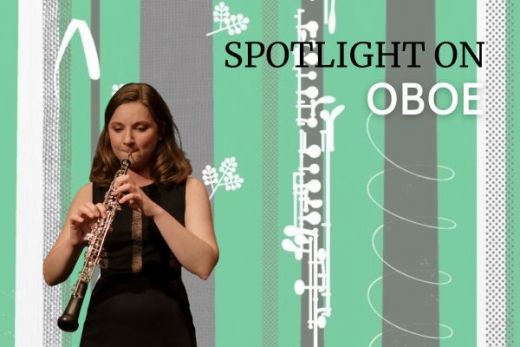
The Oboe syllabus can help develop quality tone and sound production to support technical fluency and rhythmic awareness.
The syllabus seeks to enhance and inspire oboe teachers and learners' growth and development and is underpinned by a close link between technical work and repertoire.
What sort of pieces are in the Syllabus?
Traditional repertoire is a feature of the Syllabus but the classical (and well loved) pieces are paired with modern and interesting contemporary compositions. This includes a diversity of composers where musical merit allows. The pieces align to the technical work, which progressively develops key concepts and technique to build and broaden the base knowledge required to demonstrate and achieve musicality. You'll see repertoire Lists with focuses on works like unaccompanied, Baroque and Classical, Romantic and Post-Romantic and, from Grade 6 onwards, orchestral excerpts are introduced as List options, too, helping support pathways to the industry.
Can I play cor anglais or oboe d'amore in my exam program?
In the higher Grades, yes you can. The Oboe syllabus ensures that foundations are well set before introducing an alternative instrument but the cor anglais can absolutely be part of your exams. From Level 2, onwards, you can select works on cor anglais. Here's a break down:
Grade 5: You can choose to play either your List B or List C piece on cor anglais.
Grade 6-8: You can choose to play either your List B or List C piece on cor, as well as your List D orchestral excerpts.
Certificate of Performance: You can choose to play one of your List A, List B or List C piece on cor, as well as your List D orchestral excerpts.
Extra List pieces can also be done on cor if you wish.
AMusA: You can choose to play either your List B or List C piece on cor.
LMusA: You can choose to play your List B piece on oboe d'amore or your List C piece on cor anglais.
In both the Associate and Licentiate, you can also include works performed on oboe d'amore. But check the Syllabus on that one - there are some approval requirements you may need to do first. We always recommend referring to the current Syllabus to ensure you're prepared for all exam requirements.
What resources are available?
Each Syllabus outlines the objectives and requirements for each exam so that's always the best place to start. There are also books housing collations of repertoire to provide cheaper access to sets of List pieces (the Grade books). You can use recorded accompaniments (up to Grade 3 in most Syllabuses) to practice as well, as use in your exam. Our publications also include the Technical Work books, and even practice books to help you with your aural and sight-reading skills. Head to your favourite local music retailer or the AMEB Online Shop for these and more.
What is the Certificate of Performance exam?
It's an exam that's designed to partially bridge the gap between Grade 8 and AMusA, and provide a capstone to Level 2. The CoP is a recital-style exam, like the Diplomas, but is a natural continuation of skills from Grade 8. We have a Spotlight article dedicated to Certificate of Performance exams here, if you're keen to find out more.
Can I get TCE bonus points for an Oboe exam?
Yes you can! And that goes for any AMEB exam, including all Rockschool and PAA syllabuses. In fact, all practical exams are eligible for TCE bonus points from Grade 4 onwards, as well as Theory Grade 2+.
When can I do an Oboe exam?
Our face-to-face exams are available in the June/July and October/November sessions. Alternatively, you can do a Video exam absolutely any time that suits you. To find out more about exam dates, head to our Exam information page.
I have more questions.
That's great! We'd love to help with those. Please feel free to browse the other great sources of information on our website or get in touch to find out more.
