
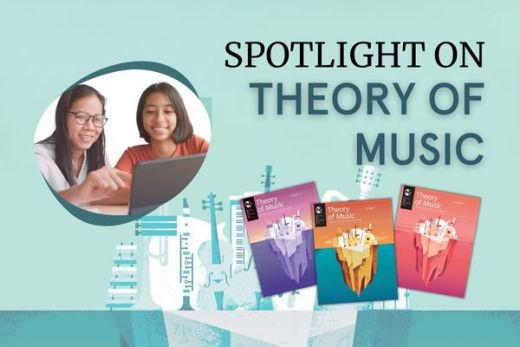
We have lots of options for learning and getting qualifications in music theory so let's explore one of them: Theory of Music. It has the most resources directly aligned to the Syllabus to support your learning. It's designed to support emerging artists by enhancing the skills they need for their artistry.
What's in the syllabus?
You'll start by covering the basics - how to read music notation and the various scales, intervals, chords, and rhythms. Transposition, terminology, modulation, and general knowledge are also introduced at the foundational level. This knowledge is soon after applied to practical and creative questions such as writing a melody or harmony. At Grade 5, Set Works are introduced to put skills into context and prepare for deeper analysis.
Theory of Music runs from Grade 1 to 6 (by which time you're at a university level of knowledge) then extends into Associate and Licentiate Diplomas that specialise in Musicology, Harmony and counterpoint, and Orchestration and arrangement.
How will theory help my practical skills?
This Theory Syllabus is incredibly useful in supporting EVERY type of music performance study.
We know that understanding theory can be a huge help when it comes to growing your skills and passion for your craft. By learning theory, you deepen your knowledge and comprehension of your actions, helping inform your artistic choices. By increasing your understanding of the notes and harmonies behind the dots on the page, you gain the tools to bring the notes to life and discover new and interesting layers to your repertoire. Theory will help you to get more out of your performing arts education, and support you in your learning journey.
- You'll gain deeper insight into the composers' intentions and be able to better (and more easily) translate notes into music.
- Get to know your piece on a deeper level to easily identify phrases and musical lines of expression.
- Understand the written musical instructions and expand your tool kit of techniques.
- Practical exam Discussion and General Knowledge segments are a breeze when you know the backstory.
The Theory of Music material is directly relevant to all AMEB (and Rockschool) music syllabuses and is one of the options you can take to achieve any corequisite requirements for senior practical exams: if you're working towards a Grade 6 practical exam, you'll need to have successfully completed your Grade 2 theory exam and so on.
How is it different to the other AMEB music theory syllabuses?
Each of our four theory syllabuses has its own style and focus areas so it really depends what and how you want to learn. They all cover the basics - notation, harmony, terms etc - but each are presented in different ways and then take their own paths to specialised learning topics. The content is actually closest to its contemporary counterpart, Rockschool Popular Music Theory, with each Syllabus focusing on relevant music performance practices. What sets Theory of Music apart from our other classically-based syllabuses is that it comes with its own Course to walk you through the concepts. The Courses have been created to align perfectly with the syllabus, and have been developed by AMEB's own Theory Editor, Andrew Raiskums. These are available in both printed Workbooks and as Online Courses. There are loads of fantastic resources to support teachers and learners but only Theory of Music has course books directly related to the syllabus material. And they're excellent teaching tools even if you aren't pursuing your qualification!
What resources are available for learners?
The syllabus itself provides the scope of what you'll need to learn and the exam conditions to prepare for. For the actual learning (or teaching), we recommend the Theory of Music Online Course or the Theory of Music Integrated Course and Workbook. Each Grade is supported by its own Course and both the printed and online options include explainers, examples, and exercises throughout the whole syllabus content. The material is broken down to lessons to introduce new concepts and support self-guided learning. It's not meant to replace a teacher (nothing could replace that!) but it's a fantastic learning tool to discover the material and have a go yourself.
The Online Courses are available through SCORE - your AMEB enrolment platform - and come with 12 months' access and unlimited practice exams. They also use the exact same software as the Online Exam so you get to practice your theory knowledge at the same time as experiencing the exam platform. Integrated Course and Workbooks are available from our AMEB Online Shop or your favourite local music retailer.
What resources are available for teachers?
The syllabus maps out the content to help you prepare your students. You'll find the Courses to be excellent teaching tools as they've been developed by one of Australia's leading and most prolific theory minds: Andrew Raiskums. If you have enrolled your students in either the Theory of Music Online Course or Online Exam, you can log into SCORE to track their progress. You can view which lessons have been completed and also the results of any practice exams. This will help you to support them to fill the gaps in their knowledge and best prepare for their exam. The Integrated Course and Workbooks also include a practice exam at the end of the book for you to check the knowledge of your students.
Past exam papers are still available from our AMEB Online Shop but please note that these are being gradually phased out in favour of the automatically generated exams that are included with the Online Courses.
How does the online exam platform work?
As soon as you enrol in either an Online Course or Online Exam, you'll have access to practice exams. All exams (both the official exam and all practice exams) use an integrated software called Musition that has been created just for us by Rising Software. If you'd like to read more about the music theory tools and notation, or if you are looking for some guidance, we have a heap of helpful FAQs available on SCORE.
Your practice exams get marked automatically (some grades this may not be the whole exam) so you'll have a really good idea of the result you're likely to get and also where you might need to do some more study. That means you can take the time to familiarise yourself with the platform and give yourself the best possible chance of success.
Teachers can enrol a cohort of students in a Class Exam for them all to sit at the same time. This also provides all candidates in the group with the exact same sets of questions to help with benchmarking across the class.
All exams require an exam supervisor to ensure exam policies are adhered to. If you need to trouble shoot anything with the online platform, check the FAQs on SCORE or reach out to your customer support team in the AMEB Federal office.
Can I get TCE bonus points for my Theory of Music exams?
Yes you can! And that goes for any AMEB exam, including all Speech & Drama, PAA, Classical, and Rockschool syllabuses. In fact, all theory exams are eligible for TCE bonus points from Grade 2 onwards, as well as practical Grade 4+.
When can I do a my Theory of Music exam?
Almost any time! Exams can be done online and at a time that suits you. You'll need a supervisor to ensure all the work is your own but the online platform is available 24/7. We even see people achieving their theory exam on Christmas Day! Head to SCORE to enrol and start practicing with access to free practice exams.
If you're wanting to do a paper-based exam, please have a read of our website information page.
I have more questions.
That's great! We'd love to help with those. Please feel free to browse the other great sources of information on our website or get in touch to find out more.
